To train its employees in artificial intelligence (AI), a company in Switzerland can choose between four routes: an introductory day, a short course at a university, a six-month certificate of advanced studies or an in-house programme. Published prices range from free, for a day funded by the State of Geneva, to 9,200 francs, registration included, for a certificate course in artificial intelligence at the Geneva School of Business Administration (HEG-Genève).
The right choice depends on each person's role: executive, project manager, employee who uses an assistant or data specialist. This page deals with training only. First uses and the method for getting started are covered in our guide AI for SMEs, which is part of the AI in business section.
Key figures
- 0 francs for the company: the State of Geneva's AI day for small and medium-sized enterprises (SMEs), if attended in full;
- 1,500 francs: the two-day course at the Swiss Federal Institute of Technology in Lausanne (EPFL), at the price of its latest edition;
- 9,000 francs, plus a 200-franc registration fee: the six-month certificate from HEG-Genève, worth 13 credits in the European Credit Transfer System (ECTS), according to HEG-Genève;
- 2,000 francs: a single module of this certificate;
- 7,900 francs: the six-month certificate from the Haute école de gestion Arc (HEG Arc), in Neuchâtel, according to orientation.ch;
- 28% of UBS's workforce had completed the in-house "UBS AI Citizen" programme by July 2026;
- 70% of respondents to a survey by the firm EY access AI through built-in tools, such as Microsoft Copilot or Gemini.
What AI training is available in Switzerland for a company?
The public offer falls into three formats: the introductory day, the course lasting a few days and the Certificate of Advanced Studies (CAS) from the University of Applied Sciences and Arts Western Switzerland (HES-SO). The table compares four programmes in French-speaking Switzerland whose provider publishes the duration, and the price when it gives it.
| Training | Provider | Duration | Published price | Target audience |
|---|---|---|---|---|
| AI training day for SMEs | State of Geneva and University of Geneva | 1 day, from 8:45 to 16:30 | Covered by the State for companies based in Geneva | SME managers, two people per company at most |
| AI and Machine Learning Essentials | EPFL, in Lausanne | 2 days | 1,500 francs (latest edition) | Professionals and managers, without a technical background |
| CAS Artificial intelligence for digital transformation | HEG-Genève | 6 months, 13 ECTS credits, with a personal project | 9,000 francs, plus a 200-franc registration fee; 2,000 francs per module | Executives and managers who steer the integration of AI |
| CAS Artificial intelligence (AI) applied in business | HEG Arc, Neuchâtel | 11 in-person days and 10 remote evenings over 6 months, plus the certification work | 7,900 francs | Information systems and data profiles |
Is one day enough for an SME executive?
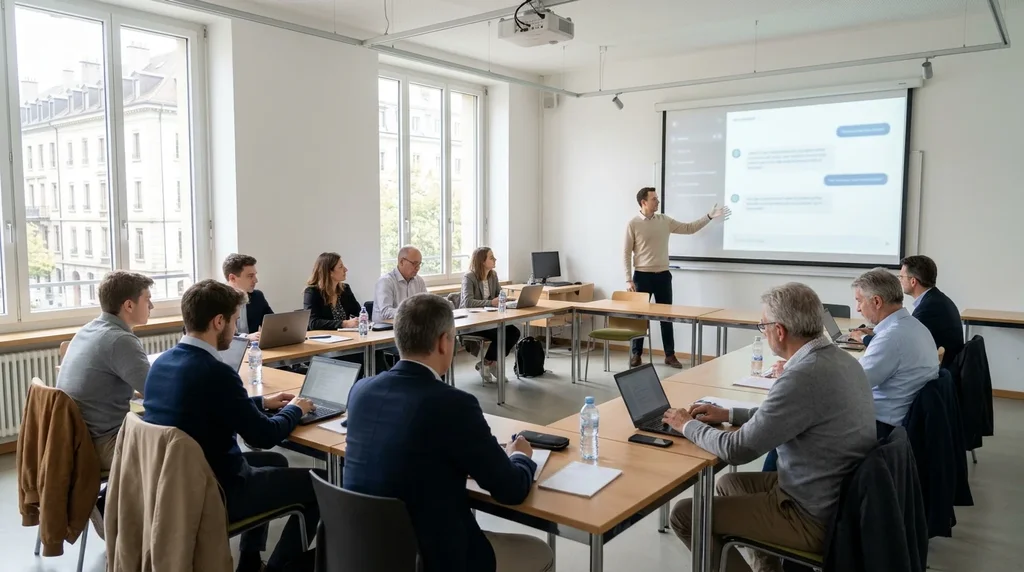
To decide where AI serves the company, one day provides a foundation. The Geneva Department of Economy, Employment and Energy offers a day called "Understand, decide, act" with the University of Geneva. It covers the fundamentals, applications for SMEs, automation with AI agents, data quality and legal aspects.
Participants leave with practical tools, according to the university: a use-case sheet, a specifications template and checklists on data quality and legal compliance. In autumn 2026, the day was offered on 12, 19 and 26 November. An absence not announced seven days in advance may be charged.
Which course to choose for managers and business teams?
EPFL's AI and Machine Learning Essentials course is aimed at people without technical training. Led by Professor Negar Kiyavash, holder of EPFL's chair of business analytics, it lasts two days. It explains how a model is built, then has participants practise writing instructions (prompts) for large language models.
EPFL points out a useful limitation: governance, ethics and security are not at the centre of the programme. The session on 26 and 27 November 2026 was fully booked. Members of EPFL Alumni and the school's partners get a 10% discount.
When to aim for a six-month certificate?
A CAS is justified for the person who will lead AI projects in the company. The one from HEG-Genève covers strategy, data, algorithms, adoption and uses. Its modules can be taken separately, at 2,000 francs each according to orientation.ch, which allows an SME to fund only part of the programme. The next intake starts on 11 March 2027, with a registration deadline of 15 January 2027.
The HEG Arc CAS is more technical. It ranges from data governance to machine learning and infrastructure. It requires a university degree and at least one year of experience in information systems, or a higher vocational school diploma or a federal diploma with four years of experience.
Is there funding available for AI training?
The most direct support identified is in Geneva. The State of Geneva covers the cost of its AI day for SMEs, provided it is attended in full. According to the University of Geneva, it is part of a set of measures supporting companies' digital transition. According to orientation.ch, the HEG-Genève CAS is also eligible for the canton of Geneva's annual training cheque (CAF).
Discounts are also available through membership of a network. Members of HR Genève, the association of human resources professionals with nearly 850 members, get 10% off the HEG-Genève CAS. Our analysis: before enrolling, a company would do well to check whether its professional association has concluded a similar agreement.
Training in-house: what does the UBS example show?
The major bank UBS trains its employees at two levels, according to the Evident AI Index study cited by Fintechnews Switzerland on 20 October 2026. Since 2024, more than 49,000 employees have enrolled in online AI courses, and more than 38,000 have completed a learning path.
- "UBS AI Citizen" is a company-wide programme: AI basics, use cases, productivity and responsible use of tools. More than 21,000 people had completed it by July 2026.
- "AI Enabler" is aimed at managers, to integrate AI into teamwork. More than 96% of them had taken the first steps.
This training weighs in UBS's AI maturity ranking, according to the study, along with the deployment of more than 300 use cases in 2025, detailed in our article on AI in banking at UBS. Our analysis: an SME will not reproduce this scale, but it can keep the structure, with a common foundation for everyone and a module for team leaders.
Which skills should be prioritised?
Three skills recur in the programmes and in official texts. The first is the use of tools already present in the office. According to a survey by the firm EY published in May 2026 of more than 600 people working in companies in Switzerland, 89% of respondents use AI daily, mainly through built-in tools. The rules for a specific assistant are detailed on our page ChatGPT in business.
The second is data protection. On 24 September 2025, the Federal Data Protection and Information Commissioner (FDPIC) pointed out that the Federal Act on Data Protection (FADP) applies directly to AI. Users must state the purpose of AI processing and its data sources; high-risk processing requires an impact assessment. These guidelines belong in a company AI charter, which training helps make known.
The third is checking results. The EPFL course covers, among other points, the limitations and safeguards of generative models. The FDPIC, for its part, points out the right to demand that an automated decision be reviewed by a human being.
Sources
- University of Geneva: "Journée de formation IA pour les PME"
- UNIL-EPFL Continuing Education: "AI and Machine Learning Essentials"
- HEG-Genève: "CAS Intelligence artificielle au service de la transformation digitale"
- orientation.ch: "Intelligence artificielle au service de la transformation digitale", HEG-Genève
- orientation.ch: "Intelligence artificielle (IA) appliquée en entreprise", HEG Arc
- Federal Data Protection and Information Commissioner: "IA et protection des données" (24 September 2025)
- Fintechnews Switzerland: "UBS Ranks 6th Globally in AI Banking Maturity" (20 October 2026)