A properly generated bitcoin private key can still be recalculated: all it takes is for two signatures to reuse the same nonce, the number meant to be used only once. Researchers at the University of Liège, in Belgium, recovered 3,620 private keys this way across several blockchains, according to their March 2026 publication. They put potential losses at up to 101 million euros.
Journal du Coin, which reported on their bot traps on 22 November 2026, frames the story differently. It speaks of badly generated keys and cites 106 million dollars exposed since the network was created.
What the Liège researchers published
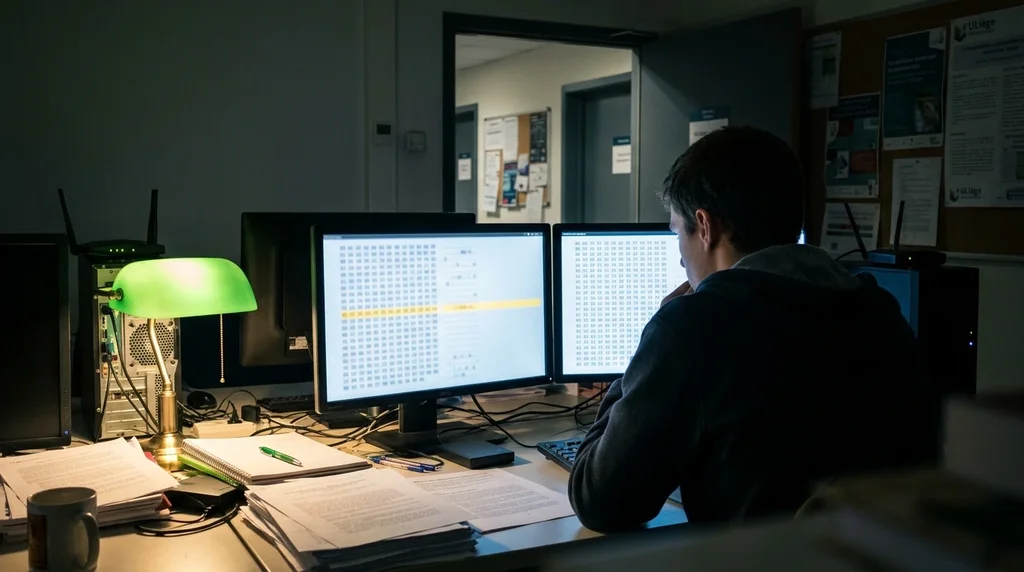
The paper is titled "Short Paper: Oops... I Did It Again. I Reused my Nonce.". Its authors, Vincent Jacquot and Benoît Donnet, work at the Montefiore Institute, the department of electrical engineering, electronics and computer science of the University of Liège. The paper was peer-reviewed and presented in March 2026 at the Financial Cryptography and Data Security conference in Basseterre (Saint Kitts and Nevis). It is published by Springer and has been available since 7 January 2026 on ORBi, the university's open-access repository.
The precise subject is the nonce of the ECDSA (Elliptic Curve Digital Signature Algorithm) signature algorithm, which authenticates transactions. This number must change with every signature. If it is reused, the private key can be recalculated and the funds stolen, the paper's abstract points out.
The established result comes down to one figure: 3,620 private keys recovered. The authors found nonces reused within the same blockchain, but also from one blockchain to another, which widens the attack surface. The 101 million euros is an estimate of potential losses, not an observed amount stolen. The project, called CyberExcellence, is funded by the Walloon Region. The full text is freely available on ORBi, which also mentions the ECDSA-Cracker dataset.
The abstract also mentions honeypots, baits set up to observe attackers, without detailing how they played out. According to Journal du Coin, a few dollars were deposited in them and then drained within seconds, sometimes before the first confirmation. The outlet describes these addresses as addresses with guessable keys. The study's abstract, for its part, links all the recovered keys to nonce reuse.
The outlet gives its figure in dollars without explaining how it was calculated. The study's abstract, for its part, puts a euro figure on potential losses across several blockchains.
How can a bitcoin private key leak?
A bitcoin private key is a 256-bit number. Properly generated, it hides among 2 to the power of 256 combinations, far beyond what all the computing power on Earth could search through, Journal du Coin stresses. The secp256k1 elliptic curve that secures Bitcoin has never been broken. The weak link is the randomness used to create the key, or to sign.
Three flaws recur in the known cases:
- The brainwallet: a memorised phrase becomes a private key through a simple SHA-256 hash. If the phrase appears in a dictionary, the key is no longer private.
- The faulty random number generator: software generates the key or the seed (the sequence of words that restores a wallet) within a reduced space, which the attacker searches through.
- The reused nonce: the key was sound, but two signatures sharing the same nonce are enough to give it away. This is the subject of the Liège study.
Against badly generated keys, thieving bots work from tables of precomputed keys and scan the chain continuously, Journal du Coin explains. As soon as a balance appears on an address in their database, the draining transaction goes out automatically.
The bait technique is also used outside laboratories. On 24 October 2026, researcher James Pavur launched his "Steal My Bitcoin" challenge: a bitcoin wallet key on a server deliberately left vulnerable to the PHP2Shell flaw. The server fell on 25 October, a little more than 19 hours after the launch. There, it was the server that gave way, not the key.
Weak keys documented since 2013
| Case | Flaw | Reported scale |
|---|---|---|
| Android, August 2013 | Predictable SecureRandom generator, reused nonce | Alert published by bitcoin.org, according to Journal du Coin |
| Brainflayer, 2015 | Brainwallets tested en masse | Nearly 18,000 wallets already drained, according to researcher Ryan Castellucci |
| Milk Sad, 2023 | Libbitcoin Explorer 3.x, Mersenne Twister generator | About 4 billion possibilities; more than 900,000 dollars stolen in July 2023 |
| Randstorm, 2023 | BitcoinJS library, wallets created in a browser between 2011 and 2015 | Up to 1.4 million BTC potentially affected, according to Unciphered |
| Coldcard, 2026 | Firmware: seeds of about 40 to 72 bits instead of 128 | About 1,800 BTC stolen |
The Milk Sad team, which documented the CVE-2023-39910 flaw in Libbitcoin Explorer, links the thefts of 12 July 2023 to several faulty generators. It publishes a collection of more than 350,000 weak wallet addresses and refrains from withdrawing funds from wallets that are not its own. The most recent case, that of the Coldcard hardware wallet, shows that the flaw can also come from a genuine device.
Who is exposed, and who is not
A key properly generated over 256 bits escapes the bots that search through guessable keys, Journal du Coin points out. It escapes the risk studied in Liège only if the signing software draws a new nonce for every signature.
Those exposed are brainwallets, seeds created with a faulty version of a piece of software or firmware, and addresses whose signatures reused a nonce. Our analysis: this last risk depends on the signing software, not on the recovery phrase.
This risk differs from the distribution risk. On 30 October 2026, Trezor, a hardware wallet maker, was examining a report of an alleged implant in a Safe 5 bought from a former reseller in Southeast Asia. There, it is the delivered device that would be at fault, not the quality of the randomness.
What a holder in Switzerland can check
- The origin of the key: a key derived from a phrase you made up yourself is a brainwallet and must be considered exposed.
- The software and the creation date: Libbitcoin Explorer version 3.x, a browser wallet created between 2011 and 2015, or an affected Coldcard firmware are among the documented cases.
- The seed itself: in the Coldcard case, Coinkite, its manufacturer, pointed out that an update fixes future seeds, not an existing seed. Importing the old seed elsewhere solves nothing: a new one must be created and the funds transferred to it.
- The installed program: the software should be downloaded through the publisher's official channel. A byte-for-byte reproducible build makes it possible to verify that a program really comes from the published code.
- The paper wallet: the one sold by the SBB's bitcoin vending machines in Switzerland carries the private key as a QR code. That piece of paper is worth the bitcoins.
Journal du Coin sums up the rule: a wallet's randomness should be checked before sending funds to it, not after. This article does not constitute investment advice.
What we do not know yet
- How the 106 million dollars was calculated: Journal du Coin does not specify the method, whereas the study's abstract puts potential losses at 101 million euros.
- The identity of the thieving bots: neither the study's abstract nor Journal du Coin attributes them to a specific actor.
Sources
- University of Liège, ORBi: "Short Paper: Oops... I Did It Again. I Reused my Nonce.", Vincent Jacquot and Benoît Donnet, Financial Cryptography and Data Security, March 2026
- Journal du Coin: "Bitcoin: badly generated keys exposed 106 million dollars to thieves", 22 November 2026
- Milk Sad: page of the research team on weak keys