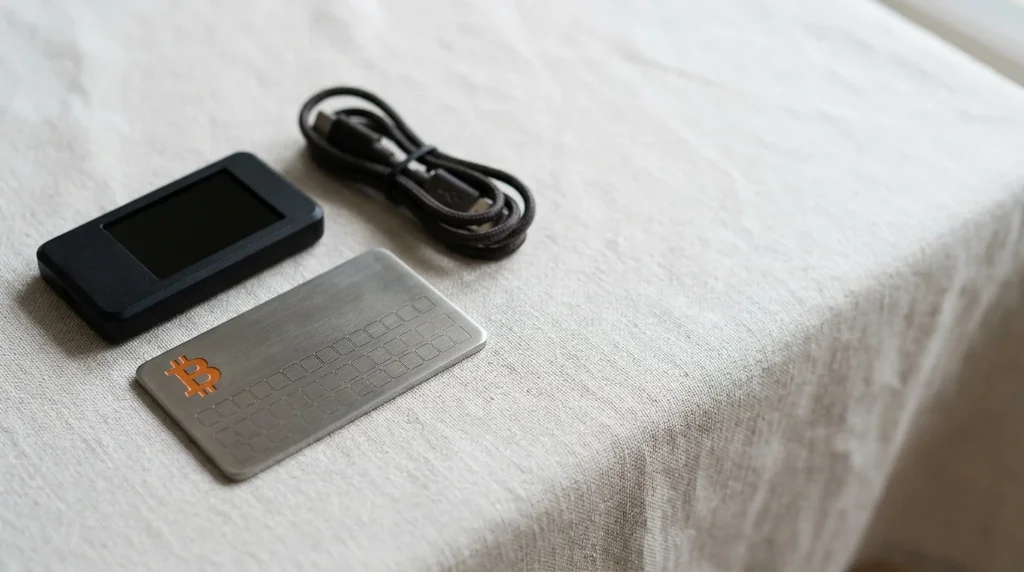
Coldcard, the bitcoin hardware wallet from Canadian manufacturer Coinkite, remains at the centre of a dispute over its audits. On November 9, 2026, Rodolfo Novak, known as NVK, Coinkite's chief executive, claimed on X that at least fifteen external reviews had missed the flaw that allowed around 1,800 BTC to be stolen, according to Journal du Coin. Developer Luke Dashjr replies that he had reported problems. For a holder, nothing changes: a seed created on affected firmware must be replaced.
What Coinkite acknowledges about the Coldcard flaw
Coinkite's security advisory, published on July 30, 2026 and updated on August 1, sets out the framework. The devices were neither hacked nor taken over remotely. A firmware bug weakened seed generation, the sequence of 12 or 24 words that rebuilds all the keys of a wallet. The attackers recalculated the private keys offline, then emptied the addresses.
The origin goes back to March 2021, Decrypt explains in its analysis of August 4, 2026. Coinkite then migrated the Coldcard's cryptography to libsecp256k1, the Bitcoin Core library. In the process, seed generation moved away from the hardware randomness chip to Yasmarang, a fallback software generator from MicroPython.
The cause comes down to one line of code. A compilation safeguard used #ifndef, which tests whether a setting exists, not whether it is enabled. Coinkite had set this setting to zero. Since zero still counts as "defined", the compilation went through without any warning, Decrypt reports.
The outcome differs by model. According to Coinkite's advisory, seeds created on the Mk2 and Mk3 with versions 4.0.1 to 4.1.9 are the weakest: around 40 bits of entropy, according to the manufacturer's estimate cited by Decrypt. On the Mk4, Mk5 and Q, before the fixed versions, they drop to around 72 bits instead of the expected 128. The engineering team of the American company Block, for its part, puts the search space for the recent models at 232 candidates.
How many bitcoins were siphoned off?
No official tally exists. The published figures vary depending on the date and the counting method:
| Figure | What it measures | Source |
|---|---|---|
| 1,196 addresses in 41 minutes | First sweep, on July 30, 2026 | Journal du Coin |
| More than 1,596 BTC | Three confirmed waves | Galaxy Research, cited by Decrypt (August 4, 2026) |
| Around 2,055 BTC | Total including a suspected, unconfirmed fourth wave | Galaxy Research, cited by Decrypt |
| Around 1,800 BTC | Estimate repeated in November 2026 | Journal du Coin |
| At least 15 | Number of distinct attackers | Coinkite, cited by Decrypt |
| 52.37 BTC | Funds pooled by whitehats in a Wyoming trust for the victims, on September 21, 2026 | Journal du Coin |
The 52.37 BTC recovered represent barely 3% of the estimated haul, Journal du Coin calculates.
Coldcard audits: the two competing accounts
In his thread of November 9, 2026, NVK lists at least fifteen external reviews of the Coldcard's hardware, firmware or random number generator. Two were paid reviews: the one of the Mk4 in 2022 and the one of the Q in 2024. He also cites an examination by developer Rob Ham using OpenAI's cybersecurity tool: 85 potential issues flagged, but not the one affecting the seeds. "It took a new AI model to find what humans had not found," he writes, according to Journal du Coin.
Coinkite had already put forward this theory in August. "We have to assume that someone used AI to examine old versions of our firmware," the manufacturer wrote, as cited by Decrypt.
Luke Dashjr, a Bitcoin Core developer, disputes this account. The same day, he published nine observations on the Coldcard's random number generator, which he says he first passed on privately to Coinkite. He specifies that he only took a quick look and does not claim that every point is exploitable. Presenting the flaw as something an AI alone could find is, in his view, a lie, Journal du Coin reports.
Developer James O'Beirne says he examined the firmware as early as May 2025 and asked questions about the fallback software generator. He was reportedly told that the configuration was correct on the physical devices; he admits he did not press the matter. NVK, for his part, repeats that a private message expressing concern is not the same as disclosing a reproducible flaw.
Both camps run up against the same blind spot. On August 3, 2026, Nick Percoco, head of security at the Kraken exchange, explained that auditors checked that the right generator was present in the code, without checking that the production firmware actually called it. At the end of August, Trezor, another hardware wallet manufacturer, added that a paid audit from March 2022, which covered random number generation, had missed it, according to Journal du Coin.
What the checks on the fixed firmware are worth
Coinkite's security status page, updated on October 1, 2026, lists four targeted independent checks. A test on a Mk4 running version 5.6.0 observed eight reads from the hardware generator for a 32-byte seed. Two source code reviews confirm that the fallback software generator has been removed. Finally, the reviewer PortlandHODL recompiled version 5.6.0 and reproduced every byte of the published signed firmware.
This recompilation follows the method that made it possible to recompile Satoshi's client byte for byte: proving that a program really does come from the published code. Coinkite itself sets out its limits. These checks "validate their scope", not the absence of any defect. There is no complete independent audit of each fixed firmware, and the detailed technical postmortem is still "in preparation".
Coldcard: what a holder in Switzerland should check
Coinkite does not publish a complete list of victims by model. A holder in Switzerland therefore cannot take comfort from their location or their device. The question concerns the seed itself: where and when was it created? The instructions in the security advisory and on the status page can be summarised as follows:
| Your situation | What Coinkite says |
|---|---|
| Seed created on a Mk2 or Mk3 with version 4.0.1 to 4.1.9 | Funds at risk: install 4.2.0, the last version for these models, then migrate |
| Seed created on a Mk4 or Mk5 before 5.6.0 (or Edge 6.6.0X) | Seed affected: migrate to a new seed |
| Seed created on a Q before 1.5.0Q (or Edge 6.6.0QX) | Seed affected: migrate to a new seed |
| At least 50 fair, private dice rolls, never written down or exposed | Not considered at risk from this flaw alone; 99 rolls or more provide around 256 bits |
| Strong, unique BIP-39 passphrase | An additional barrier, but it does not fix the seed: migrate as soon as possible |
Updating the device is not enough. Coinkite's advisory says it again: an update fixes future seeds, not an existing seed. The recommended versions are 5.6.3 for the Mk4 and Mk5 and 1.5.3Q for the Q, released on September 30, 2026. Before installing it, Coinkite asks users to compare the SHA-256 hash and to verify the signed signatures.txt file.
The migration follows a precise order, according to the manufacturer's advisory:
- install the fixed firmware and check its version on the device;
- generate a new seed, write down and verify its backup;
- verify a receiving address on the Coldcard's screen;
- send a small test transaction, then the rest of the funds;
- keep the old backup until full confirmation.
Coinkite warns against rushing: a botched migration can create a more immediate risk than the flaw. Importing the old seed into another application solves nothing, Decrypt points out: the weakness travels with the words. On the new versions, creating a seed requires input from the user: 65 key presses at an unpredictable pace, 50 dice rolls or 128 coin tosses.
The dice themselves have been debated. On July 31, 2026, Luke Dashjr recommended precision casino dice, since ordinary dice are not designed for cryptography. Developer Justin Sharp countered him with a calculation, cited by Decrypt: a clearly biased die brings 99 rolls down from around 256 to 252 bits, far from the 40 bits of the flaw.
For crypto wallet security, the affair joins other recent alerts. At Trezor, the risk would lie in distribution, if confirmed, with an alleged implant in a Safe 5 sold by a reseller in Southeast Asia. At Coldcard, the device was genuine: it was its own code that produced guessable keys.
What we do not know yet
- The content of the detailed technical postmortem, which Coinkite has described as "in preparation" since summer 2026.
- The number of Mk4, Mk5 and Q wallets actually emptied: Coinkite's status page states that no complete register of victims by model exists.
- The final tally of the thefts, as the fourth wave identified by Galaxy Research remains unconfirmed.
Sources
- Journal du Coin: "Coldcard hack: NVK invokes 15 audits, Luke Dashjr calls it a lie", November 13, 2026
- Coinkite: "Coldcard Security Advisory", July 30, 2026, updated on August 1, 2026
- Coinkite: "Current COLDCARD Security Status", update of October 1, 2026
- Decrypt: "Coldcard Bitcoin Exploit Explained: Entropy, How Keys Are Generated, and Why Bits Matter", August 4, 2026