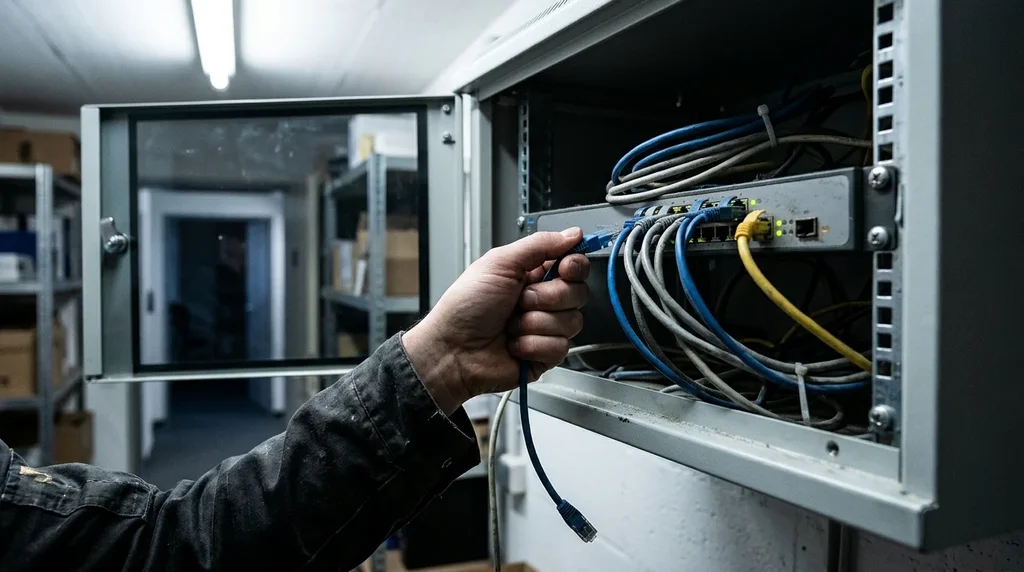
CrediBill, a Swiss service for paying bills by credit card, has taken its systems offline after a cyberattack that has been under way since November 11, 2026. Customers can no longer log in or make payments. According to Fintechnews Switzerland, on November 16, 2026, the latest analyses point to data theft, although it is not yet known which data was taken.
What CrediBill has announced
The shutdown is a precautionary measure, according to the company. Its CEO, Alexander Segmüller, explains that it acted quickly to protect customer data. Internal teams and an unnamed Swiss IT security firm are investigating.
The assessment changed within a few days. Up to noon on November 14, 2026, investigators had found no evidence that data had left the systems. Subsequent findings, however, point to exfiltration, meaning an unauthorized copy of data to the outside. CrediBill says it does not yet know which data is affected.
Two categories of data could be affected, according to the company:
- personal data: contact details, identity documents, identity verification data (KYC, for "know your customer") and the encrypted fingerprint (hash) of each password;
- transaction data: IBANs, card tokens and invoices.
CrediBill states that it has never stored card numbers: each card is recorded only in the form of a token. The company has reported the case to the Federal Data Protection and Information Commissioner (FDPIC) and filed a criminal complaint. A police unit specializing in cybercrime has also been brought in.
CrediBill: neither a bank nor invoicing software
CrediBill is used to pay bills, not to issue them. According to the page dedicated to it by card issuer Swisscard, users enter their bills online or in the app, for example a rent payment or a health insurance premium. The amount is then charged to their credit card, even if the recipient does not accept cards. The service and the app are offered by the company Finviu AG, Swisscard states.
Some creditors themselves refer their customers to this service. Health insurer Helsana, for example, presents CrediBill Accept as a way to pay its QR bills by card. The payer scans the bill, and the money generally reaches the recipient on the following business day. Service fees of up to 3% per payment (4% for a foreign card) are borne by the payer.
Our analysis: this explains the nature of the data at stake. A bill uploaded to CrediBill also contains the contact details and IBAN of whoever issued it. A leak can therefore affect people and companies that have never opened a CrediBill account.
What users should do now
CrediBill has issued several instructions, relayed by Fintechnews:
- when the service returns, every user will have to choose a new password on first login;
- anyone who uses their CrediBill password elsewhere should change it on those other services without delay;
- caution is called for with emails, calls and text messages asking for personal or payment data: CrediBill says it never asks for passwords or card data through these channels;
- if in doubt about a message, do not click its links and write to privacy@credibill.ch.
The company says it will contact its customers again as soon as it has new information concerning them.
Data leak: what it means for an SME
An SME is affected if it paid its bills through CrediBill, or if its customers paid its invoices this way, as Helsana offers its own customers. Our analysis: in both cases, its invoices and its IBAN could be among the data concerned.
Our analysis: the most concrete risk is the fake invoice. A fraudster holding a genuine invoice can send a credible copy with a different IBAN. The TCS Camping precedent shows this: after the TCS Camping data leak, fraudsters used genuine booking information, and some 15,000 customers were warned. A change of bank details announced by email therefore warrants a check by phone, using a known number.
The rule applies to the whole team. According to the "Cybersécurité des PME 2026" study, phishing plays a role in around a third of incidents. The approaches for organizing employee phishing awareness training apply directly to this case.
Reporting to the Commissioner and to the Federal Office for Cybersecurity
Reporting to the FDPIC is the responsibility of the controller. According to the Commissioner's "DataBreach" page, it is mandatory for a data security breach likely to result in a high risk to the personality or fundamental rights of the data subjects. The controller must also inform those persons when this is necessary for their protection. The Commissioner provides an online form for these reports.
The Data Protection Act also governs processing by processors, in its Article 24: the processor reports any breach to the controller. The PK Softech case, a pension fund software provider, shows what can follow. The company reported the attack to the Commissioner on October 8, 2026, and the Commissioner opened an investigation into PK Softech on October 23.
On the technical side, the Federal Office for Cybersecurity (FOCS) receives voluntary reports from companies. Only operators of critical infrastructure have been required to report a cyberattack to it, since April 1, 2025. CrediBill has not indicated that it reported the attack to the FOCS. The office points out that it does not record criminal complaints, which go through the police.
A series of attacks on service providers
The CrediBill case joins a series of attacks in which the service provider is targeted and its customers are exposed. In Zug, the Zug pension fund learned several weeks after the attack that data on its insured members might be affected. Attacks on service providers have also hit the Zurich pension funds and that of Swiss Post, as well as the Federal Pension Fund, victim of a data leak at Publica.
| Service provider | Key date | Data cited | Steps announced |
|---|---|---|---|
| CrediBill (bill payment, Switzerland) | Attack since November 11, 2026 | Identity, KYC, password hashes, IBANs, card tokens, invoices (to be confirmed) | Report to the FDPIC, criminal complaint |
| PK Softech (pension fund software, Switzerland) | Attack in late September 2026 | According to the funds: name, address, AHV number, salary | Report to the FDPIC on October 8, formal investigation by the Commissioner |
| Camping.care (TCS Camping bookings) | Leak reported on October 27, 2026 | Names, phone numbers, booking numbers; no IBANs according to the TCS | Customers warned of fraud attempts |
| Maileva (mail sending, Docaposte, France) | Services suspended on September 23, 2026 | First name, last name, address of 22 million people | Six-day shutdown, notification to the French authority, complaint |
Our analysis: the voluntary shutdown of systems recalls that of Maileva, whose case is detailed in the article on the Maileva data leak. Disconnecting affected systems is also the first measure the FOCS recommends when facing ransomware in a company. For now, nothing indicates that CrediBill was targeted by ransomware.
What we do not yet know
- The nature of the attack and its perpetrator: CrediBill has mentioned neither a ransom nor a claim of responsibility.
- Which data was actually copied, and how many users, payers and bill issuers are affected.
- The date service will resume: the company has not announced one.
Sources
- Fintechnews Switzerland, "CrediBill Suspends Service After Cyberattack Amid Signs of Data Theft", November 16, 2026: fintechnews.ch
- Swisscard, CrediBill presentation page: swisscard.ch
- Helsana, credit card payment with CrediBill Accept: helsana.ch
- Federal Data Protection and Information Commissioner, "DataBreach": edoeb.admin.ch
- Federal Office for Cybersecurity, "Report to the FOCS": bacs.admin.ch