Nestlé, the Vevey-based food group, has opened a Deep Tech Center in Orbe (VD) dedicated to artificial intelligence (AI), connected sensors and industrial robotics, the specialist magazine ICTjournal reported on 23 November 2026. The group intends to develop and test its applications there before rolling them out in its factories and other operations. The centre is located on a Nestlé site that has been designing machines and systems since 2013.
What will Nestlé do at its Orbe centre?
The centre brings together specialists in advanced technologies and engineering, according to ICTjournal. Their task: to develop, test and then roll out applications for the group's various businesses. The work covers three areas: industrial production, research and development (R&D) and the consumer experience.
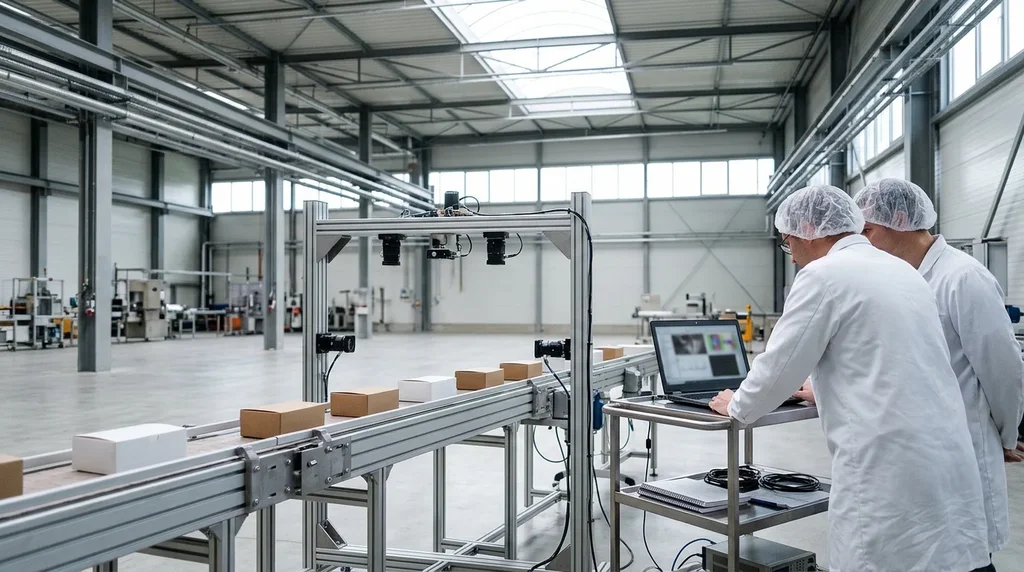
On the production lines, smart sensors and robots are meant to keep quality consistent and improve efficiency. They will also be used to automate repetitive or physically demanding tasks. Nestlé also wants to make use of data from its laboratories and lines to derive new applications.
In R&D, the group is relying on AI, sensors and rapid prototyping to assess new ideas more quickly. On the consumer side, ICTjournal mentions coffee menus tailored to individual preferences and information on pet health. AI-driven personalised nutrition at scale remains something envisaged "in the long run": it is a prospect, not a product.
The centre has prototyping and pilot-scale testing facilities. Applications are validated there before being extended across the group. A hub in Shenzhen, China, will complement the set-up by scouting technologies in the local ecosystem.
What was announced in May 2025, and what is described today
The project dates back to Nestlé's press release issued in Vevey on 14 May 2025. In it, the group presented the centre as the first of its kind in the food and nutrition industry. That is its own assessment, with no published comparison. The timetable aimed for an opening in the first half of 2026.
| Item | Nestlé press release, 14 May 2025 | ICTjournal, 23 November 2026 |
|---|---|---|
| Technologies | Sensors, robots, coding systems, AI, virtual and mixed reality | AI, connected sensors, robotics, rapid prototyping |
| Applications mentioned | Smart coffee machines, precision nutrition, self-monitoring equipment, dynamic quality assurance | Quality on the lines, automated repetitive tasks, personalised coffee menus, pet health |
| Location | Existing premises of the System Technology Center in Orbe | Orbe, complemented by a hub in Shenzhen |
| Timetable | Opening in the first half of 2026 | Opening announced in November 2026 |
Both texts describe intentions. Neither gives any measured result: no productivity gains, nor the number of applications already in service in the factories.
Why Orbe rather than elsewhere?
The May 2025 press release does not explicitly explain the choice of site. It cites the expertise the centre builds on: sensor systems, product recognition, remote control and displays. The centre occupies the existing premises of the System Technology Center (STC).
This STC, opened in March 2013, brought together more than 120 experts from 25 countries at the time, according to the page Nestlé published then. They worked in industrial design, microelectronics and already in robotics, notably for Nespresso and Nescafé Dolce Gusto. Since 1959, the Orbe site has also been home to a Product Technology Center, the group's reference centre for coffee and cereals.
Orbe's industrial roots go back even further. Nestlé set up a Nescafé production line there in 1938, followed by the first Nespresso factory. The group is therefore not so much bringing testing back home as concentrating it where its machine engineers already work.
What is the link with the AI ecosystem in Vaud?
Neither the 2025 press release nor the ICTjournal article mentions any partnership with the Swiss Federal Institute of Technology in Lausanne (EPFL). Yet the canton is home to one of the two hubs of AI research in Switzerland, with the EPFL AI Center and the Swiss AI Initiative run jointly with ETH Zurich.
The country has strengths in AI applied to robots, according to expert Jan Kerschgens, quoted in our feature on Swiss robotics and artificial intelligence. He sees them in the combination of research at the federal institutes of technology and a precision industry. The same feature notes that China, where Nestlé is opening its Shenzhen hub, is betting on volumes and costs.
The talent pool also has its limits. A large share of AI graduates join American tech groups, according to the NZZ, as detailed in our article on AI specialists in Switzerland. An industrial company recruiting these profiles in Orbe is entering that competition.
What does industrial AI change for jobs and subcontractors?
Nestlé has not published any headcount figure for the centre. The 2025 press release does, however, explain how it is funded: a "leaner" R&D organisation, a tighter project portfolio and the redeployment of existing R&D resources. The centre is therefore not presented as a net creation of jobs.
In the factories, the stated aim is to automate repetitive or arduous tasks. Nestlé does not say how many jobs would be affected, nor whether they would be cut or reassigned. According to consultant Cyril Louis of Mavericx, a firm with offices in Geneva and Zurich, quoted in our guide AI for SMEs, companies mainly want to put the time saved to use elsewhere.
On the training side, offerings in French-speaking Switzerland range from a free one-day course to a six-month certificate, as detailed on our page training your employees in AI. Nestlé has not announced any programme for its factory teams.
As for local subcontractors, none of the published sources mentions any suppliers from Vaud or elsewhere in Switzerland involved with the centre. Their possible role remains for the group to clarify.
What we do not know yet
- The number of people working at the Deep Tech Center and the amount invested.
- The factories where the first applications will be rolled out, and when.
- Any partnerships with EPFL or suppliers in the region.
Sources
- ICTjournal, "Nestlé ouvre un centre dédié à l'IA et à la robotique à Orbe", 23 November 2026
- Nestlé, press release "Nestlé to create industry-leading capabilities in bio tech and deep tech", Vevey, 14 May 2025 (text reproduced by Marktpuls)
- Nestlé, "Nestlé centralizes expertise in system technology", 25 March 2013