Buying bitcoin in Switzerland today goes through four routes: a Swiss bank such as PostFinance or Zurich Cantonal Bank, an exchange platform, a product listed on SIX Swiss Exchange, or a ticket machine of the Swiss Federal Railways (SBB). They differ in both fees and custody. Before paying, two checks are essential: the provider's status with the Swiss Financial Market Supervisory Authority (FINMA), and declaring the bitcoins as part of your taxable wealth.
This overview compares the purchase routes, their fees and the precautions specific to Switzerland. Prices and listed funds are tracked in our crypto markets section.
What does buying bitcoin at a Swiss bank cost?
PostFinance, the bank of Swiss Post, publishes a full fee schedule on its "Négoce de cryptomonnaies" page. Trading fees reach 0.95% of the amount up to 250,000 dollars, then 0.75%, and 0.55% from one million dollars. On top of that comes a wallet management fee of 0.15% per year, excluding VAT, decreasing to 0.05%.
PostFinance reserves the offer for its clients who are tax resident in Switzerland, holding a Swiss identity document or a B, C or C1 permit. An order, like a periodic savings plan, starts at 50 dollars. PostFinance says it keeps the keys in Switzerland and provides an annual asset overview for the tax return.
Swissquote, a Swiss online bank, applies a volume-based scale. According to its pricing page, a client with no crypto trading over 30 days pays 1% per order. The rate falls with the volume of the last 30 days, down to 0.08% for a limit order above 60 million dollars in volume. Swissquote states that no stamp duty applies.
At Swissquote, custody and withdrawal also come at a price. Quarterly custody fees range from 20 to 50 francs, with crypto included in the calculation. Withdrawing bitcoins to an external wallet costs 10 dollars per transfer.
Zurich Cantonal Bank (Zürcher Kantonalbank, ZKB) offers bitcoin in its e-banking and its app. The order is placed under "Anlegen", category "Digitale Vermögenswerte", as a number of coins or as an amount. Its help page does not put a figure on the fees: it refers to the bank's fee schedule for investment transactions.
Should you go through an ETP listed on SIX?
An ETP, or exchange traded product, is bought like a share, through your bank or broker. It is a debt security on its issuer, backed by bitcoins entrusted to a custodian. The investor therefore does not own bitcoins and cannot withdraw any. Our comparison bitcoin directly or via an ETP details this difference in custody.
SIX Swiss Exchange, the Swiss stock exchange in Zurich, has a long head start in this area. According to SIX, Amun, which became 21Shares, listed the first ETP on a basket of cryptos there in November 2018. WisdomTree followed in December 2019 with an ETP physically backed by bitcoin alone. At the end of 2024, SIX counted 429 crypto products, including 169 ETPs, and bitcoin accounted for 51.6% of trading.
On fees, an ETP reverses the logic of a direct purchase: modest brokerage, but annual fees charged by the issuer. For European products, they range from 0.05% to 0.25% for the cheapest, and up to 1%, or even 2%, according to the Journal du Coin guide cited by 2clics.
On 20 October 2026, FINMA authorised the first Swiss-law bitcoin ETF open to the public, the Bitcoin Fund ETF (BBIT). Its listing on SIX is expected in November 2026, as detailed in our article on the Swiss bitcoin ETF BBIT. Unlike an ETP, its bitcoins are held off the manager's balance sheet.
Can you buy bitcoin with cash at a railway station?
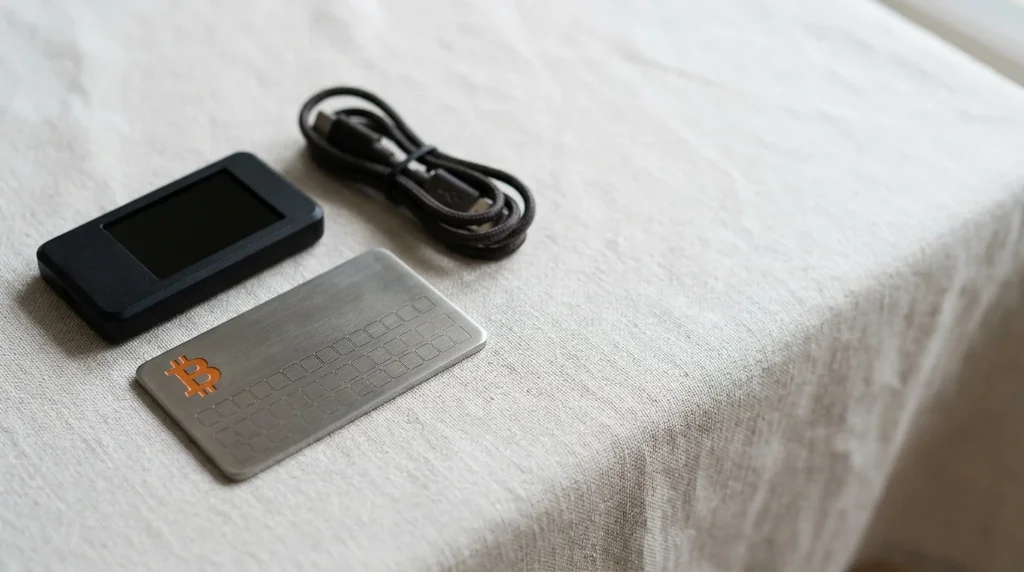
Yes, at SBB ticket machines, according to the guide published by Proton Wallet, Proton's bitcoin wallet. You need to select "Other tickets and offers", then "Prepaid / Money transfers" and "Bitcoin Paper Wallet". The buyer enters a valid Swiss phone number and pays in cash or by debit card.
The machine prints a paper wallet, with a public address and a QR code for the private key. This paper is worth the bitcoins: lose it, and you lose them. Proton's guide does not state the rate charged on purchase.
How much does each purchase route cost?
Some schedules charge for the order, others for holding: the table shows the amounts as each source publishes them.
| Route | Purchase fees | Holding fees | Who holds the bitcoins |
|---|---|---|---|
| PostFinance | 0.95% up to 250,000 dollars | 0.15% per year, excluding VAT | The bank, keys in Switzerland |
| Swissquote | 1% with no recent volume, down to 0.08% | 20 to 50 francs per quarter, all assets | The bank, withdrawal possible for 10 dollars |
| Zurich Cantonal Bank | Investment transactions fee schedule | Investment transactions fee schedule | The bank |
| Exchange platform | Around 0.1% on an order book, 1.5% or more for a simplified purchase | None, according to the guide | The platform or the client |
| ETP listed on SIX | Bank brokerage | 0.05% to 2% per year depending on the product | A custodian of the issuer |
| SBB ticket machine | Not stated by Proton's guide | None, paper wallet | The client |
The ranges for platforms and ETPs come from the European guide by Journal du Coin: an order of magnitude, not a Swiss rate.
How do you check that a crypto platform is authorised?
The first reflex is FINMA's warning list. It lists companies that may be operating without the required authorisation. FINMA warns, however, that it is neither exhaustive nor fully up to date: a name missing from it proves nothing.
FINMA therefore advises cross-checking several sources. Its list of supervised institutions shows who holds an authorisation. It also recommends the list of the Zurich cantonal police, on cybercrimepolice.ch, and that of IOSCO, the International Organization of Securities Commissions (I-SCAN).
The right status depends on the activity, as 2clics explained in its page on FINMA authorisations. Trading bitcoins and providing wallets require at least affiliation with a self-regulatory organisation (SRO). An institution with a fintech licence can accept crypto assets, but its funds are not covered by the deposit guarantee in the event of bankruptcy.
Who holds the bitcoins, and with what risk?
On a platform or at a bank, the main risk is the failure of the intermediary. The collapse of FTX in 2022 showed that client funds can stay frozen for years. Holding your own bitcoins shifts the risk: lose your recovery phrase of 12 or 24 words, and you lose your bitcoins.
Moving bitcoins out of a Swiss institution follows a precise rule. According to FINMA guidance 02/2019, in the absence of a transmission system on the blockchain, a supervised institution only sends crypto to the external wallets of its own identified clients. A direct transfer to a third party's wallet does not fall under this exception.
No route protects you from the market. Bitcoin has lost more than 50% of its value several times, and the bitcoin price fell back to around 81,500 dollars on 23 October 2026. When authorising the BBIT ETF, FINMA pointed out that the capital invested can lose a significant part of its value.
How do you declare your bitcoins for tax in Switzerland?
Bitcoins are part of taxable wealth, declared every year. According to the Geneva tax administration, their market value on 31 December is entered in the securities statement. The Federal Tax Administration (FTA) publishes on its ICTax platform the value of the main cryptos, calculated as the average of several platforms.
The gain made on a sale, for its part, is exempt from income tax if the bitcoins are part of private wealth. There is a flip side: a capital loss is not deductible. On the other hand, income from staking, mining, lending or airdrops is taxable, and a quasi-professional trader is taxed on their gains.
The details depend on the canton of residence, and the rules cited here are those of Geneva. Bitcoin can even be used to pay taxes in the canton of Zug: according to 2clics, it has been accepted there since February 2021, with a cap of 1.5 million francs per invoice since March 2023. The Swiss overview is in our article bitcoin turns 18 in Switzerland.
Key figures
- 0.95%: PostFinance trading fees up to 250,000 dollars, plus 0.15% per year for wallet management.
- 1%: fee for an order at Swissquote for a client with no crypto trading over 30 days.
- 429 crypto products listed on SIX at the end of 2024, including 169 ETPs, according to SIX.
- 51.6% of crypto product trading on SIX involved bitcoin in 2024.
What we don't know yet
- The exact listing date of the BBIT ETF on SIX, expected in November 2026, and its management fees, absent from the October 2026 announcements.
- The Swiss banks that will offer BBIT from day one: according to Danielle Reischuk of SIX Swiss Exchange, each institution must first complete its technical integration.
This article does not constitute investment advice.
Sources
- PostFinance: "Négoce de cryptomonnaies"
- Swissquote: "Cryptocurrency fees"
- Zürcher Kantonalbank: "Wie kaufe ich Kryptowährungen bei der Zürcher Kantonalbank?"
- SIX: "Crypto Market Thrives with Outstanding ETP Performance at SIX Swiss Exchange", 24 February 2025
- Proton: "Comment acheter du Bitcoin dans les gares suisses"
- FINMA: "Liste d'alerte"
- Republic and Canton of Geneva: "Imposition des particuliers détenant des crypto-monnaies", updated 11 November 2025
- 2clics.com: "FINMA crypto authorisation: which licence for which activity?", 23 October 2026
- 2clics.com: "FINMA travel rule: what a crypto transfer requires", 26 October 2026