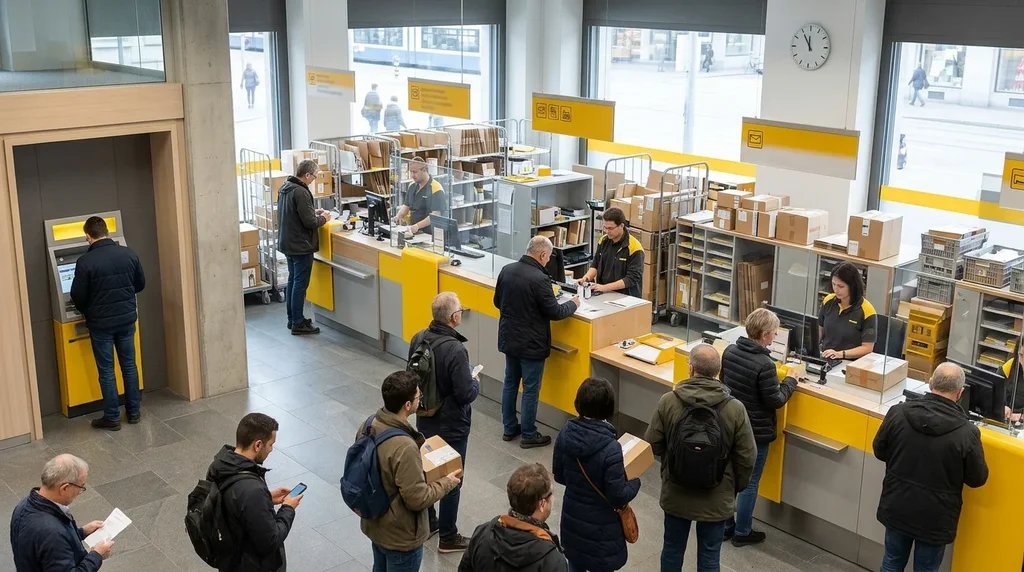
PostFinance, a Swiss financial institution offering accounts, payments and investments, is the main bank for 19% of the people surveyed in 2026 by the Lucerne University of Applied Sciences and Arts (HSLU). For these customers, it therefore plays the role of a bank. Its precise status, however, lies beyond the reach of the sources consulted in October 2026: they describe neither its licence, nor its limits on lending, nor its link with Swiss Post and the Confederation.
This page deals solely with the question of PostFinance's status and the protection of its customers. The overview of the sector, with its market shares, can be found on our page about the cantonal bank and its competitors. Other banking topics are gathered in the Banks and FINMA section.
Does PostFinance act as a bank for its customers?
Yes, in practice: nearly one person in five names it as their main bank. The figure comes from an HSLU study, reported by the financial website finews.ch on 26 October 2026. The Bilendi institute conducted the online survey from 29 May to 11 June 2026, among 2016 people aged 16 to 89.
PostFinance ranks third, behind the cantonal banks and Raiffeisen, but ahead of UBS. Together with these three groups, it accounts for 89% of main banking relationships in Switzerland.
| Main bank cited | Share in 2026 |
|---|---|
| Cantonal banks | 28% |
| Raiffeisen | 25% |
| PostFinance | 19% |
| UBS | 17% |
| Other banks (regional banks, savings banks, Migros Bank, Bank Cler) | about 9% |
| Digital banks (Revolut, Yuh, Neon…) | slightly more than 2.4% |
This ranking measures a household habit, not a legal status. It does not say under which authorisation PostFinance operates, nor what it is allowed to do with the money it receives. Nor does the study publish PostFinance's share two years earlier.
What services does PostFinance offer?
Its homepage, consulted on 31 October 2026, describes a retail banking offering. It includes in particular:
- opening an account;
- international payments, in the PostFinance App or via e-finance;
- financial investments and portfolio management, with the formula "Let us manage your portfolio";
- multibanking, current interest rates and tax documents;
- a section headed "I would like to finance a project".
This last section specifies neither the product offered nor the institution that grants the financing. The homepage therefore does not make it possible to say whether PostFinance lends money itself.
PostFinance also took part in launching an app. Yuh, launched as a start-up in 2021, was born of a joint venture between PostFinance and Swissquote. According to Yuh's website, consulted on 27 October 2026, Swissquote bought out PostFinance's stake in July 2025. Yuh's banking services are now provided by Swissquote Bank SA.
Where can PostFinance's authorisation be checked?
On the FINMA website. The Swiss Financial Market Supervisory Authority (FINMA), in Bern, publishes on its official website a list of all authorised institutions and products. It also maintains a warning list there.
According to its homepage, FINMA protects financial market clients and supervises in a proportionate, risk-based and technology-neutral way. Its mandate is primarily aimed at protecting creditors, investors and policyholders, as our article on the Swiss financial centre points out.
FINMA devotes dossiers to small banks, the mortgage market and "too big to fail" banks. These rules target systemically important banks such as UBS, whose capital requirements are under debate. Our sources do not say whether PostFinance falls into this category.
What does the revision of the Postal Act provide for?
This matter concerns Swiss Post, without mentioning PostFinance. According to a Keystone-SDA dispatch picked up by SWI swissinfo.ch, the consultation on the revision of the Postal Act, opened in June, has been completed. The government wants to respond to the decline of traditional postal services and to the expansion, by Swiss Post, of commercial activities that go beyond its core mission.
The text also provides for rules on company acquisitions by Swiss Post, which welcomes "dynamic regulation". It is a preliminary draft: nothing has been adopted, and the dispatch does not say whether PostFinance would be affected.
Is money deposited with PostFinance protected?
The general rule is known; its application to PostFinance is not confirmed by our sources. According to the esisuisse website, the self-regulatory organisation of Swiss banks, all banks with a branch in Switzerland must be members. This private association is headquartered in Basel.
Deposit insurance protects assets up to 100,000 francs per customer and per bank in the event of bankruptcy. It covers private individuals and companies alike. esisuisse finances the payout if the liquidity of the bankrupt bank is insufficient. A partial revision of the Banking Act, in force since 1 January 2023, strengthened this protection.
If PostFinance operates as a bank in Switzerland, this rule applies to it. esisuisse publishes an overview of its members, which makes it possible to check. The ceiling is calculated per bank: at Yuh, for example, the Yuh and Swissquote accounts of the same person count as a single entity.
Some banks offer more. According to Wikipedia, cited by 2clics, 21 of the 24 cantonal banks benefit from a state guarantee: their canton is liable, on a subsidiary basis, for all their commitments. None of the sources consulted mentions a comparable guarantee from the Confederation for PostFinance. To find out how many cantonal banks have one, our list details the 24 institutions.
| Institution | esisuisse deposit insurance | Public guarantee |
|---|---|---|
| 21 of the 24 cantonal banks | Yes, up to 100,000 francs per customer | Full guarantee from the canton, on a subsidiary basis |
| Banque cantonale vaudoise, Berner Kantonalbank and Banque cantonale de Genève | Yes, up to 100,000 francs per customer | None |
| Yuh (Swissquote Bank SA) | Yes, up to 100,000 francs for Yuh and Swissquote combined | Not mentioned |
| PostFinance | Not specified in our sources; mandatory for any bank with a branch in Switzerland | Not specified in our sources |
Key figures
- 19% of respondents cite PostFinance as their main bank (HSLU, 2026).
- 89% of main banking relationships are held by the cantonal banks, Raiffeisen, PostFinance and UBS.
- 2016 people surveyed, from 29 May to 11 June 2026.
- July 2025: Swissquote buys out PostFinance's stake in Yuh.
- 100,000 francs: the deposit insurance ceiling, per customer and per bank (esisuisse).
- 21 of the 24 cantonal banks have a state guarantee (Wikipedia).
What should PostFinance customers check?
A few checks help to place your account. They follow from the rules of FINMA and esisuisse and do not constitute financial advice.
- Authorisation: the list of authorised institutions, on the FINMA website.
- The guarantee: the overview of esisuisse members.
- The ceiling: 100,000 francs per customer and per bank, combining all of your relationships with the same institution.
- Financing: the terms of a loan should be checked with PostFinance itself, as its homepage does not detail them.
What we do not yet know
- Under which FINMA authorisation PostFinance operates, and since when.
- Whether PostFinance can grant loans and mortgages on its own, and what its "finance a project" section offers.
- The structure of its capital and its legal link with Swiss Post and the Confederation.
- Whether a public guarantee, beyond deposit insurance, covers its commitments.
- Whether the revision of the Postal Act, still at the preliminary draft stage, would affect PostFinance.
Sources
- PostFinance: "Private customers" homepage, postfinance.ch, consulted on 31 October 2026
- FINMA: homepage, list of authorised institutions and warning list, finma.ch, consulted in October 2026
- esisuisse: homepage, esisuisse.ch, consulted in October 2026
- 2clics: « Banque cantonale : poids, clientèle et différences avec UBS et Raiffeisen », HSLU study reported by finews.ch on 26 October 2026
- 2clics: « Garantie de l'État des banques cantonales : ce qu'elle couvre », based on Wikipedia and esisuisse
- 2clics: « Yuh application : compte, paiements, placements et frais », based on Yuh's website consulted on 27 October 2026
- 2clics: « Loi sur la poste : la révision critiquée de gauche comme de droite », based on Keystone-SDA and SWI swissinfo.ch