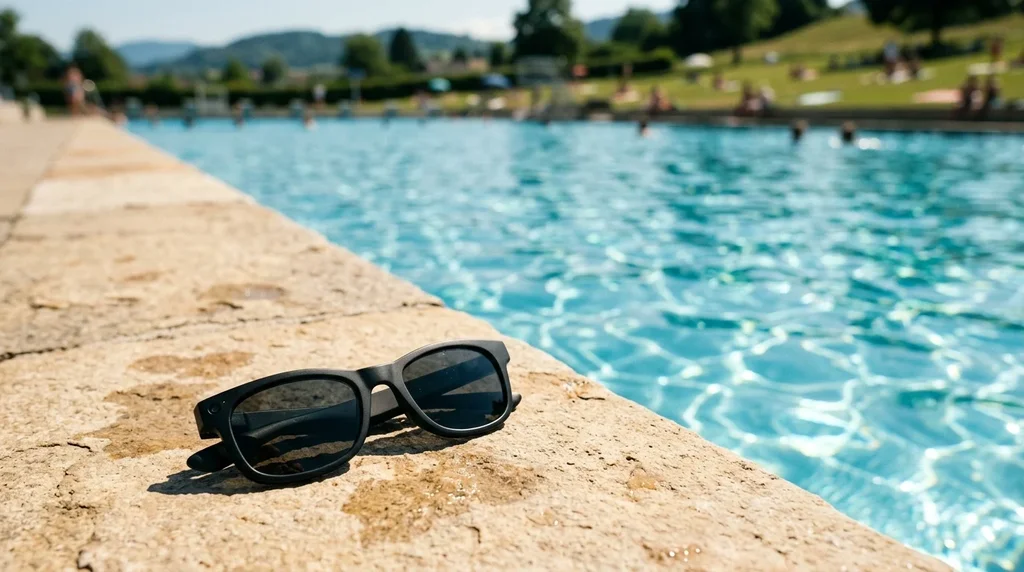
Smart glasses are selling noticeably better in Switzerland this year, at least at Galaxus. The online retailer reports sales up 307% year on year and says men account for 87% of purchases. At the same time, these camera-equipped devices are fuelling a political debate on privacy protection, in the canton of Vaud and elsewhere.
What are we talking about?
Smart glasses look like ordinary glasses, but they incorporate electronics. The source mentions two components: a camera and built-in speakers. It does not describe the functions of the various models in any further detail.
According to Galaxus, this equipment can be helpful for people with disabilities. Thanks to the camera and speakers, deaf people could follow a conversation in real time and take part in it more easily. Blind people could receive a spoken description of their surroundings. These are the retailer’s claims: the source specifies neither how these functions work technically nor which models offer them.
What Galaxus’s figures say
In a press release quoted by swissinfo.ch, Galaxus says its smart glasses sales have quadrupled this year compared with the same period last year, an increase of 307%. The company states that “several thousand pairs” were ordered between January and September, and says the glasses are “selling like hot cakes”.
Again according to the retailer, the best-selling brands are Ray-Ban, Xreal and RayNeo, followed by Viture and Oakley. Buyers are mostly men, who account for 87% of purchases. The dispatch’s standfirst rounds this figure to “nine out of ten”.
Galaxus also cites a manufacturers’ estimate according to which millions of smart glasses will be in circulation worldwide by 2026.
The limits of these figures
These figures should be read with caution. They come from a single retailer and a press release, and therefore do not measure the Swiss market as a whole. The source does not give the exact number of units sold, only “several thousand pairs” over nine months. A 307% increase may therefore start from a modest base. Nor does the source specify how the share of men was calculated, or what smart glasses represent in Galaxus’s overall sales. Finally, the global estimate comes from the manufacturers, who have a direct interest in the growth of this market.
Privacy at the heart of the controversy
Galaxus acknowledges that this technology is criticised. Some people use these glasses to film others without their consent, then illegally share the footage online.
In the canton of Vaud, Green member of parliament Raphaël Mahaim has tabled a motion in the cantonal parliament calling for a new legal framework. Under his proposal:
- anyone using smart glasses to record another person’s image, voice or biometric data would have to clearly signal it;
- a recording would be considered unlawful if the device does not display a visible recording indicator that cannot be switched off;
- manufacturers would have to demonstrate that their devices meet privacy safeguards before they are placed on the market.
In recent months, other cantons have also seen political initiatives on the subject, notably Zurich, Lucerne, Basel-Stadt and St. Gallen. Much of the debate concerns a possible ban on these glasses in swimming pools. Its supporters argue that a ban would prevent people in swimwear, notably children, girls and women, from being discreetly filmed with built-in cameras without their consent. In some cases, this footage is then posted online. The source does not specify the status of these various initiatives.
Key takeaways
Galaxus’s figures show growing interest in smart glasses in Switzerland, especially among men. They are not, however, enough to measure the national market. The privacy debate has already led to a motion in the Grand Council of Vaud and to political initiatives in several other cantons. The question to watch is this: will protecting the people being filmed come through rules of use, through technical requirements imposed on manufacturers, or through both?