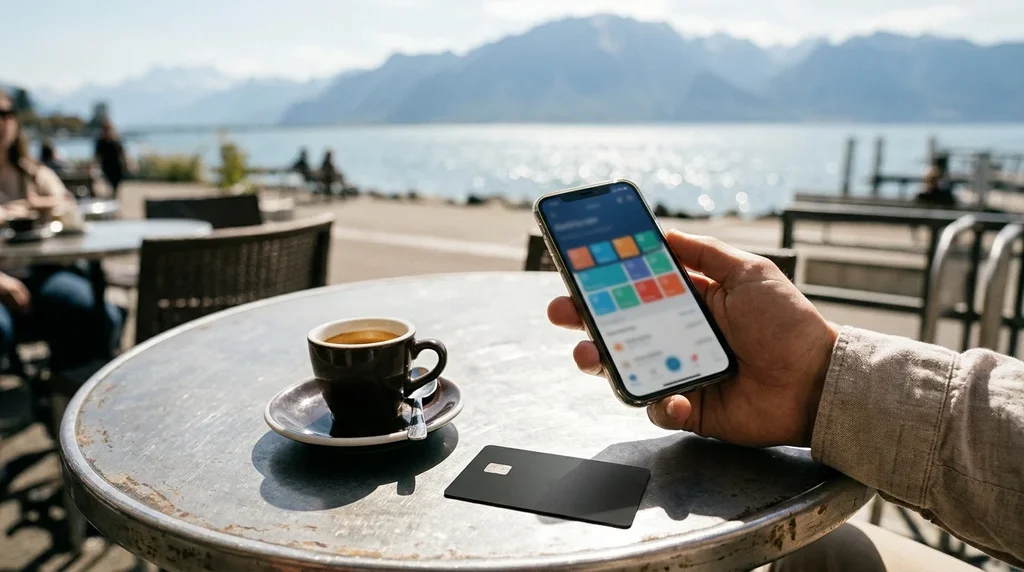
A Swiss neobank serves its customers over the Internet or through a mobile app, without the word referring to any legal status. In Switzerland, the Swiss Financial Market Supervisory Authority (FINMA) classifies these providers according to their activity: bank, fintech institution or intermediary subject to the Anti-Money Laundering Act. For the customer of a Swiss online bank, this status matters: it decides what happens to their money in the event of bankruptcy.
This page gives an overview of the subject: licences, deposit protection, remote account opening and differences from a traditional bank. The other articles in the series are gathered in our section on neobanks and online banks.
What is a neobank in Switzerland?
A neobank is first and foremost a channel: customers open their account and manage their payments from an app, as with Revolut. FINMA notes that financial intermediaries are increasingly operating via the Internet or mobile devices. It has therefore set rules for entering into a business relationship by digital means.
The word “neobank” does not appear among the types of authorisation listed by FINMA. A provider presented as a neobank therefore falls under one of the existing regimes. Everything depends on what it does with its customers’ money.
Does a neobank have a banking licence?
Not necessarily: three levels of supervision coexist, from the lightest to the most demanding.
- Membership of a self-regulatory organisation (SRO). Anyone who accepts assets belonging to third parties, or helps to invest or transfer them, is subject to the Anti-Money Laundering Act (AMLA). This is the case for a payment service, a currency exchange office or a wallet provider. Anyone subject to the AMLA must join an SRO.
- Fintech licence. Created by the legislator for innovative financial companies, it has lighter requirements. It is based on Article 1b of the Banking Act (BankA).
- Banking licence. It covers banking activity that goes beyond the scope of the fintech licence.
Before starting out, a company must check two things: whether it is subject to the AMLA and whether it may need to obtain a licence. When faced with an application, FINMA itself assesses whether the activity requires a licence and which one is appropriate.
What does the fintech licence allow?
The fintech licence allows a company to accept public deposits of up to 100 million francs, or crypto-assets. These deposits may be neither invested nor interest-bearing. A model that wants to invest the money received or pay interest therefore falls outside this framework.
The institution must be a company limited by shares, a partnership limited by shares or a limited liability company. It must also carry out its business activity in Switzerland. FINMA is responsible for granting the licence and for any amendment to it.
Is the money protected by deposit insurance?
With a fintech institution, no: for the customer, this is an important difference from a bank. In the event of bankruptcy, customer funds are neither given preferential treatment nor protected by deposit insurance. The law requires prospective customers to be informed of this (Art. 1b para. 4 let. d BankA and Art. 7a para. 3 of the Banking Ordinance).
The Federal Council recognised the need for action in this area in a report dated 16 December 2022, according to FINMA. This should take the form of a draft amendment to financial market law. Its content and timetable are not specified in the pages consulted.
How do you open an account remotely?
Remote account opening is governed by FINMA Circular 2016/7 “Video and online identification”. In force since 18 March 2016, it was updated on 6 May 2021. It sets out the anti-money laundering due diligence obligations for relationships established by digital means.
On 8 October 2026, FINMA adopted a partial revision of this text, in force on 1 November 2026. It changes several points for customers who sign up from their phone:
- the electronic identity (e-ID) provided for by the new federal act may be used for identification;
- documents bearing a QR code, such as the Swiss driving licence, are equivalent to those with a machine-readable zone;
- liveness detection becomes mandatory, given the risks linked to artificial intelligence;
- reliable digital methods may be used to verify the place of residence.
What are the differences from a traditional bank?
The digital channel says nothing about status: it is the licence that determines what a provider may do with the money it receives. The table summarises the two regimes that allow public deposits to be accepted, according to FINMA.
| Criterion | Fintech licence | Banking licence |
|---|---|---|
| Public deposits | Up to 100 million francs, or crypto-assets | Banking activity outside the fintech framework |
| Investing or paying interest on deposits | Prohibited | Outside the fintech framework: banking licence to be considered |
| Customer funds in the event of bankruptcy | Neither given preferential treatment nor covered by deposit insurance | Different regime, presented as an important difference; amount of the guarantee not detailed |
| Customer information | Mandatory regarding the absence of a guarantee | Not detailed in the sources consulted |
What does the Revolut example show?
The outage of 20 October 2026 illustrates another difference: a neobank customer depends on their app and the infrastructure that runs it. That day, Google Cloud’s London region piled up errors. Revolut saw its card payments, withdrawals and app blocked, as reported in our article on the Google Cloud outage at Revolut.
Revolut has more than 50 million customers, according to Journal du Coin as cited by 2clics in October 2026. Cryptocurrencies bought in the app are held by Revolut, not in a wallet whose keys the user holds. During the outage, selling and withdrawing them was also cut off.
The risk goes beyond a single player. According to the same source, Amazon, Microsoft and Google host nearly two-thirds of the world’s cloud. Banks and fintechs have moved their core applications there.
What should you check before opening an account?
For an individual, a few checks drawn from FINMA’s rules are enough to place a provider. This is not a product recommendation.
- Status: the FINMA website publishes the “Authorised institutions” and “Warnings” sections.
- Protection: a fintech institution must state that funds are not covered by deposit insurance.
- Interest: a fintech account cannot pay interest on deposits.
- Continuity: a second means of payment with another institution limits the inconvenience on the day of an outage.
For an SME or a start-up that wants to launch a service, the order is set by FINMA. It first checks whether it is subject to the AMLA, then whether it needs a licence. It can present its project to FINMA before the formal application, at fintech@finma.ch. The procedure incurs fees, and an audit report may be required on a case-by-case basis. Its duration depends on the complexity of the project and the quality of the application.
Key figures
- 100 million francs: ceiling on public deposits under a fintech licence (FINMA, page consulted in October 2026).
- 18 March 2016: entry into force of the circular on video and online identification, updated on 6 May 2021.
- 1 November 2026: entry into force of its revision, which accepts the e-ID.
- 16 December 2022: Federal Council report recognising the need for action regarding fintech institutions.
- More than 50 million customers at Revolut (Journal du Coin, October 2026).
- Nearly two-thirds of the world’s cloud in the hands of three players: Amazon, Microsoft and Google (Journal du Coin, October 2026).
What we don’t know yet
Several points remain open in the sources consulted. The FINMA pages consulted specify neither the content nor the timetable of the draft amendment to financial market law. The amount covered by bank deposit insurance is not detailed there. Finally, these sources do not specify the status of each neobank active in Switzerland: FINMA’s list of “Authorised institutions” remains the starting point for checking it.