The Foundation for Innovation and Technology (FIT), which supports young companies in the canton of Vaud and French-speaking Switzerland, is granting a Tech Seed loan of 100,000 francs to three start-ups, according to its press release of 28 October 2026. Biodelphis Therapeutics targets osteoporosis, PolaSight cancer surgery and Swiss Soil vineyard management. Each loan funds a specific stage before market launch.
These are loans, not a fundraising round: the FIT announces no investor taking an equity stake. For Swiss Soil, the loan is precisely meant to prepare a first round. This support therefore comes ahead of the rounds described in our guide to raising funds as a startup in Switzerland.
Three Tech Seed loans, three different stages
The three amounts are identical, but how they are used differs markedly from one start-up to the next, according to the FIT's press release.
| Start-up | Origin | Field | What the loan funds | Announced timeline |
|---|---|---|---|---|
| Swiss Soil | Not specified | Vineyard management | Share of 66,000 francs in an Innosuisse project, incorporation of a public limited company | Commercial launch targeted for 2028 |
| PolaSight | Spin-off of the University of Bern | Tissue analysis during cancer surgery | CE marking, first hospital installations | CE marking expected in early 2027 |
| Biodelphis Therapeutics | Emerged from EPFL | Targeted treatment of osteoporosis | Safety tests and first study of the drug in the body | No date for human trials |
Swiss Soil: a loan that unlocks others
At Swiss Soil, the FIT's 100,000 francs act as a lever. According to the foundation, they unlock support of 100,000 francs from the Canton of Vaud. They also fund the 66,000-franc share that the start-up must contribute to a project with Innosuisse, the Swiss Innovation Agency.
This two-year project was approved by Innosuisse in July 2026. Carried out with the Changins school of viticulture, it is to test the complete system in real vineyards in 2027 and 2028. Swiss Soil has already signed ten letters of intent.
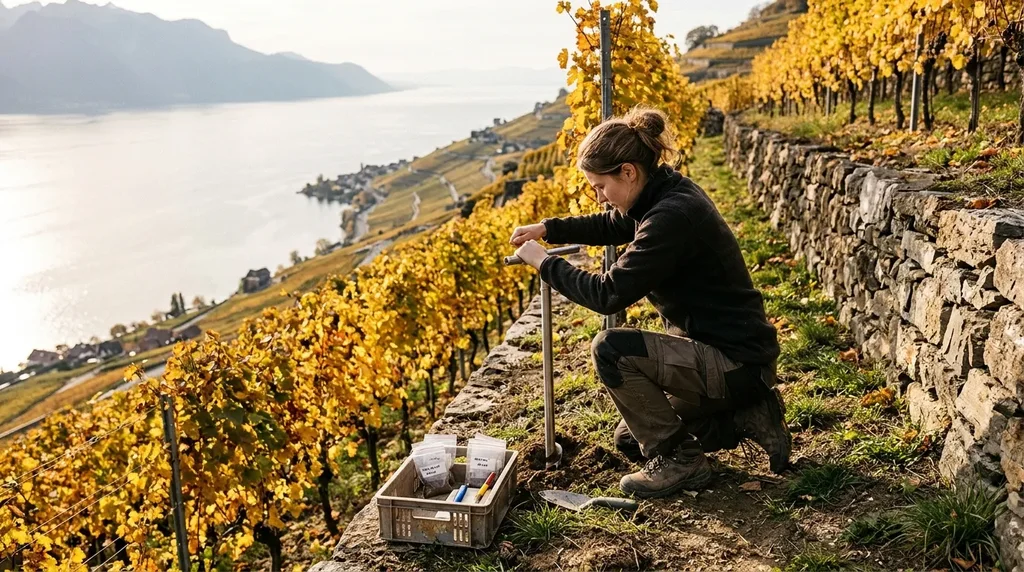
The product is called AGROSTASIS. It combines soil and sap analyses, weather data and images from an automated microscope to detect stress and deficiencies in the vines. The teams of the start-up, led by Craig Arnold, handle the sampling and the interventions: the winegrower delegates the management. The three main building blocks were developed in particular with the School of Engineering and Management Vaud (HEIG-VD) and the Swiss Federal Institute of Technology in Zurich (ETH Zurich).
PolaSight: analysing tissue during surgery
PolaSight, a University of Bern spin-off led by Roi Finish, wants to shorten the wait during cancer surgery. Today, the intraoperative frozen-section examination of a sample generally takes 20 to 40 minutes, according to the FIT. The patient remains under anaesthesia during this time.
Its PolaOne platform maps the entire fresh sample in around sixty seconds, without staining. The pathologist thus knows which areas to examine first, and the tissue remains intact for the usual analysis. According to the foundation, this could reduce anaesthesia time and the need for a second operation. These benefits have yet to be demonstrated through clinical validation.
PolaOne is already used for research in several pathology laboratories. The loan is to fund CE marking, which is mandatory for use in European hospitals and expected in early 2027.
Biodelphis Therapeutics: targeting only the cells that destroy bone
Biodelphis Therapeutics, which emerged from the Swiss Federal Institute of Technology in Lausanne (EPFL) and is led by Aaron Petruzzella, is tackling a known failure. According to the FIT, five drugs that block cathepsin K, a protein involved in bone destruction, have been abandoned. One of them was dropped in the final phase of trials, due to an increased risk of stroke.
The start-up attaches a small inhibitor peptide to an antibody that carries it only to the cells that destroy bone. It applies the same method to lung cancer. Its first tests have shown efficacy in animals; no human trial has yet taken place.
The loan is to be used to show that this treatment does not increase the risk of stroke, and to conduct a first study of how the drug behaves in the body. This work precedes the studies required before any human trial.
How does the FIT Foundation's Tech Seed loan work?
The Tech Seed loan is one of the three instruments of the FIT Tech programme, alongside the Tech Grant and the Tech Growth loan, according to the foundation's "Loans and grants" page. FIT Tech targets start-ups based on a technological innovation that is hard to imitate, with strong growth potential. Its amounts range from 100,000 to 500,000 francs, across all instruments.
The foundation offers two other programmes: FIT Digital, from 20,000 to 200,000 francs, and FIT Impact, from 10,000 to 20,000 francs. FIT Impact has just supported the Niv'o and EC Knit projects, with 10,000 francs each. Founded in 1994, the FIT supported 61 projects for 5.475 million francs in 2025, according to its website. The overview of FIT loans brings together its other support for the year.
Startup funding in Switzerland: where does a 100,000-franc loan fit?
At 100,000 francs, the Tech Seed loan is on a par with other public or philanthropic seed support. The figures come from the programmes' pages, as compiled by 2clics.
| Programme | Area | Seed tier | Amount |
|---|---|---|---|
| FIT Tech Seed | Vaud and French-speaking Switzerland | Loan | 100,000 francs per start-up in this announcement |
| FIF Seed | Geneva | Form not specified by the sources | Up to 100,000 francs |
| Venture Kick | All of Switzerland | Philanthropic support in three stages | Up to 150,000 francs |
The FIF, the canton of Geneva's innovation programme, granted 100,000 francs in FIF Seed Tech to dEEGtal and S-SENTIA, 2clics reported in October 2026. Venture Kick, for its part, starts with 10,000 francs for an idea coming out of a university, according to our page on the seed funding round. The next steps go through business angels, then venture capital.
What we don't know yet
- The terms of the loan: neither the press release nor the FIT's "Loans and grants" page gives the interest rate, the term or the repayment terms of a Tech Seed loan.
- Swiss Soil's first round: its amount and date have not been announced.
- The Canton of Vaud's support for Swiss Soil: its exact form is not specified.
- The first hospitals equipped by PolaSight: none is named.
- Biodelphis Therapeutics' timeline: no date is given for a first human trial.
All our news on startup fundraising is gathered in the dedicated section.