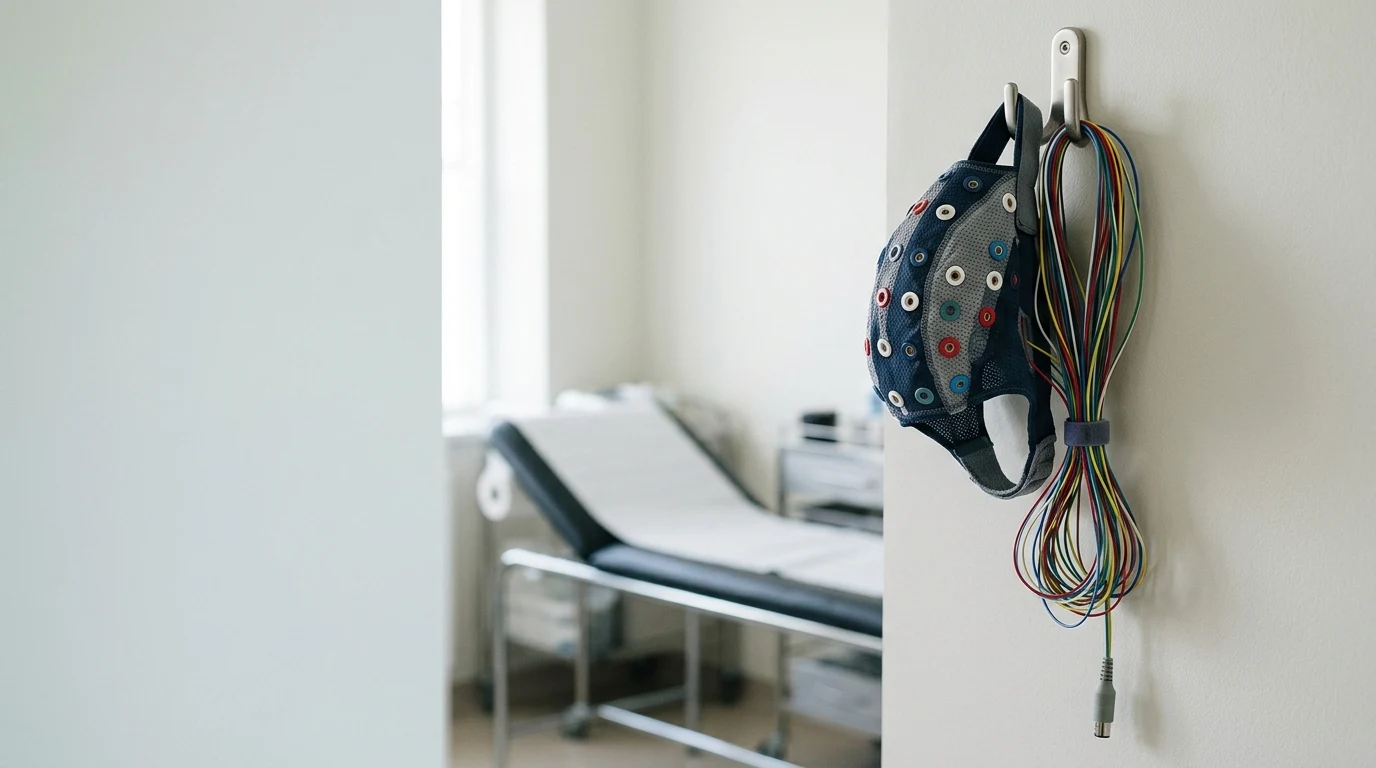
The Swiss National Science Foundation (SNSF) has awarded 1,990,000 francs to PRECISE MDD, a randomized controlled trial led by the digital health company DeepPsy. The announcement, reported on October 7, 2026 by Startupticker.ch, is based on the company’s own communication. The aim: to measure whether a report based on biomarkers derived from brain and heart activity actually helps in choosing treatment for major depression. That is precisely what has not yet been established, and what the study is meant to test.
The method: reading EEG and ECG to compare options
DeepPsy analyzes two types of recordings: the electroencephalogram (EEG), which captures the brain’s electrical activity, and the electrocardiogram (ECG), which records that of the heart. The software extracts electrophysiological biomarkers from them that the company describes as scientifically linked to depression and to treatment response.
From these measurements, DeepPsy produces a report intended for clinicians. This document does not propose a new treatment: it is meant to make it possible to compare therapeutic options already approved for depression, so that the decision rests on more data. The company argues that this personalized approach could reduce successive trials, shorten the time before an effective treatment and speed up recovery. At this stage, this is a hypothesis, not a result.
What is presented as established
According to DeepPsy, the biomarkers used rest on a substantial body of research, including more than 20 studies conducted by members of its team and by external researchers. Several of these biomarkers have reportedly been replicated in independent datasets. The source details neither these studies, nor the biomarkers concerned, nor the size of the effects observed: these elements therefore cannot be assessed here.
Two questions must also be distinguished. That an EEG or ECG signal is statistically associated with the response to a treatment is one thing. That handing a report to the doctor improves patient outcomes is another. It is this second question, that of clinical utility, that PRECISE MDD seeks to settle.
The trial: 500 patients, three centers, four years
The study, planned over four years, is to include 500 patients with major depressive disorder at university psychiatric centers in Zurich, Bern and Basel. The design compares two groups: one receives an individualized report based on the biomarkers, the other a report based on standard treatment recommendations. The study will also examine biological changes and healthcare costs.
The division of roles is announced as follows: DeepPsy provides the EEG and ECG analysis software and the biomarker calculation, while an independent academic consortium conducts the trial. This split aims to separate the company developing the tool from the team evaluating its effect.
Mateo de Bardeci, co-founder and CEO of DeepPsy, presents PRECISE MDD as “the first large-scale, multicenter, prospective, randomized, controlled and triple-blind trial” designed specifically to evaluate the clinical utility of the DeepPsy report as a whole for treatment selection. He describes it as one of the most robust study designs for prospectively evaluating clinical efficacy. Triple-blind means, in principle, that neither the patients, nor the caregivers, nor the people in charge of the analysis know who receives which report.
What the study still has to prove
The SNSF funding does not constitute a validation of the tool: it makes it possible to put it to the test. Several points remain open. The source does not specify the trial’s primary endpoint, that is, the measure that will show whether the report works (remission rate, time to response or other). Nor does it indicate the recruitment timeline or the expected date of the results.
For Mateo de Bardeci, positive results could be an important step toward integrating the tool into clinical treatment guidelines, and toward bringing more biological information into routine psychiatric care. The conditional is essential: if the trial shows no benefit compared with the standard report, the clinical value of the approach would remain to be demonstrated.
In the meantime, the established result is limited to this: a large trial, publicly funded and conducted by an academic consortium, will compare in a controlled manner a decision aid based on EEG and ECG with a standard approach. Patients suffering from depression should not see it as a solution available today.