PostFinance, the bank of the Swiss Post group, wants to process its merchants' card and TWINT payments itself. On 27 November 2026, the institution announced its own "full acquiring" service in Switzerland. According to Fintechnews Switzerland, the launch is planned from mid-2027, starting in shops and restaurants. PostFinance justifies the project by pointing to a market it considers dominated by a single provider.
What PostFinance announced on 27 November 2026
PostFinance already does acquiring, but part of the work currently goes through a partner. According to finews.ch, which cites a statement from the bank dated 27 November 2026, it now wants to provide more of these services itself. The name of the current partner is not mentioned in either of the two articles.
"Full acquiring" brings everything together with a single acquirer. According to finews.ch, this provider handles the acceptance, authorisation and settlement of cashless payments for a merchant, whatever payment method is used. Fintechnews Switzerland gives examples of the methods covered by this type of offering: PostFinance Card, Visa, Mastercard and TWINT. The merchant then no longer needs a separate contract for each one.
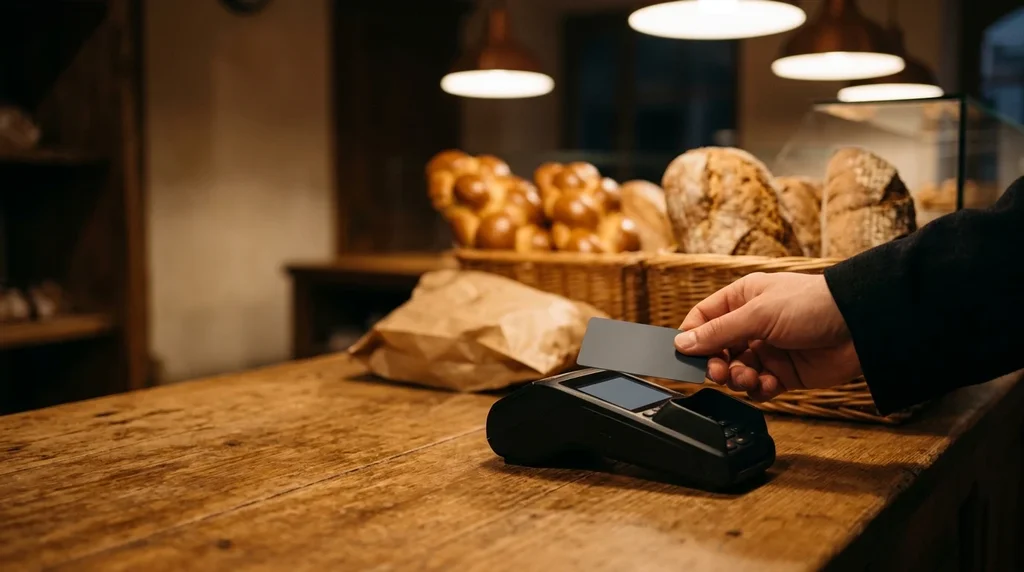
The rollout would be gradual. Payments at physical points of sale, such as shops and restaurants, would come first. E-commerce would follow later, with no date announced. PostFinance thus wants to link payment collection more closely with its banking services, according to the two articles.
Beat Röthlisberger, chief executive officer (CEO) of PostFinance, presented the project at the Retail Banking Konferenz in Rotkreuz. "This will give Swiss merchants more choice and strengthen competition in payment transactions in Switzerland," he said, according to Fintechnews Switzerland.
What is an acquirer for a merchant?
The acquirer is the invisible intermediary between the shop's till and its account. According to a guide published by PostFinance on its blog on 18 June 2026, it receives the payment, forwards it for verification and makes sure the money is paid into the business account. It is also answerable to the merchant for the smooth running of the process and its security.
A payment acceptance solution has three elements, according to the same guide:
- the terminal, the only part visible to the customer;
- the accepted payment methods: TWINT, debit and credit cards, PostFinance Card, mobile wallets;
- payment processing, or acquiring, which affects fees, settlements and payment processes.
Many SMEs work with several providers. PostFinance notes in the same guide that this multiplies contracts, settlements and contact persons. This text is commercial content from the bank, which presents its own integrated solutions in it.
Why does the Swiss market depend on a single provider?
Market concentration is PostFinance's central argument. According to finews.ch, the bank describes a market "strongly shaped by one provider". Fintechnews Switzerland adds that Swiss companies have often asked for another Swiss provider. In these two articles, PostFinance does not name the company in question and does not publish any market share.
Several acquirers are nevertheless present. The rates recorded as at 30 April 2025 by moneyland.ch, a Swiss online comparison service, and reported by 2clics, cite two payment acquirers: Worldline for cards, Worldline and Nexi for TWINT on terminals. These figures say nothing about each one's market share.
The project is also part of PostFinance's revenue strategy. Its half-year press release of 20 August 2026 points out that it is not allowed to grant loans or mortgages. It is therefore harder hit by pressure on margins, according to the bank. The decline in over-the-counter payment transactions weighed on its result for the first half of 2026 to the tune of CHF 65 million. Conversely, its commission and service business reached CHF 171 million, compared with CHF 168 million in the first half of 2025. The press release does not link these figures to the acquiring project: the connection is a matter of analysis.
What competition can change in an SME's commissions
A new acquirer does not automatically lower fees. As long as PostFinance does not publish its rates, the effect on commissions remains a hypothesis. A comparison of current entry-level prices does, however, show significant differences depending on the payment method and the provider.
| Payment method (provider) | Rate | Cost of a CHF 100 payment |
|---|---|---|
| PostFinance Card (PostFinance) | CHF 0.23 at both CHF 50 and CHF 100 | CHF 0.23 |
| Debit Mastercard (Worldline) | CHF 0.08 + 0.49% | CHF 0.57 |
| Visa Debit (Worldline) | CHF 0.10 + 0.95% | CHF 1.05 |
| TWINT on a Worldline terminal | 1.7% | CHF 1.70 |
| TWINT direct contract, "Hybrid" model | 0.99% + CHF 0.09 | CHF 1.08 |
Table sources: moneyland.ch, rates as at 30 April 2025, and TWINT press release of 19 November 2026, as reported by 2clics. These rates may have changed since and do not take negotiated terms into account.
A merchant's commission is made up of several fees. As our article on TWINT fees for merchants explained, it includes in particular the interchange fee and the licence fee of the scheme operator. According to PimPay, a solution from French-speaking Switzerland cited by 2clics, a card or mobile payment generally costs an independent shop 1% to 3% of the amount. This order of magnitude comes from a competitor, which offers commission-free payment with PimPay.
The timing falls during a period of change for many shops. According to a PostFinance page dated 21 April 2026, older terminals no longer comply with the PCI DSS security standard. They will have to be replaced by 31 October 2027. The bank presents this replacement as the moment to review one's acquiring contract. According to the bank, activating a new contract, terminal included, generally takes about two weeks.
For an SME, three questions remain useful before switching provider:
- the percentage and fixed fees charged for each major payment method;
- the number of contracts and contact persons, and the time taken for payment into the account;
- the term of the current contract and its termination conditions.
Fee transparency is also a political issue. A Federal Council draft, in consultation until 11 February 2027, would require providers to itemise three fees, cards and TWINT included, according to 2clics. On the TWINT side, the app published on 19 November 2026 a hybrid model and a comparison tool for merchants with a direct contract. How the TWINT app works for customers is described separately.
What we don't know yet
- Prices and terms: PostFinance will announce them closer to the launch, according to finews.ch and Fintechnews Switzerland.
- The accepted payment methods and the exact scope of the services, which the bank has not yet detailed.
- The precise timetable: no date has been given for e-commerce, and the fate of the current partnership has not been specified.
Sources
- finews.ch, "Postfinance will eigenes Full-Acquiring anbieten", 27 November 2026
- Fintechnews Switzerland, "PostFinance to Launch Own Full Acquiring Service from Mid-2027", 27 November 2026
- PostFinance, "Customer trust strengthens PostFinance", press release of 20 August 2026
- PostFinance, "Choosing a payment provider: what Swiss SMEs need to look out for", 18 June 2026
- PostFinance, "Changing terminals in 2027: an obligation and an opportunity for SMEs", 21 April 2026
- 2clics.com, "TWINT fees for merchants: what makes up the price"
- 2clics.com, "TWINT merchant fees: a hybrid model and a comparison tool"