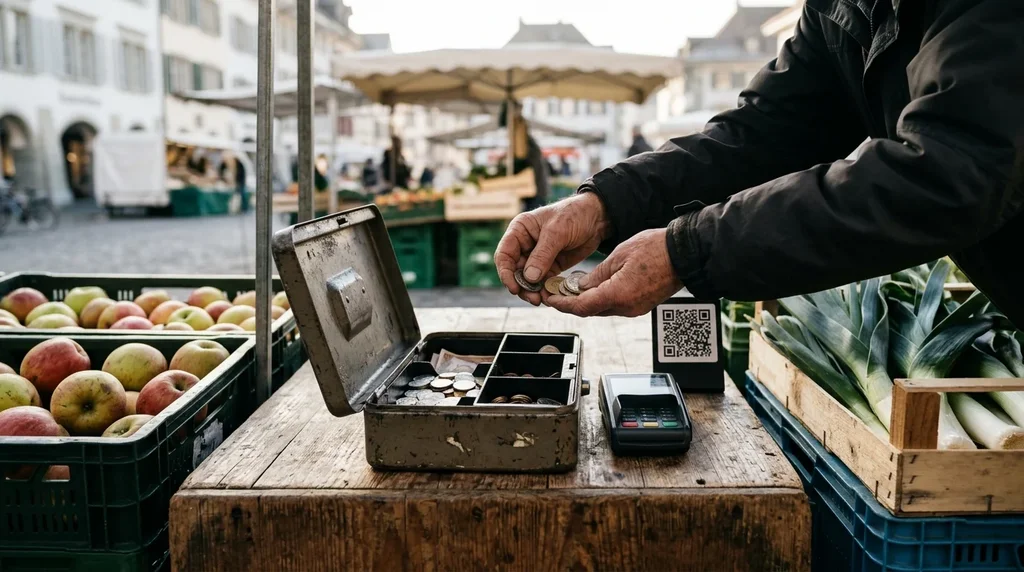
TWINT, the Swiss smartphone payment app, links to its user's bank account and is used to pay both in shops and online. According to the TWINT website, consulted on 28 October 2026, 4 out of 5 shops and more than 84% of online shops in Switzerland accept it. Its fees for merchants and the list of its partner banks do not appear on that page.
TWINT at a glance: what do the sources say?
| Question | What is established | Source |
|---|---|---|
| Who publishes the app? | Not stated on the home page | twint.ch |
| Which banks offer it? | Bank chosen from a menu; list not published in the version consulted | twint.ch |
| Where can you pay? | 4 out of 5 shops and more than 84% of online shops in Switzerland | twint.ch |
| Between individuals? | Not described on the home page | twint.ch |
| Fees for merchants? | TWINT's fees not published; 1% to 3% for card or mobile payments in general | PimPay, via 2clics |
| Security? | TWINT accounts targeted by phishing, reported on 20 October 2026 | Federal Office for Cybersecurity |
What is TWINT and who publishes it?
TWINT is a mobile payment app for iOS and Android, free to download according to its website. It lets you pay with your smartphone, wherever you are, the company says. On its home page, TWINT says it has "revolutionised mobile phone payment in Switzerland" and is celebrating its 10th anniversary.
That page names neither the company that publishes the app nor its owners. The sources consulted for this article do not make it possible to establish this, so we do not put it forward here.
How do you install TWINT and link it to your bank?
Installation starts from the user's bank, according to the process described on twint.ch. The site first invites you to select your bank from a drop-down menu. It then suggests you "choose your TWINT app", download it for iOS or Android, and then set it up.
The last step links the app to an account. TWINT sums it up in one sentence: "Set up the TWINT app and link it to your account". A QR code, to be scanned with the smartphone's camera, also leads to the download.
Which banks offer TWINT? The selection menu exists, but its contents do not appear in the version of the page we read. We therefore do not publish a list of partner institutions.
Where can you pay with TWINT?
TWINT payment targets both physical retail and e-commerce. According to TWINT, 4 out of 5 shops and more than 84% of online shops in Switzerland accept it, and "their number is growing every day". These figures are the company's own: the page specifies neither when they were measured nor how.
TWINT's FAQ mentions a less well-known use: charging an electric vehicle. The charging station may carry a sticker with a QR code or a compatible payment terminal. If it has neither, TWINT advises checking the partner functions in the app.
After a payment, the receipt can be found in the transaction overview, under "Show details", according to the same FAQ. The exact wording varies depending on the app used, TWINT points out.
How much does TWINT cost a merchant?
TWINT's fees for merchants do not appear in the sources consulted. The page aimed at private customers mentions no price, apart from the fact that the app is free.
A general benchmark comes from a 2clics article on PimPay's commission-free payment, a solution from French-speaking Switzerland launched in July 2026. According to the orders of magnitude published by PimPay, a card or mobile payment generally costs an independent business 1% to 3% of the amount, terminal not included. PimPay puts this charge at 1,000 francs per month on average.
These orders of magnitude cover card and mobile payments as a whole. They do not say what TWINT itself charges. PimPay, for its part, replaces the commission with a subscription of 0 to 29 francs per month. The other solutions in this market are covered in the 2clics Payments section.
The issue of commissions has become political. The Swiss Retail Federation, a retail trade organisation, reported them to the Competition Commission (COMCO) in July 2025. A motion on the subject was debated in the Council of States in June 2026.
The issue weighs more heavily as cash declines. According to the Swiss National Bank (SNB), cited by PimPay, its share has fallen in less than ten years from seven payments in ten to around one third.
Is TWINT safe? Scams reported by the Federal Office for Cybersecurity
TWINT accounts are a target of phishing, according to the Federal Office for Cybersecurity, the Confederation's centre of expertise in this field. On 20 October 2026, the Office described a new variant linked to hotel bookings. Until then, these campaigns had mainly targeted credit cards.
In the new variants, the scammers also try to take control of TWINT and e-banking accounts. According to the Federal Office for Cybersecurity, their methods resemble those of classified-ad phishing. The summary published by the Office does not give the number of victims.
The sources consulted do not describe the technical protections of the app itself. They say nothing, for example, about the code or biometrics required at the time of payment.
What to do in the event of a disputed payment or a hacked account?
A payment that was not approved can be disputed, TWINT's FAQ states, including an automated payment. It also covers the case of an electric vehicle charge debited two times or for the wrong amount. For other questions, TWINT refers users to its chatbot and to the app's customer service.
If the account itself appears to have been hacked, the Federal Office for Cybersecurity recommends acting quickly and methodically. Its page "What to do if your account has been hacked or your data leaked?" sets out several steps:
- for a financial service, contact the provider immediately;
- change the password at once, if the account can still be accessed;
- enable two-factor authentication wherever possible;
- update the system and apps, then run an antivirus scan;
- if bank details have been stolen, have the cards blocked and check your statements;
- file a complaint with the cantonal police in the event of financial loss.
The Federal Office for Cybersecurity also warns against fake access alerts. It advises never clicking on the link in such an email, but typing the service's address yourself.
Key figures
- 4 out of 5 shops in Switzerland accept TWINT, according to the TWINT website consulted on 28 October 2026;
- more than 84% of online shops in Switzerland accept it, according to the same source;
- 10 years: the anniversary TWINT highlights on its website in October 2026;
- 1% to 3% of the amount: the usual cost of a card or mobile payment for an independent business, according to PimPay in October 2026;
- around one third: the share of cash in payments, compared with seven in ten less than ten years earlier, according to the SNB cited by PimPay.
What we do not know yet
- the company that publishes TWINT and the make-up of its capital;
- the full list of banks that offer a TWINT app;
- how payments between individuals work, which the home page does not describe;
- the fees TWINT charges merchants, and any per-payment cost for the user;
- the measurement date and method of the acceptance rates published by TWINT;
- the number of TWINT accounts targeted by the phishing reported by the Federal Office for Cybersecurity;
- what follow-up has been given to the complaint before COMCO and to the motion debated in the Council of States.
Sources
- TWINT, home page for private customers, consulted on 28 October 2026
- Federal Office for Cybersecurity, home page and news of the Federal Office for Cybersecurity, including "Week 42: TWINT accounts targeted by a new phishing variant linked to hotel bookings", 20 October 2026
- Federal Office for Cybersecurity, "What to do if your account has been hacked?"
- 2clics.com, "Commission-free payment: PimPay claims 300 businesses in French-speaking Switzerland", 28 October 2026