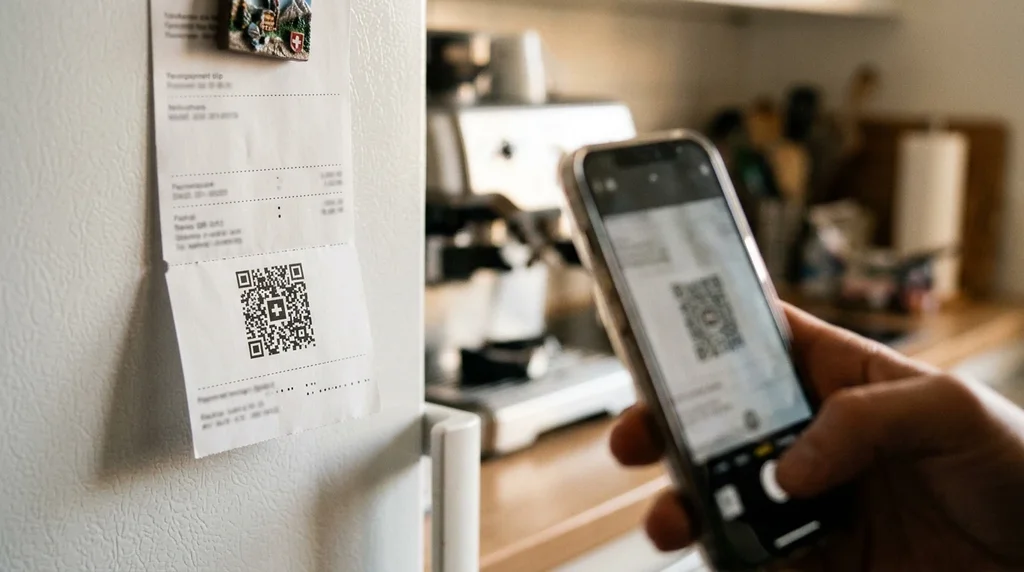
Since 4 November 2026, TWINT, the Swiss mobile payment app, has let users pay a QR-bill directly in its app. The new service is called TWINT Rechnung in German and TWINT invoice in English. The user scans the Swiss QR code on the bill and chooses the payment date themselves, before the due date. According to TWINT's press release of 4 November 2026, the bill issuer does not have to change its invoicing.
How do you pay a QR-bill with TWINT?
Payment takes four steps, according to TWINT's press release. The user scans the Swiss QR Code printed on the bill with the TWINT app. They then check the payment details. They set the execution date, any day before the payment deadline. Finally, they confirm the payment in the app.
There are two other entry points for digital bills. An invoice button can be built into an email, a website or an app: it imports the bill into the TWINT app. Users can also upload a bill into the app themselves and then pay it.
TWINT points out one case where the service is not suitable. On its page for businesses, the company recommends not using TWINT invoice for a bill that must be paid immediately, such as a reminder. In that case, it advises paying the QR-bill the usual way. The service supports QR-bills in Swiss francs, the same page states.
"Paying bills is part of everyday life in Switzerland," says Markus Kilb, CEO of TWINT, in the press release. According to him, the service makes this payment "as simple" as the app's other uses. How the TWINT app works day to day, in shops and online, is explained in our background page.
What TWINT invoice changes compared with e-banking and eBill
A Swiss household could already pay a QR-bill without manual entry. Since its launch on 30 June 2020, the QR-bill can be paid by scanning its code in e-banking or in the mobile banking app, according to SIX's press release of 9 June 2020. SIX, the operator of the Swiss financial centre's infrastructure, developed this standard. It replaced seven different payment slips with a single document.
eBill follows a different logic: the bill is no longer scanned, it arrives directly in e-banking. According to the ebill.ch website, the service is free and is activated in the e-banking of a participating bank. eBill claims more than four million users there, or "a good half" of Swiss households. This figure was announced on 27 August 2026, along with nearly 100 million transactions a year.
| Point | TWINT invoice | QR-bill in e-banking | eBill |
|---|---|---|---|
| Where the bill is paid | In the TWINT app | In e-banking or the mobile banking app | In e-banking |
| How the bill arrives | Scan of the QR code, invoice button or upload | Scan of the QR code or manual entry | Directly in e-banking |
| Payment date | User's choice, before the due date | Not specified by SIX | Not specified on ebill.ch |
| Available since | 4 November 2026 | 30 June 2020 | Not specified on ebill.ch |
| Source | TWINT | SIX | ebill.ch |
TWINT's contribution therefore lies mainly in where the payment takes place. For a household that already pays for its shopping with TWINT, the bill moves into the same app, without going through e-banking.
The usual caution still applies. On 20 October 2026, the Federal Office for Cybersecurity (FOCS) reported a phishing variant targeting TWINT accounts, as covered in our article on TWINT scams reported in Switzerland. On its business page, TWINT does not publish a ceiling for paying a bill. Our article on the TWINT payment limit sets out what is known about the ceilings.
What it changes for the issuer of a QR-bill
For an SME that issues QR-bills, TWINT promises no change to invoicing. The service is based on the Swiss QR Code standard, according to the press release. The bill can still be sent on paper or in digital form: TWINT is added as an extra means of payment. According to the magazine Netzwoche, TWINT expects the service to mean less administrative work and lower costs for businesses.
TWINT's business page sets out the technical framework. The service supports the ISO 20022 standard for exchanging structured data, for example the camt.054 statement. It is aimed at businesses, acquirers, publishers of business management software and issuers based in Switzerland. TWINT presents it as suitable for SMEs as well as large organisations with high invoice volumes.
Access is not yet open. According to the same page, online registration for issuers is "not yet available": TWINT invites them to come back in the second quarter of 2027. Until then, interested issuers fill in a contact form. It asks, among other things, for a QR-IBAN payment account and the annual volume of bills.
Among the first issuers already using the service, TWINT lists:
- Planzer Paket;
- the Elektrizitätswerk des Kantons Schaffhausen (EKS), the electricity company of the canton of Schaffhausen;
- Energie Wasser Luzern (EWL);
- green.ch, a telecommunications provider;
- ClubDesk;
- RaiseNow.
Fees remain the open question for issuers. TWINT's business page, consulted on 4 November 2026, shows no pricing for TWINT invoice. TWINT's commissions for merchants are not published on its customer page either, as detailed in our article on TWINT fees for merchants.
A first step into invoicing
TWINT presents this service as the first in a range of invoicing solutions, without detailing what comes next. According to finews.ch, the company announced in August 2026 a digital direct debit, planned from 2027. It should make it possible to manage recurring payments directly in the app.
TWINT claims more than six million active users in Switzerland, according to finews.ch on 4 November 2026. The same outlet lists its owners: Banque Cantonale Vaudoise (BCV), PostFinance, Raiffeisen, UBS and Zürcher Kantonalbank, as well as SIX and Worldline. Other means of digital payments in Switzerland are covered in our section.
What we don't know yet
- The fee charged to the issuer for each bill paid via TWINT: TWINT's business page shows none;
- whether a QR-bill from an issuer that has not registered with TWINT can be paid in the app: the press release does not say;
- the next invoicing solutions announced by TWINT, and their timetable.
Sources
- TWINT, "TWINT launches TWINT invoice for easier digital payments", press release of 4 November 2026
- TWINT, "TWINT invoice: simpler invoicing" page for businesses, consulted on 4 November 2026
- finews.ch, "TWINT macht jetzt auch QR-Rechnungen über die App zahlbar", 4 November 2026
- Netzwoche, "Twint-User können QR-Rechnungen neu per App bezahlen", 4 November 2026
- SIX, "Introduction de la QR-facture en Suisse", press release of 9 June 2020
- eBill, "What Is eBill" page for private customers, consulted on 4 November 2026