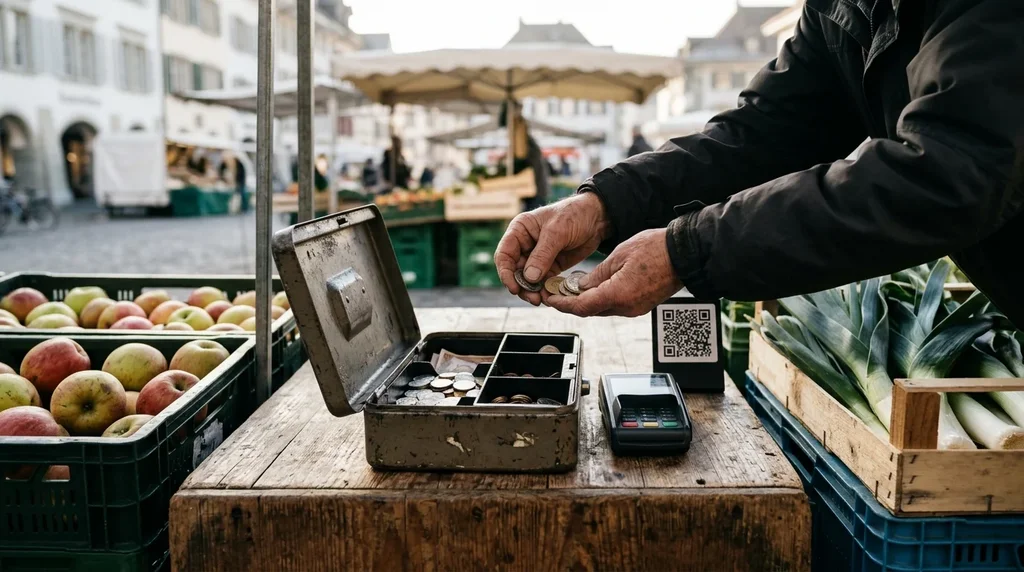
TWINT's fees for merchants do not appear in the sources consulted: the home page of TWINT, the Swiss mobile payment app, shows no pricing for businesses. Today, merchants pay a single commission that bundles several fees together. A Federal Council draft, open for consultation until 11 February 2027, would require providers to itemise three of them, according to Fintechnews Switzerland on 29 October 2026.
This page deals solely with the cost of accepting payments for a business. How the app works for customers, how to install it and how secure it is are covered in our page on how TWINT works.
How much does a TWINT payment cost a merchant?
No official TWINT pricing is available in the sources consulted. The twint.ch page for private customers, read on 28 October 2026, mentions no prices for businesses. It only states that the app is free for users to download.
The only figure available comes from another player in the market. According to the orders of magnitude published by PimPay, a French-speaking Swiss payment solution launched in July 2026, a card or mobile payment generally costs an independent business 1% to 3% of the amount. The terminal is not included in this range.
On a purchase of 100 francs, that means 1 to 3 francs in fees. PimPay puts the total burden at 1,000 francs per month on average for an independent business. These figures cover card and mobile payments as a whole: they do not say what TWINT itself charges.
One point deserves the attention of small businesses. According to PimPay, rates fall as volume rises: the smallest businesses therefore pay, proportionally, the most.
Which fees are hidden in the merchant's commission?
A TWINT or card payment goes through a multi-party system. That is the case for most cashless payments in Switzerland, according to the summary of the draft published by Fintechnews Switzerland. Visa, Mastercard and TWINT operate on this model.
Each payment carries several fees. The provider that processes payments for the business then passes them on to it as a single commission, known in English as the "merchant service charge". The merchant therefore sees a total, without knowing which share goes to whom.
The Federal Council draft names three fees to be shown separately:
- the merchant service charge, i.e. the total price billed to the business;
- the interchange fee, one of the fees included in that total;
- the licence fee paid to the operator of the payment system, for example TWINT or a card network.
On top of these per-payment fees comes, for cards, the cost of the terminal, which the 1% to 3% range does not include, according to PimPay.
How can TWINT fees be compared with card fees?
Comparing remains difficult without accessible pricing. A merchant can nonetheless ask each provider the same questions, for TWINT as for cards:
- the percentage taken on each payment, and whether it falls with volume;
- fixed costs: terminal, subscription or rental;
- the length of the contract and the termination conditions;
- how long it takes for the money collected to be paid out.
Commission-free models also exist. PimPay, for example, replaces the percentage with a subscription of 0 to 29 francs per month, with no commitment, and payment by QR code. Our article on PimPay's commission-free payments details this model and its limits.
The calculation published in that article gives an order of magnitude. At a 1% commission, the maximum subscription of 29 francs is equivalent to the fees on 2,900 francs of payments. At 3%, it is equivalent to the fees on just under 1,000 francs. The actual saving depends on the share of customers who switch payment method.
The weight of these fees grows as cash declines. According to the Swiss National Bank (SNB), cited by PimPay, cash's share fell in less than ten years from seven payments in ten to around a third. On acceptance, TWINT states on its website that 4 out of 5 shops and more than 84% of online shops in Switzerland accept it.
What would the Federal Council's draft amendment to the UCA change?
The Federal Council has opened a consultation on the transparency of card and TWINT fees. The draft amends the Federal Act against Unfair Competition (UCA). It responds to a mandate from Parliament, according to Fintechnews Switzerland.
It implements motion 25.3020, submitted by a committee of the Council of States to ease the burden on small and medium-sized enterprises (SMEs). The scope covers multi-party payment systems, including cards and TWINT.
| Point | Today | Under the draft in consultation |
|---|---|---|
| What the merchant sees | A single overall commission | Three fees shown separately |
| Itemised fees | A single overall amount | Merchant service charge, interchange fee, operator's licence fee |
| When the information is provided | Not specified by the sources | Before the contract is signed and throughout its term |
This is a draft. The text may still change after the consultation, which runs until 11 February 2027. No date of entry into force has been announced.
Why is the Federal Council holding back?
The government is presenting the draft without being convinced by it. In its view, a clear breakdown of fees would help merchants track their costs and compare offers.
The Federal Council nevertheless considers that transparent total prices are, in principle, sufficient for effective competition. It believes the new obligations would create administrative work for providers. Their benefit for competition has not been clearly demonstrated, it adds.
It has therefore kept the rules as light as possible, while responding to Parliament's request. This choice limits the scope of the text: it requires fees to be disclosed, not reduced.
What this means for a Swiss SME
For an SME, the draft would not directly reduce the bill. It would give it leverage to negotiate: by seeing the share of the interchange fee and of the licence fee, it would know what the provider adds on its own account.
The issue has been political for several months. The Swiss Retail Federation, the retail trade organisation, reported the commissions to the Competition Commission (COMCO) in July 2025, as 2clics reported. A motion on the subject was debated in the Council of States in June 2026. The sources do not specify whether it was motion 25.3020.
Until any new rules come into force, merchants can already ask their provider for a breakdown of the fees. The draft aims precisely to make this breakdown mandatory. Other payment acceptance solutions are covered in 2clics' Swiss payments and fintech section.
Key figures
- 1% to 3% of the amount: the usual cost of a card or mobile payment for an independent business, terminal not included, according to PimPay;
- 1,000 francs per month: the average burden of these fees for an independent business, according to PimPay;
- 3 fees to be itemised under the Federal Council draft: merchant service charge, interchange fee, licence fee;
- 11 February 2027: the end of the consultation on the amendment to the UCA;
- 25.3020: the number of the motion the draft implements;
- 4 out of 5 shops and more than 84% of online shops in Switzerland accept TWINT, according to its website;
- around a third: the share of cash in payments, compared with seven in ten less than ten years earlier, according to the SNB as cited by PimPay.
What we don't know yet
- the rates TWINT charges merchants, and the share of the licence fee in the commission;
- the level of interchange fees applied in Switzerland;
- the exact form the display of the three fees would take for merchants;
- the follow-up to the complaint lodged with COMCO;
- what happens to the draft after the consultation ends on 11 February 2027, and its possible date of entry into force.
Sources
- Fintechnews Switzerland, "Switzerland Consults on Card Fee Transparency Rules to Help Merchants", 29 October 2026
- TWINT, home page for private customers, consulted on 28 October 2026
- 2clics.com, "Commission-free payments: PimPay claims 300 businesses in French-speaking Switzerland", 28 October 2026