Setting up a limited liability company (GmbH/Sàrl) in Switzerland requires share capital of at least 20,000 francs, fully paid up, articles of association, a public deed executed before a notary and an entry in the commercial register, which brings the company into existence. The Swiss Code of Obligations governs this legal form in articles 772 to 827. On top of that, according to the Confederation's SME portal, come advisory, notary and registration fees.
The limited liability company, or GmbH, is one of the most widespread legal forms for starting a business in Switzerland. The Confederation's SME portal counts around 130,000 GmbHs, based on the structural business statistics (STATENT) as of 24 August 2023. The portal describes it as a hybrid between the company limited by shares and the general partnership, suited to SMEs and family businesses.
What are the steps to found a GmbH in Switzerland?
The founding follows a fixed order, because the GmbH only exists once it is entered in the commercial register. The SME portal and the commercial register office of the canton of Valais describe the same milestones:
- Choose the business name. The name cannot copy that of another company and must indicate the legal form. It is then protected throughout Switzerland, whereas the name of a sole proprietorship is only protected at its registered office, according to the Valais office.
- Deposit the capital. The founders open a capital deposit account with a bank. The bank issues a deposit confirmation and blocks the funds until registration.
- Draw up the articles of association. They set out at least the business name, the purpose, the registered office, the share capital and the amount paid in by each partner.
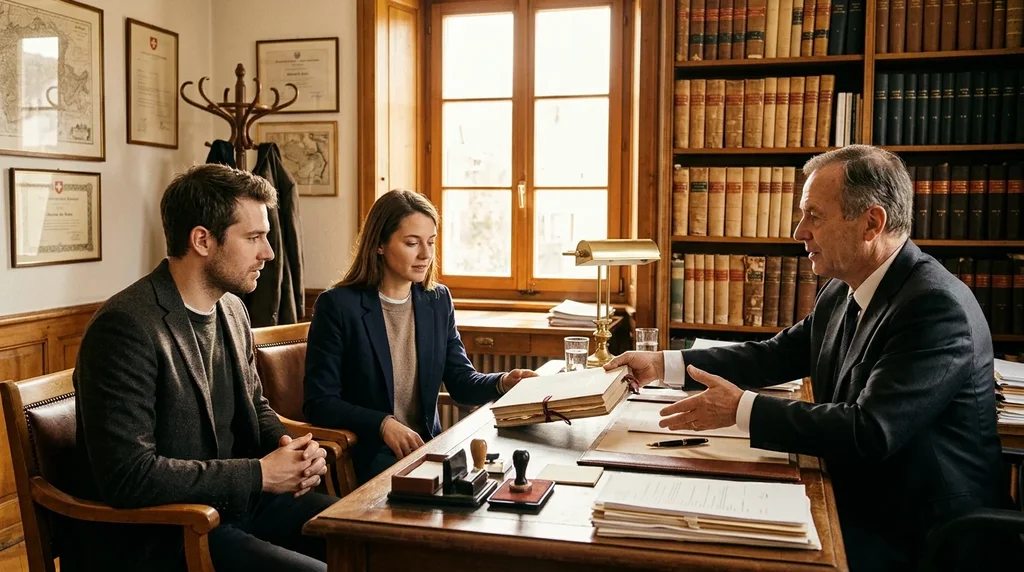
- Execute the public deed. The founding must be recorded by a notary. In it, the founders declare that they are establishing the company, adopt the articles of association and appoint the managing directors and the auditor.
- Apply for registration. As a rule, the notary sends the documents to the cantonal commercial register office. The Valais list contains thirteen of them, including the articles of association, the bank confirmation and the managing directors' declarations of acceptance.
After publication in the Swiss Official Gazette of Commerce (SOGC), the bank transfers the capital to the company's current account. According to the SME portal, this transfer takes place at the earliest on the first working day after publication, on presentation of a certified extract from the register.
The Confederation's EasyGov portal makes it possible to complete some of these procedures online. It handles entry in the commercial register, registration with the OASI compensation office, VAT registration and affiliation with accident insurance. The portal lists 269,943 registered companies.
How much capital does a GmbH need?
The share capital of a GmbH must amount to at least 20,000 francs, according to article 773 of the Swiss Code of Obligations cited by the SME portal. It must be 100% paid up at formation, in cash or through contributions in kind, such as machines or a building.
Each partner holds at least one capital contribution share. The nominal value of a share can go below one centime, provided it remains greater than zero. The capital can also be held in euros, US dollars, pounds sterling or yen, if that currency is the most important one for the business. The accounts are then kept in the same currency. Cryptocurrencies are excluded.
How much does it cost to set up a GmbH?
Excluding capital, the founding costs of a GmbH consist of three items, according to the ranges given by the SME portal:
- advice on how to set up the company: 600 to 2,000 francs;
- notary for the deed of incorporation: 700 to 2,000 francs;
- entry in the commercial register: 600 francs, as long as the capital does not exceed 200,000 francs.
Stamp duty, of 1% of the capital, only applies if the share capital exceeds 1 million francs. A GmbH founded with the legal minimum is therefore not subject to it.
Register fees are charged by the cantonal office, on the basis of the federal ordinance on commercial register fees (OEmol-RC). The canton of Vaud, for instance, publishes its own tariff. By way of comparison, the Vaud office charges 240 francs to register a sole proprietorship and 410 francs for a general partnership with two partners.
Are the partners of a GmbH liable for its debts?
No, in principle: the company alone is liable for its debts, with the company's assets. "Limited liability" concerns the partners, not the company, which remains fully liable for its obligations, the SME portal points out.
There are two exceptions. The articles of association may provide for additional contributions or ancillary obligations. These additional contributions cannot exceed twice the nominal value of the partner's share (article 795 of the Swiss Code of Obligations). They serve to cover balance sheet losses or to continue the business.
The managing directors, for their part, are personally liable for damage caused by a breach of their duties, whether intentional or through negligence. In principle, all partners manage and represent the company jointly, but they can entrust management to third parties.
The exit of a partner is regulated. The transfer of capital contribution shares requires written form (article 785). Unless the articles of association provide otherwise, the partners' meeting approves it by two-thirds of the votes represented and an absolute majority of the capital (articles 786 and 808b).
GmbH, AG or sole proprietorship: what are the differences?
The GmbH sits between the sole proprietorship, with no capital but unlimited liability, and the company limited by shares (AG/SA), which is more demanding in terms of capital. The table summarises the rules published by the SME portal and the Valais commercial register office.
| Sole proprietorship | GmbH | AG | |
|---|---|---|---|
| Minimum capital | None | 20,000 francs, 100% paid up | 100,000 francs, 20% paid up, at least 50,000 francs |
| Liability | Unlimited, on all of the owner's assets | Limited to the company's assets | Limited to the company's assets |
| Notarial deed | No | Yes | Yes |
| Entry in the register | Mandatory from 100,000 francs of turnover | Mandatory, it creates the company | Mandatory, it creates the company |
| Name protection | At the registered office | Throughout Switzerland | Throughout Switzerland |
| Founders | One natural person, the owner | One or more natural or legal persons | One or more natural or legal persons |
For the sole proprietorship, the Valais office specifies that the owner alone is liable for the debts with all of their assets. Once registered, they are subject to debt enforcement by way of bankruptcy, until six months after deregistration. Registration becomes mandatory from 100,000 francs of turnover in the previous financial year (article 931 of the Swiss Code of Obligations).
From a tax perspective, the GmbH and the AG are legal entities taxed separately. The SME portal speaks of double taxation: the company pays tax on its net profit, and the partners declare the distributed profit as income. Capital is also taxed: the company pays capital tax, and the partners declare their shares as part of their wealth.
What obligations apply after registration?
A GmbH keeps accounts and presents its financial statements in accordance with articles 957 et seq. of the Swiss Code of Obligations. It must also be able to be represented by a person domiciled in Switzerland, who has access to the register of partners and beneficial owners.
The audit depends on size. An ordinary audit is mandatory if the company exceeds two of these thresholds in two successive financial years: 20 million francs in total assets, 40 million in turnover and 250 full-time positions. Other GmbHs undergo a limited audit. According to the SME portal, they can waive it with the consent of all partners, if the workforce does not exceed ten full-time positions on an annual average (article 727a of the Swiss Code of Obligations).
Beneficial owners are another point to watch. Anyone holding 25% of the capital or more must inform the GmbH who the beneficial owner of those shares is, and the company keeps this list up to date. In addition, EasyGov announces the entry into force of the law on the Swiss transparency register on 1 October 2026. A new authority, attached to the Federal Office of Justice, keeps this register. Many companies will have to declare their beneficial owners in it within two years, and EasyGov makes it possible to do so online.
Key figures
- 20,000 francs: minimum share capital of a GmbH (article 773 of the Swiss Code of Obligations), 100% paid up.
- 100,000 francs: minimum share capital of an AG, of which at least 50,000 francs paid up.
- 600 francs: entry of a GmbH in the commercial register, according to the SME portal, for capital of up to 200,000 francs.
- 700 to 2,000 francs: notary fees for the deed of incorporation.
- Around 130,000: number of GmbHs in Switzerland (STATENT, as of 24 August 2023).
- Twice the nominal value: cap on the additional contributions a partner may owe.
- 25%: share of the capital from which the beneficial owner must be reported to the company.
Sources
- Confederation's SME portal: GmbH, liability, share capital, formation
- Confederation's SME portal: the company limited by shares
- Valais commercial register: limited liability company
- Valais commercial register: sole proprietorship
- Commercial register of the canton of Vaud: tariffs
- EasyGov, the authorities' online one-stop shop for businesses