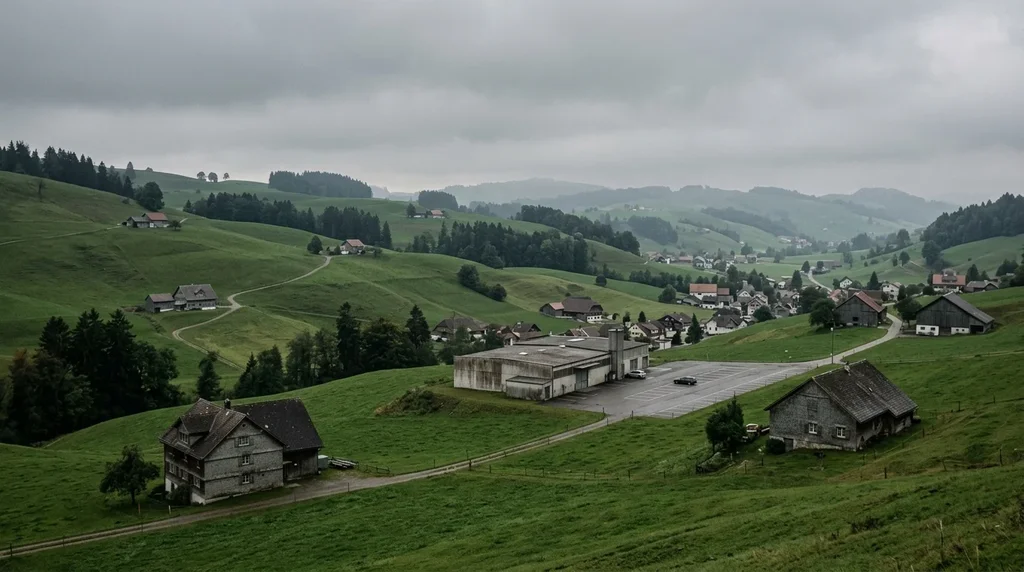
The family-owned industrial company Wagner, based in Waldstatt (AR), is closing down for good. According to a Keystone-SDA news agency report published on 13 October 2026 by SWI swissinfo.ch, the closure will result in the loss of 69 jobs. Its activities will be gradually transferred to other partners. The decision comes at the end of a consultation procedure that yielded no alternative solution.
A consultation from 23 September to 9 October, with no proposals
The consultation procedure opened on 23 September and ended on 9 October. According to the company, no proposals were received that would have made it possible to adjust the planned orderly closure. In other words, the phase meant to explore alternatives did not change the original scenario.
This outcome is part of a longer sequence. Wagner says it made intensive restructuring efforts and held talks with investors, without managing to find an economically viable solution for the company as a whole. An additional injection of funds from the owners was not enough to avert the closure either.
Production extended until the end of March 2027
An apparent paradox: the shutdown is not immediate, and activity over the coming months will even be busier than expected. Production is set to continue until the end of March 2027, on a larger scale than originally planned, due to additional orders from customers, according to the company. From mid-October, that amounts to just under six months of operation.
This information should be read with caution: additional orders during a wind-down period do not amount to a turnaround in the company's situation. The report specifies neither the identity of the partners nor the volume of the orders concerned.
Staggered departures and a voluntary social plan
The dismissals and resignations of the 69 employees will take place in stages. A voluntary social plan has been agreed for those affected, in consultation with the administrator of the procedure. Its content is not detailed in the available source: neither the precise timetable of the departures nor the amount or nature of the planned measures is known.
The company says it now intends to handle the handover of projects carefully, support staff in finding new jobs and ensure a fair and orderly process. One question remains open: the continuation of the insolvency proceedings must still be approved by the court and then receive the consent of the creditors.
The reasons put forward by the company
Wagner specialises in metal die casting and plastic injection moulding. It supplies the automotive industry as well as the machinery and plant engineering sectors. To explain its closure, it cites four factors:
- a difficult demand situation;
- significant overcapacity;
- pressure from international competition;
- the general conditions for industrial production in Switzerland.
These reasons are the company's own. The source reports no reaction from staff, union representatives or the authorities, and provides no figures on how Wagner's turnover or orders have developed in recent years. It is therefore not possible, at this stage, to weigh the relative importance of each of these factors.
The CEO and co-owner, Silvan Halter, represents the third generation at the helm of the company, which has been in business for more than 80 years. “The definitive closure of our family business is an extraordinarily painful step for us,” he said, according to the English version of the report, itself translated from German.
What this case says about Swiss industry
Taken in isolation, the Wagner case does not allow any general conclusion to be drawn about Swiss industry. It does, however, offer a concrete example of how several pressures can build up for a company of this size: dependence on exposed customer sectors such as automotive and machinery, foreign competition, overcapacity and the general conditions for production in Switzerland. In this particular case, neither restructuring, nor the search for investors, nor the owners' additional financial commitment proved sufficient.
One figure helps to put things in context, without implying any direct link with this case. In another article published on 2 October 2026, SWI swissinfo.ch reported that 11,412 companies had gone bankrupt in Switzerland in the first nine months of the year, 37% more than in the same period of 2025. This statistic covers the economy as a whole, across all sizes and sectors; it says nothing in particular about the subcontracting industry. And Wagner's situation, involved in insolvency proceedings still subject to the approval of the court and the creditors, is not the same as a bankruptcy.
For the Waldstatt region, the most tangible consequence remains local: 69 jobs set to disappear by the time production stops, and a family business more than 80 years old ceasing to exist. The available source does not specify how these jobs are distributed, nor what concrete redeployment prospects exist in the region.
What remains to be watched
Several elements will determine what happens next: the court's decision on the continuation of the insolvency proceedings, the creditors' consent, the identity of the partners who will take over the activities and the actual pace of departures until the end of March 2027. None of this information is available to date in the sources consulted.