Bacteria capable of binding grains of sand together to form a solid material: the phenomenon has long been known. Karen Antorveza Paez, who has just completed her doctorate at the Department of Architecture at ETH Zurich, uses it to manufacture free-form architectural elements by combining biomineralisation, 3D printing and robotics, according to an ETH News article published on 14 October 2026.
A “mineral glue” produced by bacteria
The starting point is an observation: cement production is among the largest sources of CO2 emissions in the construction sector. Instead of firing rock at more than 1000 °C, the researcher puts bacteria to work. “We use bacteria to produce a kind of mineral glue,” she explains.
The process is called microbially induced calcite precipitation (MICP), or more simply biocementation. Combined with sand or other solid grains, certain bacteria trigger the formation of calcium carbonate, the mineral that makes up limestone. Tiny calcite crystals form between the grains and interlock with one another: this is not a glue in the conventional sense, but a network of crystals that holds the particles together mechanically.
The method is nothing new in itself. The species used, Sporosarcina pasteurii, has been studied for many years, for example to stabilise loose soils, and has been used in research on so-called “self-healing” concrete, in which bacterial spores cause cracks to close up. The researcher’s contribution lies in how the process is controlled so as to make it a fully fledged architectural material, by bringing together two fields that have remained largely separate: biocementation and digital fabrication.
First method: print, then immerse in a bath
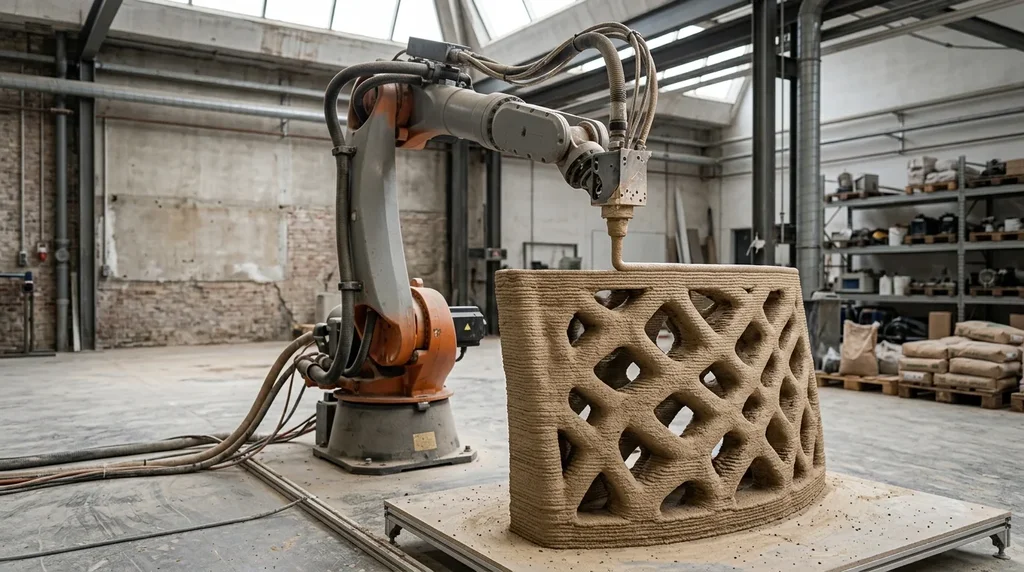
For the 3D printing of biocement, the team developed a “bio-ink” made of a gel based on water, alginate and xanthan, sand and living bacteria. The object is then immersed in a bath of urea and calcium chloride. The bacteria break down the urea using an enzyme, urease, which releases carbonate ions and, as a by-product, ammonium. The carbonate and the calcium chloride in the solution combine to form calcium carbonate wherever the bacteria are located in the printed object.
The whole process takes two to five days depending on the target strength, with the mineralisation bath renewed every day so that the bacteria do not run short of the substances they need. The object then dries; the structure is mineralised and the bacteria are no longer active. No heat source is used. “It’s a bit like baking a cake,” the researcher sums up: the bacteria play the role of the oven. A façade element in particular was produced in this way; this type of element can serve as sun shading or as a partition, for example.
Second method: a robotic arm that builds in layers
The second approach does away with the immersion bath. A robotic arm repeatedly applies the bacteria, the mineralisation substances and the sand, one after the other, onto a surface, which it builds up in height layer by layer. The process is inspired by stromatolites, the layered sedimentary formations that occur in nature when micro-organisms deposit minerals over long periods. At the 2025 Venice Architecture Biennale, it ran without interruption for six months. “We have proven that the entire biocementation process can be automated,” says Karen Antorveza Paez.
The two methods are complementary: printing is aimed more at architectural elements, spraying more at surfaces. They are not, however, at the same stage. According to the researcher, the spraying process still requires considerably more research into its mechanical properties, in particular into the arrangement of the grains and the binder inside the object.
The limits: ammonium, strength, durability
The first weakness is environmental. The ammonium produced during the reaction is very harmful to the environment, and the researcher is currently working on a study of the environmental impact of biocementation. “If we don’t integrate the removal of this chemical by-product into our designs, then using biocement in construction will unfortunately not be such a sustainable practice,” she warns.
The second concerns performance. As things stand, she acknowledges, biocement is closer to a mortar than to concrete. The concrete formula, which sets the combination and proportions of grains of each size, has been refined for more than a century; for biocementation, this work is only just beginning. It is known that the bacteria can in principle be combined with certain grain sizes, but research has not yet established how to turn this into a durable material that is as stable as possible. “The big question is no longer whether biocement works, but to what extent we can control its properties,” she concludes.
What has been established, what remains to be demonstrated
Demonstrated: the manufacture of printed biocement objects, including a façade element, and, according to the researcher, the full automation of the process through robotic spraying. Still to be confirmed: the value of biocementation as a less energy-intensive alternative to cement, considered promising but whose overall balance also depends on how the ammonium is dealt with. Outlook: load-bearing elements, still a distant prospect.
The work was published in 2026 in three journals: NPJ Materials Sustainability (3D printing of biocement), Architectural Intelligence (robotic spraying of biocement) and Biotechnology Design (design of printed porous geometries). Benjamin Dillenburger and André R. Studart are among the co-authors.
Sources
- ETH Zürich News: “When bacteria become masons”