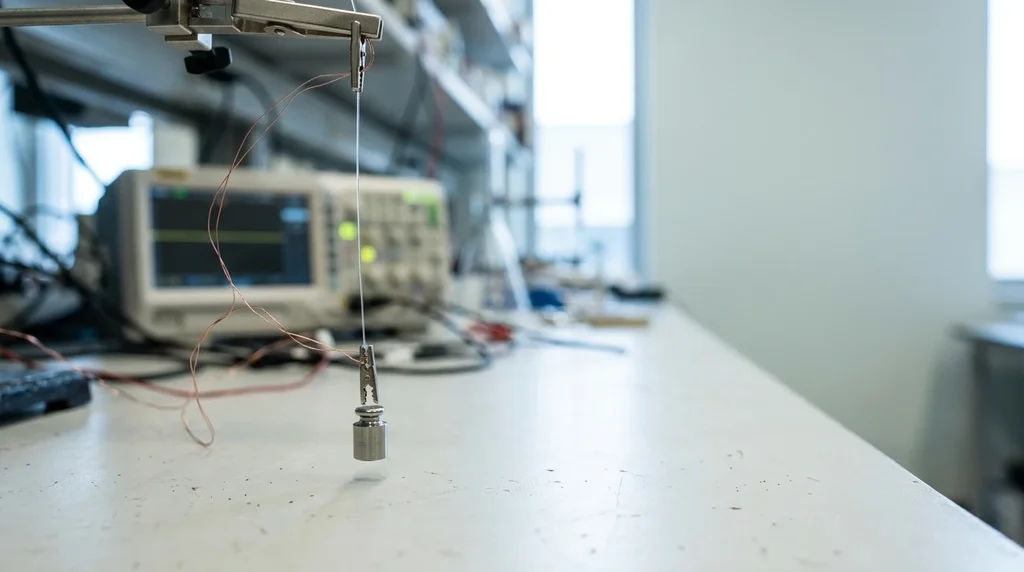
EPFL’s Soft Transducers Laboratory (LMTS) on 7 October 2026 presented FiberMotor, a flexible linear motor 1 to 3 millimetres in diameter that converts electrical energy directly into motion. The work by Sylvain Schaller and Herbert Shea is published in the journal Advanced Materials under the title “Fiber-format flexible linear electrostatic motors”. The tests described remain laboratory demonstrations: the walking-assistance robotic suits mentioned in media coverage are a research prospect, not a product.
Two nested fibres, electrodes thinner than a hair
The device consists of two concentric hollow fibres, one slipped inside the other. Around each of them, insulated copper wire electrodes, slightly thinner than a human hair according to EPFL, are tightly wound. When a voltage is applied to these electrodes, electrostatic forces repeatedly pull the fibres into alignment. The inner fibre then slides within the outer fibre, like the nesting sections of a telescope.
“FiberMotor is the first sliding fibre motor,” says Herbert Shea, head of the laboratory. According to him, it “produces enough force to actuate devices for soft robotic applications, while remaining imperceptible, flexible and bidirectional”.
This motor follows on from earlier work: in 2023, the same laboratory presented a fibre-format pump, a flexible tube capable of generating its own pressure and flow, designed to be sewn into smart textiles.
Why linear motion without gears
Lifting, pushing or pulling rely on linear rather than rotary motion. In wearable robotics, reproducing it often requires gears, transmissions and other rigid, bulky components. Existing “artificial muscles” partly get around this problem, but their range of motion remains limited by the ability of their materials to stretch, contract or bend. For FiberMotor, the range of motion is limited, according to EPFL, only by the length of the fibres.
The absence of gears also makes the motor backdrivable: it can be safely driven by an opposing force. If the wearer moves unexpectedly or in the opposite direction, the fibres slide relative to each other instead of locking up. That is a safety and comfort argument for a device worn against the body.
What the tests show
The results reported by EPFL are as follows:
- a single FiberMotor supported static loads equivalent to about 75 grams;
- four motors grouped together lifted a 46-gram chocolate bar and bent a tendon-actuated robotic finger;
- one motor was integrated into a prototype garment fitted to the shape of a knee (swissinfo.ch refers to a pair of trousers).
These figures indicate the order of magnitude: we are talking about tens of grams, and the 75-gram value refers to a static load. The sources consulted do not specify the operating voltage, speed, efficiency, power consumption or lifespan of the motor. The study published in Advanced Materials may contain them, but we have not consulted it directly. The knee prototype example shows integration into a textile; the sources do not say that it actually assists a person’s movement.
Robotic suits: a prospect, not an application
Because each motor is thin and light, the researchers envisage distributing a large number of them across a smart textile rather than concentrating the force in a single rigid motor. Swissinfo.ch, drawing on the Keystone-ATS agency, mentions robotic suits that would help people walk, for example by bending or straightening the leg. This is a hypothesis put forward by the team, in the conditional: nothing in the sources indicates that such a garment has been tested on people.
In the longer term, the team is targeting several types of wearable assistive devices: soft exoskeletons for mobility, wearable haptic systems for virtual reality and lightweight prostheses. None yet exists based on FiberMotor.
Next steps
For now, the team is mainly seeking to improve the motor’s power and durability, with even thinner electrodes, made mainly of insulators, and optimised materials. Another avenue is to integrate data on the wearer’s position and movements, so that the motor can quickly adapt its operation to the wearer’s intention.
The first author, Sylvain Schaller, has founded a start-up, Elecsyor, to commercialise the technology. The sources give neither a timeline nor an announced product. The work was funded by the Swiss National Science Foundation (SNSF) and the Novo Nordisk Foundation.
Sources
- EPFL News, Celia Luterbacher, “Semblable à un fil, un moteur libère le mouvement”, 7 October 2026 (CC BY-SA 4.0).
- SWI swissinfo.ch / Keystone-SDA, “Swiss researchers develop wire-shaped motor for robotic suits”, 7 October 2026.
- Original publication, cited by EPFL: Schaller, S. and Shea, H., “Fiber-format flexible linear electrostatic motors”, Advanced Materials (2026), doi 10.1002/adma.75156.