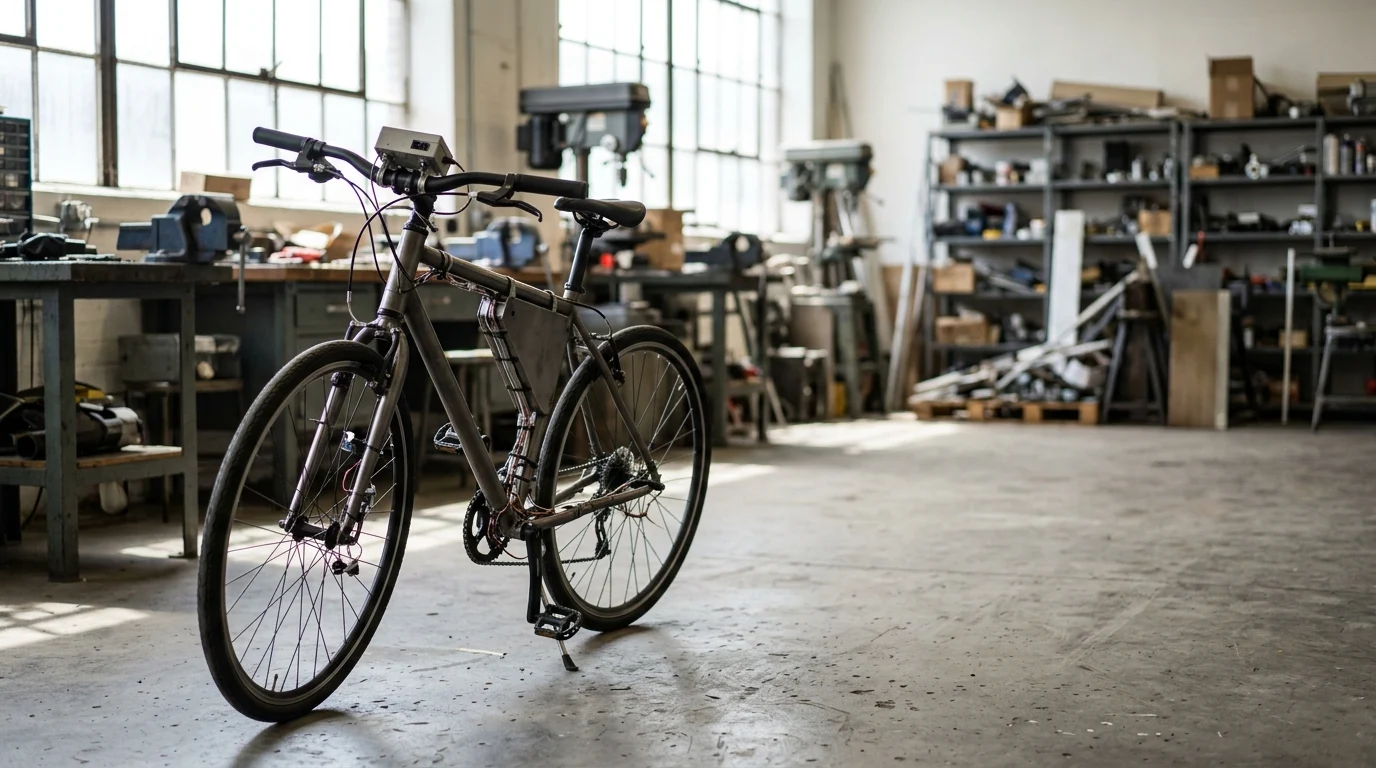
Mechanical engineering students at ETH Zurich have built an autonomous bicycle, called AutoBike, as part of a one-year bachelor’s project. ETH Zurich announced this in an ETH News article published on 6 October 2026 and written by Nicole Davidson of Corporate Communications. The idea put forward: such a bike could, in the future, help bike-sharing companies redistribute their fleets.
What the project produced
According to ETH Zurich, the project allowed the students to develop the technology “from concept to prototype”. The established outcome can therefore be summed up as follows:
- a bike capable of moving autonomously was designed and built by bachelor’s students;
- it is a prototype, resulting from a teaching project lasting one year;
- ETH files the project under the “Teaching & Learning” section, in other words under teaching, and not under a research programme or industrial development.
The problem targeted: redistributing bikes
In a bike-sharing service, bikes do not stay where they are needed: they pile up in some places and are lacking in others. Operators therefore have to redistribute them. This is the task the AutoBike could contribute to, according to ETH, which speaks of a “potential” to help companies in the sector “in the future”.
This wording should be read for what it is: a prospect, not an application. The source mentions no partnership with an operator, no trial on a real fleet and no plans for commercialisation.
How it works: what the source does not say
The ETH News text available to us is brief and does not describe the method. In particular, it does not specify:
- how the bike keeps its balance without a rider;
- which sensors it uses to perceive its surroundings and how it finds its way;
- under what conditions it was tested (closed track, campus, public road), over what distances and with what measured results;
- how many students took part and under what supervision;
- the cost of the prototype or what it would take to adapt it to mass-produced bikes.
The ETH article links to a page dedicated to the AutoBike project, which we did not consult for this article. Without this information, we cannot assess the level of autonomy achieved or the robustness of the system.
What this changes in practice
For now, nothing for bike-sharing users: no AutoBike is running in a commercial fleet, and the source does not announce any. What the project shows is that a team of bachelor’s students was able to take an autonomous bike to the prototype stage in one year. Between this prototype and use by operators, the system’s reliability in real-world conditions, its safety in traffic and its economic value would still need to be demonstrated, all questions the source does not address.
Sources
- ETH Zurich, ETH News, Nicole Davidson, “Autonomous bike: ETH students redefine bike-sharing”, 6 October 2026 (in English).