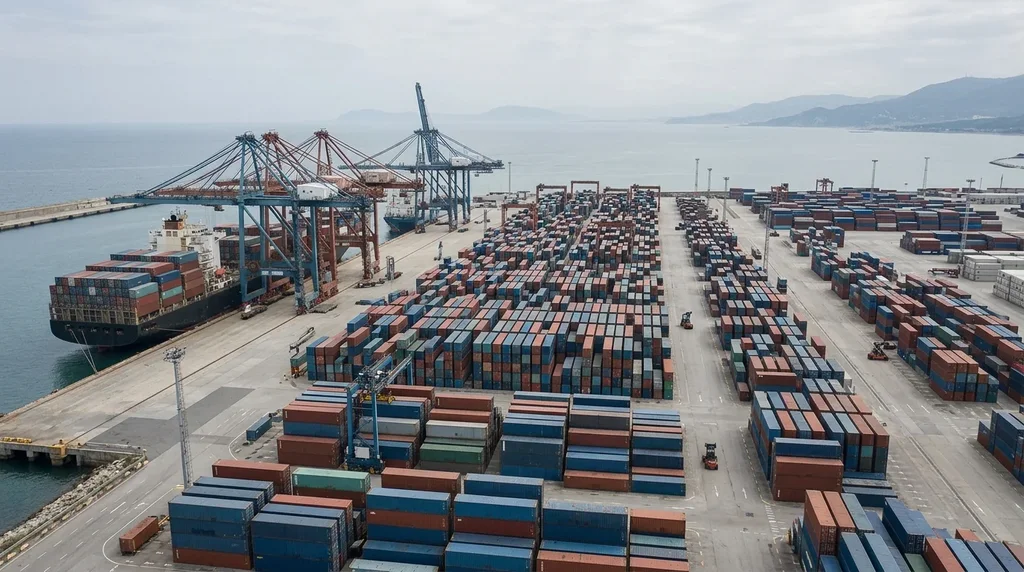
Chinese exports rose 36.3% year on year in September, according to Chinese Customs data published on Wednesday. The figure clearly exceeds the median forecast of 25.7% from a panel of analysts surveyed by Bloomberg. With imports also rising sharply, the world’s second-largest economy is heading towards a record trade surplus for 2026, at the risk of reviving criticism from Washington and Brussels.
What Chinese Customs says
The official figures cover the month of September, compared with the same month last year:
- exports: +36.3% year on year;
- imports: +31% year on year;
- monthly trade surplus: $133.5 billion (€119 billion), the highest level since January 2025;
- cumulative surplus at the end of September: $938.1 billion.
To put this last amount in context, the annual surplus reached $1,200 billion last year. The 2026 cumulative total has not yet reached that level, but it points to a new annual record. This is a projection, not an established fact: the final quarter has yet to be published.
The fact that imports are also rising (+31%) tempers the view of Chinese trade as purely outward-looking. The rise in exports is nevertheless stronger, which explains the size of the monthly surplus.
A base of comparison that inflates the US figure
By destination, exports to the United States jumped 39.6% year on year. This increase benefits from a favourable base effect: trade between the two countries had fallen sharply last year, against the backdrop of their trade war. Part of the rise therefore reflects a catch-up from a low starting point, rather than an unprecedented level of trade.
To the European Union, the increase reaches 25.3%, while Chinese imports from the Twenty-Seven remained stable. It is this imbalance that Brussels highlights: the EU considers its trade deficit with China, which exceeds one billion euros a day, “unsustainable”, and says it wants to rebalance the relationship.
The source does not detail which products are driving the increase. It is therefore not possible, at this stage, to say which sectors account for most of the growth.
Interpreting the figure
A distinction must be made between the fact published by Customs and the interpretations that accompany it. The former is a figure: 36.3%. The gap with the consensus of 25.7% indicates that analysts had underestimated the month’s momentum.
Two readings then clash on the substance. On Beijing’s side, exports serve as a driver of growth: faced with markedly less dynamic domestic demand, the government relies heavily on them to reach its annual growth target, set at “between 4.5% and 5%”. On the Western side, many officials accuse China of favouring its manufacturers at the expense of international competition, which Beijing disputes. The dispatch does not report any analysis by economists going beyond the consensus forecast.
What consequences for Switzerland?
The source does not mention Switzerland and provides no figures on Sino-Swiss trade. Several questions nonetheless arise for businesses and employment in Switzerland, though they cannot be answered from these data alone:
- What place does China hold among Switzerland’s trading partners, and can Swiss exporters benefit from the rise in Chinese imports (+31%)? The source gives no breakdown by supplier.
- If Chinese products arrive in greater numbers on European markets, what price pressure will there be on the Swiss export industry present there?
- Could tensions between Beijing, Washington and Brussels over this imbalance lead to new trade measures, and with what indirect effects for a third country such as Switzerland?
The answers will depend on detailed data by product and by country, which this release does not contain, as well as on political reactions in Washington and Brussels in the coming months.