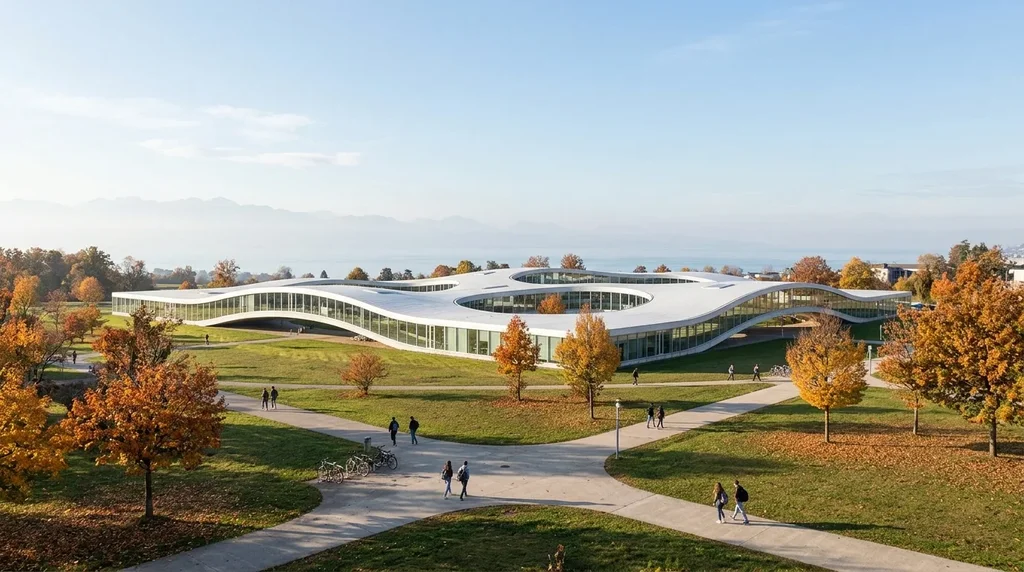
The Swiss Federal Institute of Technology in Lausanne (EPFL) will launch a Bachelor in artificial intelligence (AI) at the start of the 2027–2028 academic year, it announced on 12 November 2026. Run by its School of Computer and Communication Sciences (IC), the programme aims to train engineers who can understand and design AI systems, not just use them.
What will students learn in this EPFL AI Bachelor?
The programme rests first and foremost on mathematics and computer science. According to EPFL's announcement, the school is working with the institution's Institute of Mathematics to place these two disciplines at the heart of the curriculum.
"Our goal is to train students who can do more than simply apply existing AI technologies," explains Haitham Al Hassanieh, professor at the IC school and director of the new programme.
The programme page sets out what follows. After the foundations in mathematics, computational science and programming, courses cover algorithms, computational methods and machine learning.
Students will then be able to choose one of four specialisations:
- robotics;
- the theory of artificial intelligence;
- life sciences;
- computer systems.
For Katerina Argyraki, associate dean for education at the IC school, studying AI applied to robots "must mean learning mechanics and control systems."
The curriculum will also include a compulsory course on AI ethics and policy. It will address fairness, accountability and the social consequences of these technologies, according to EPFL.
How does it differ from the Bachelor in computer science?
The two Bachelors share the same first year, the propaedeutic year. The programmes diverge from the second year onwards. According to the programme page, students can switch freely from one to the other at the end of this first year.
Those aiming for the theoretical foundations can follow a joint enhanced programme, "Computer Science with Math Honors". It also makes it possible to join the Bachelor in mathematics in the second year.
Data science does not appear as a Bachelor track on this page. It is listed among the pathways at Master's level, alongside the Master in Data Science, the Master in Neuro-X and the Master in computer science.
What are the requirements and in which language?
Language is the first practical criterion. In the first year, programming courses will be taught in French, and mathematics and physics courses in French or English. All courses in the second and third years will be in English, EPFL specifies.
Neither the announcement nor the programme page mentions any admission requirement specific to this Bachelor, nor a number of places. Applicants to EPFL's Bachelor programmes can also apply for an excellence scholarship. According to the school's page, applicants must in particular hold Swiss nationality or a C permit, or have obtained their upper secondary diploma in Switzerland while living there.
How does it compare with what is already on offer in Switzerland?
EPFL is not the first Swiss higher education institution in this field. Lucerne University of Applied Sciences and Arts (HSLU) presents its Bachelor in Artificial Intelligence & Machine Learning as "the first of its kind in Switzerland." The two programmes, however, do not target the same audience.
| EPFL, Bachelor in artificial intelligence | HSLU, Bachelor AI & Machine Learning | |
|---|---|---|
| Type of institution | Federal institute of technology | University of applied sciences |
| Location | Lausanne | Zug-Rotkreuz campus |
| Language | French and English in the 1st year, English thereafter | German (C1 certificate required), some modules in English |
| Access as described | No specific requirement announced | Federal vocational baccalaureate with recognised training, or academic baccalaureate plus around one year of internship |
| Pace | Three years, common core with computer science in the 1st year | Three years full-time or four years part-time |
| Next intake | 2027–2028 academic year | 20 September 2027 (registration until 15 August 2027) |
HSLU champions practice-oriented training, producing graduates able to run projects "without getting lost in theory." EPFL, by contrast, is betting on the mathematical and scientific foundations of AI.
What does this change for students in French-speaking Switzerland?
The new Bachelor offers French-speaking Switzerland a programme dedicated to AI, with a first year partly taught in French. The HSLU programme, for its part, requires a C1-level German certificate.
The switch to English from the second year remains something to prepare for. The common core, on the other hand, limits the risk of a wrong choice: students can still switch to computer science after one year.
EPFL is also planning AI minors for other programmes. It is studying the possibility of an interdisciplinary course on the use of AI, according to Nicolas Grandjean, vice president for education. Neither project has a date yet.
And for companies recruiting these profiles?
The first graduates of this Bachelor will only emerge after three years of study, and the programme page then steers them towards a Master's. The effect on the job market will therefore be gradual.
The curriculum includes an internship, which can be done abroad. The programme page lists Google, IBM Research Lab, NEC Labs, INRIA, CSEM and Armasuisse as partners.
For Swiss SMEs and start-ups, competition for this talent is already fierce. According to the NZZ, as reported by ICTjournal on 26 October 2026, a large share of AI specialists in Switzerland join American tech giants. Training more students does not guarantee that they stay in the local economy.
The new programme adds to an already dense landscape, described in our feature on Swiss AI research and its institutions. Together with ETH Zurich and the Swiss National Supercomputing Centre (CSCS), EPFL notably released the Swiss language model Apertus.
What we don't know yet
- The detailed study plan for the second and third years: the programme page specifies that the simplified plans may still be adjusted and that only the official regulations are binding.
- The number of students expected in the first intake: EPFL does not publish it.