On October 23, 2026, EPFL unveiled LogSync, an implantable neural chip that tracks communication between brain regions in real time. This neurotechnology work, published in an IEEE journal, aims at brain stimulation tailored to psychiatric disorders. It has only been tested on existing human recordings and on one rat.
The work comes from the team of Mahsa Shoaran, who heads EPFL's Integrated Neurotechnologies Laboratory (INL). It appears in the IEEE Journal of Solid-State Circuits, a journal of the Institute of Electrical and Electronics Engineers (IEEE), in early access since September 9, 2026. No clinical application has been announced.
What the LogSync neural chip does
LogSync is a system-on-chip: a single component combines recording, computation and control. It captures brain activity across 32 channels.
The chip extracts biomarkers from it, meaning measurements that describe a brain state. They relate to the strength of brain waves, known as oscillations. They also relate to the synchrony between signals from different regions.
A machine learning algorithm then analyses these network measurements. It distinguishes cognitive and emotional states. When it recognises a specific state, it emits a signal that triggers stimulation.
According to the scientific paper, this classifier adapts during use, without backpropagation, the usual training method for neural networks. A programmable controller then coordinates an external stimulator.
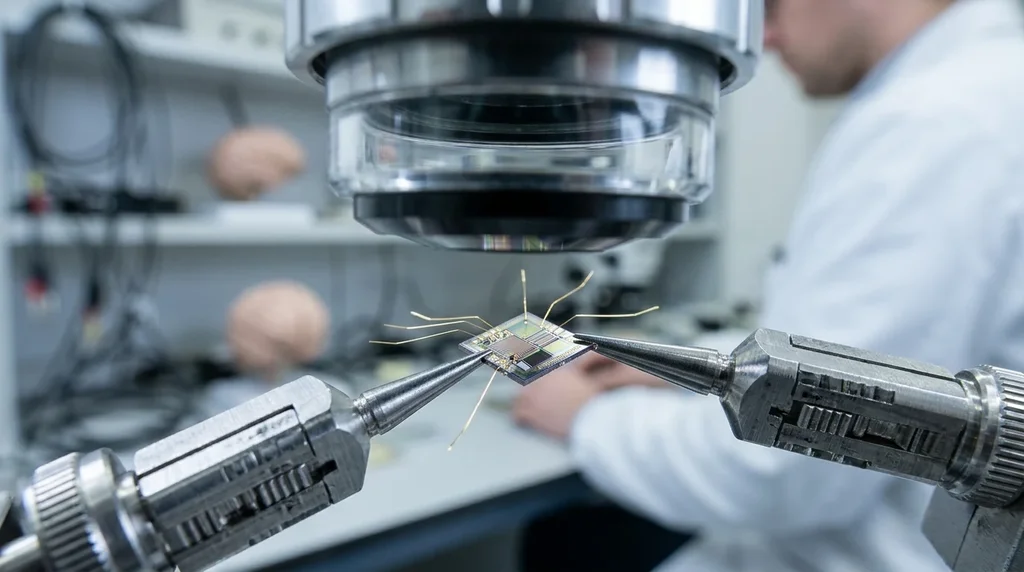
Another distinctive feature: LogSync computes in logarithms. This choice simplifies the complex operations involved in analysing brain networks and extracting biomarkers. EPFL's photos show chips of about 4 x 2 mm. The paper reports an area of 5.46 mm², in a 65-nanometre process.
Why track several brain regions
The chip addresses a limitation of deep brain stimulation (DBS). This technique sends electrical pulses to specific areas of the brain through an implant.
DBS is already widely used against movement disorders such as Parkinson's disease. Researchers are also exploring its use against major depression, post-traumatic stress disorder and obsessive-compulsive disorder.
Most systems, however, operate "open loop": stimulation follows settings fixed in advance. Even adaptive systems, known as closed-loop systems, often read a single brain region.
Yet for psychiatric disorders, the useful information may be spread across several interacting regions. "Our work builds on a growing body of research suggesting that psychiatric disorders arise more from disruptions in communication between brain regions than from the dysfunction of a single region," explains Mahsa Shoaran. This is a research hypothesis, not an established fact.
What was tested in humans and in animals
The chip has not been implanted in a human being. The researchers evaluated it on human brain recordings from earlier psychiatric experiments.
According to the paper, two datasets come from intracranial electroencephalography, measured by electrodes placed in the brain. The first tracks engagement during a mental interference task. The second tracks an emotional conflict resolution task. A public surface electroencephalography (EEG) database completes the evaluation on emotion.
Sensitivity measures the share of target states that the algorithm detects. Specificity measures the share of other moments that it correctly rules out. The results remain far from perfect:
| Dataset | Sensitivity | Specificity |
|---|---|---|
| Interference task (intracranial recordings) | 80.9% | 74.2% |
| Emotional conflicts (intracranial recordings) | 74.8% | 73.1% |
| Public EEG, emotional arousal level | 70.5% | 69.8% |
| Public EEG, valence (positive or negative emotion) | 72.5% | 66.3% |
Trials then took place in rats, at the University of Minnesota. There, the implant tracked ongoing oscillations and generated stimulation signals at predefined phases of brain activity.
The paper specifies that this in vivo validation involved one Long-Evans rat. It aimed to verify the acquisition electronics and the stimulation controller. The sources report no measurement of any therapeutic effect.
An energy-efficient chip
The main technical challenge lay in the very limited energy available in an implant. "Our entire system is designed in an integrated way: the algorithms and the hardware are developed together, with the constraints of the implant in mind," explains Mahsa Shoaran.
According to her, the chip stays below 200 microwatts, a fraction of what many implantable neural interface systems require. The paper puts power consumption at 6.14 microwatts per channel and energy at 0.197 microjoule per classification.
Established result, hypothesis or outlook
| Claim | Status |
|---|---|
| Classifying cognitive and emotional states from existing human recordings | Established, outside the body, on prerecorded data |
| Tracking oscillations and triggering stimulation at a precise phase | Established in one rat |
| Power consumption below 200 microwatts | Established by the team's measurements |
| Psychiatric disorders linked to disrupted communication between regions | Research hypothesis |
| Adaptive DBS against movement disorders, non-invasive stimulation, focused ultrasound interfaces | Outlook mentioned by EPFL |
| Implantation in a patient | Not announced |
A project run from Geneva, funded on both sides of the Atlantic
The INL team works on EPFL's Geneva campus. Mahsa Shoaran is affiliated with the School of Engineering and the Neuro-X Institute.
LogSync is part of a 6.6 million franc grant from the US National Institute of Mental Health (NIMH). It targets implants capable of measuring and controlling the brain's oscillatory networks, especially for mood and anxiety disorders.
The work also benefits from a European Research Council (ERC) Starting Grant, funded by the State Secretariat for Education, Research and Innovation (SERI).
The chip extends earlier work by the laboratory. A 32-channel, 196-microwatt version was presented in 2025 in Kyoto, at the Symposium on VLSI Technology and Circuits, devoted to very-large-scale integrated circuits (VLSI). The laboratory has also worked on brain-to-text decoding and closed-loop neuromodulation.
In parallel, the team presented RECTOR at the International Conference on Machine Learning (ICML) 2026. This model learns directly from recordings, without predefined biomarkers. According to its authors, it achieves state-of-the-art performance in EEG-based emotion recognition and is robust to missing channels.
Finally, EPFL cites Infera Neuro, a spin-off co-founded by Mahsa Shoaran, among the paths to the clinic. On 2clics, other projects from the school have been featured, such as FiberMotor for soft robotics or the FIT grants at EPFL from the Foundation for Innovation and Technology.
What we don't know yet
- No trial of the implanted chip in humans has been announced, nor any clinical timeline.
- The sources do not specify whether Infera Neuro will itself commercialise LogSync.
- The animal validation involves a single rat and technical functions, not a treatment.
- The sources say nothing about the long-term durability of the implant.