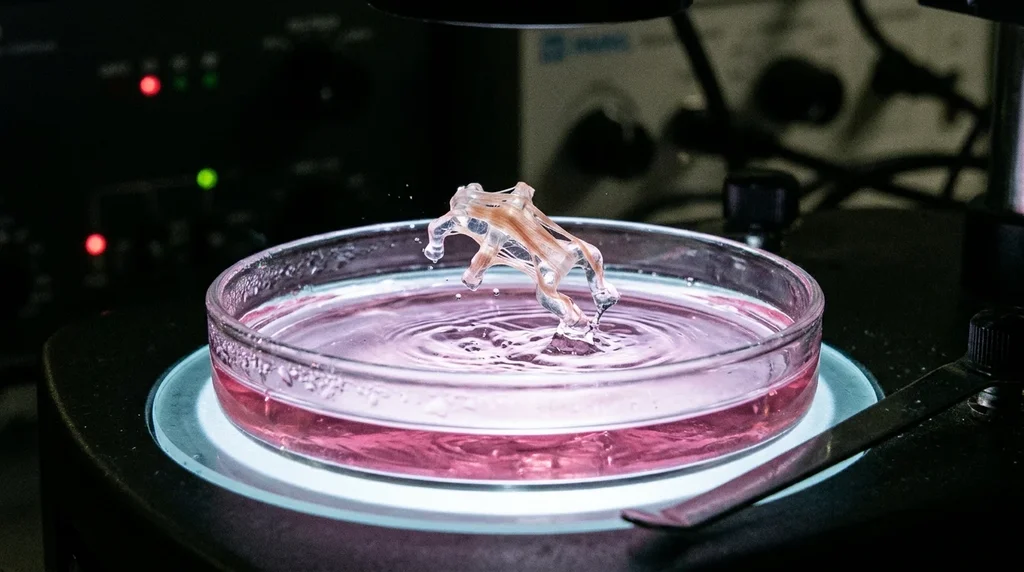
Researchers at ETH Zurich have developed living-muscle actuators powerful enough to make small robots jump, swim, walk and grip. Published on 11 September 2026 in the journal Nature Communications and presented by ETH Zurich on 22 October 2026, this advance in Swiss robotics rests on a simple idea: designing the muscle and its support together, on a computer.
A muscle and its support designed as one unit
The starting point is a well-known problem of the biohybrid robot, a machine whose motor is living muscle tissue grown in the lab. This tissue contracts, but often so weakly that the movement is barely visible. “With previous systems, you sometimes had to look through a microscope to see the bending,” explains Aiste Balciunaite, a doctoral student at Professor Robert Katzschmann's Soft Robotics Lab.
The team's bioactuators combine two elements. On one side, skeletal muscle tissue grown from mouse muscle cells. On the other, a soft hydrogel scaffold, a water-rich material that bends and stretches like living tissue.
The novelty lies in the method: both parts are conceived as a single system from the outset. A computer simulation first determined where to place the muscle, in what quantity, and what properties to give the hydrogel. An evolutionary algorithm then searched for the shapes that produce the greatest movement of the whole.
According to the scientific paper, each simulation took less than 5 seconds, which made it possible to run a large number of them in succession. The algorithm converged on a two-layer structure: a layer of muscle bonded to a layer of hydrogel, which bends when the muscle contracts. The calculations put the optimum where the muscle makes up 40 to 50% of the total thickness.
The move to the lab followed. The scaffolds were 3D-printed with light, using a technique called xolography, in about one minute per piece. Fine grooves, 300 micrometres wide and 500 deep, anchor the tissue and align its fibres. This continuous contact limits the force lost between the muscle and its support.
Jumping, swimming, walking and gripping
The result is bioactuators around 1.5 centimetres long whose bending is visible to the naked eye. The researchers report a range of motion up to eleven times greater than that of earlier systems, for a comparable amount of muscle.
- Jumping: in a single contraction, the actuator rises about 5 millimetres, a third of its length.
- Walking: a walking version covers 6.2 millimetres per second. Relative to its size, that is faster than any walking biohybrid robot described so far, according to ETH Zurich.
- Swimming and gripping: other set-ups swim or grip small objects.
- Assembly: the paper also describes systems made up of several muscle units.
The jump is the test that made the biggest impression on Aiste Balciunaite. This movement requires a particularly strong change of shape. For her, it shows the importance of the interaction between the living muscle and the soft scaffold.
Key figures from the study
| Figure | What it measures |
|---|---|
| 1.5 cm | Length of a bioactuator |
| Up to 11 times | Gain in range of motion over earlier systems, for comparable muscle |
| 5 mm | Height of a jump, a third of the robot's length |
| 6.2 mm/s | Speed of the walking version |
| About 1 minute | Printing of a scaffold by xolography |
| 2 weeks | Muscle growth and differentiation protocol |
| 85% | Share of functional actuators achieved after fine-tuning |
Why use living muscle?
The authors put forward several advantages, which are still a promise. In their paper, they point out that bioactuators in principle offer a capacity for adaptation and self-repair that is hard to achieve with conventional motors.
For Robert Katzschmann, the study above all shows that a muscle does more than produce force. It can change shape and thereby influence how a body moves. The shape of the muscle then becomes a parameter the engineer can design, rather than a constraint to work around.
The work brought together cell biology, materials science, robotics and computer-aided design. In the longer term, Robert Katzschmann envisions robots that would make greater use of the properties of living matter, instead of relying solely on motors and rigid parts. “We are only just beginning to build robots in a more natural way,” he sums up.
The limits: a robot that does not leave the lab
These robots remain laboratory demonstrators, and ETH Zurich says so clearly. Their muscle tissue only survives when immersed in a nutrient solution. The researchers are still far from a robot that can be used over the long term.
- Scale: larger systems would require artificial perfusion, a network of vessels that supplies oxygen and nutrients and removes waste. Robert Katzschmann sees this as one of the biggest challenges ahead.
- Variability: unlike an industrial part, two cultured actuators do not behave in exactly the same way. The team wants to better understand and control how the tissue matures.
- The nature of the tissue: the authors specify that their muscle layer is not complete physiological tissue, which would require several cell types and perfusion.
What we don't know yet
Several questions remain open on reading the sources. Neither the ETH Zurich press release nor the published paper specifies how long a bioactuator remains functional once grown. No timetable is given for the artificial vascular system deemed essential for larger versions.
No concrete application has been announced either. The established result is a design method and centimetre-scale robots that move markedly more than their predecessors. The use of living muscle outside the lab remains, for now, a research prospect.
One more avenue for Swiss robotics
This publication illustrates an often-cited Swiss strength: academic research. In our article on Swiss robotics in the face of China, innovation expert Jan Kerschgens highlights EPFL and ETH Zurich, combined with a precision industry rooted in microtechnology, watchmaking and medtech.
The Zurich work adds to other avenues followed on 2clics, from EPFL's fibre motor for soft robotics to the 3D-printed biocement explored by ETH Zurich.
Sources
- ETH Zurich, “One small leap for a muscle, one giant step for robotics”, 22 October 2026: ETH Zurich press release
- Balciunaite A., Michelis M. Y., Filippi M., Paniagua P., Yasa O., Katzschmann R. K., “Co-optimized volumetric muscle design for large dynamic deformations in versatile biohybrid robots”, Nature Communications 17, 10732, 11 September 2026: paper in Nature Communications
- Keystone-SDA via swissinfo.ch, 22 October 2026: news wire on the muscle-powered robots