The Swiss Federal Institute of Technology in Lausanne (EPFL) presented spora on 28 October 2026, an open-access atlas of tissue data designed for AI research on cancer. According to EPFL, the collection brings together 13,546 tissue images from 5477 patients. It is intended for training and comparing artificial intelligence (AI) models. This Swiss research project involves hospitals and universities in Zurich and Geneva.
The school describes it as the world's largest open-access collection of tissue images and molecular data. This is its own assessment: the press release does not compare it with any other database. The work is described in a scientific paper co-authored by Benedikt von Querfurth and Charlotte Bunne, among others, and listed at the Neural Information Processing Systems (NeurIPS) 2026 conference.
What is spora for in AI models?
A central use is evaluating models outside their original study. In addition to the data, spora provides tools to access and analyse it, develop AI models and measure their performance across several studies, according to the EPFL press release.
The team starts from a known limitation of medical AI. "A model can achieve excellent results in a given study yet run into difficulties as soon as the patients, laboratories or measurement technologies change," explains Lukas Klein, a postdoctoral researcher at EPFL and University Hospital Zurich. Sharing datasets and evaluation protocols should make it possible to study these gaps systematically.
The atlas also keeps track of its origins. Each dataset remains linked to its original study and its annotations. Differences in the proteins measured, imaging conditions or clinical information remain visible. A researcher can thus choose the data that suit their question.
Key figures of the spora atlas
- 13,546 multiplex images;
- 5477 patients;
- 14 tissue types;
- five imaging technologies, including mass cytometry;
- two years of work to build the collection.
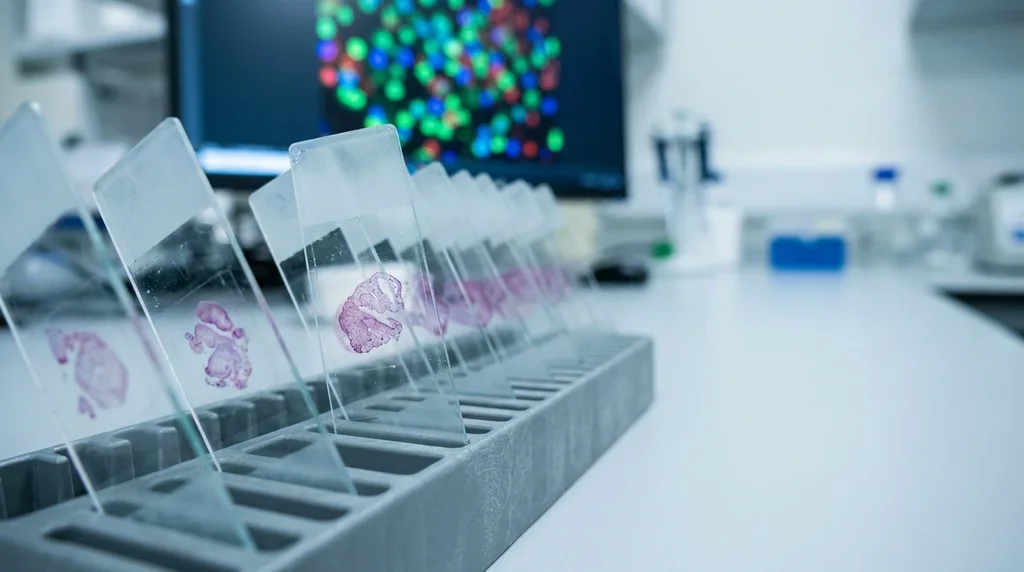
Where they exist, histopathology images are attached. These are the images used in clinical pathology. The link between molecular measurements and clinical images is therefore preserved.
Why gathering this data took two years
Spatial proteomics data are hard to combine from one laboratory to another. This technique measures dozens of proteins in a tissue without losing their position. It shows how cancer cells and neighbouring immune cells are arranged and interact.
Each laboratory, however, uses its own instruments, its own target proteins and its own file formats. For spora, the researchers sorted through thousands of images, harmonised protein annotations, cross-checked medical data and identified individual cells. "Collecting and harmonising data across different cohorts takes a considerable amount of time," sums up Benedikt von Querfurth, a doctoral student at EPFL and first author of the study. In his view, this is a major obstacle both for large-scale AI and for biology.
A Swiss research project in AI for health
The project brings together several Swiss institutions and a European partner. Charlotte Bunne's team works in EPFL's Artificial Intelligence in Molecular Medicine group, part of the School of Life Sciences and the School of Computer and Communication Sciences. It collaborated with the European Bioinformatics Institute of the European Molecular Biology Laboratory (EMBL-EBI). Specialists from University Hospital Zurich, the University of Zurich, Geneva University Hospitals and the University of Geneva took part.
Funding comes through two national programmes. spora was developed as part of the National AI Initiative for Precision Oncology (NAIPO), an initiative dedicated to AI in precision oncology. The AI models that accompany it were trained using computing resources from the Swiss AI Initiative, according to EPFL.
The latter is a joint project of the two Swiss Federal Institutes of Technology. As 2clics reported in its article on AI specialists in Switzerland, ETH Zurich and EPFL launched it to foster the development of AI technologies in the country. According to the Neue Zürcher Zeitung (NZZ), as reported by ICTjournal on 26 October 2026, it also supports Apertus, an open AI model. The same NZZ article credits Switzerland with the world's highest concentration of highly qualified AI specialists.
Opening up data ties into a broader debate. In our feature on Swiss robotics in the face of China, Jan Kerschgens, co-director of the Swiss Center for Digital Sovereignty, considered it worthwhile to continue efforts in open AI models. The feature also noted that scientific excellence does not guarantee industrial success.
Spora and LogSync, two recent EPFL projects
In October 2026, EPFL presented another project combining machine learning and health: the LogSync neural chip. Both projects are at the research stage.
| spora | LogSync | |
|---|---|---|
| Presented by EPFL | 28 October 2026 | 23 October 2026 |
| Nature | Tissue data atlas and tools to train and evaluate AI models | Implantable chip with a machine learning algorithm |
| Field | Cancer research, primarily | Psychiatric disorders |
| Publication | NeurIPS 2026 | IEEE Journal of Solid-State Circuits |
| Data | 13,546 images from 5477 patients | Existing human recordings, tests on a rat |
| Clinical application | Not announced, long-term goal | Not announced |
Established result, hypothesis or outlook
| Claim | Status |
|---|---|
| An atlas of 13,546 images, 14 tissue types and five imaging technologies | Established, according to EPFL |
| Tools to develop and evaluate AI models across several studies | Established, delivered with the atlas according to EPFL |
| The world's largest open-access collection of its kind | EPFL's claim |
| Models that perform well in one study often fail elsewhere | The team's observation, which motivates the project |
| Extension to other tissues, diseases and imaging technologies | The team's wish |
| Better predicting disease progression and choosing each patient's treatment | Outlook, according to Charlotte Bunne |
Charlotte Bunne sets out the long-term goal: "to turn the knowledge gained from thousands of tissue samples into information that can help each individual patient". She plans to work on this with clinicians. The press release announces neither a diagnostic tool nor a clinical trial.
What we do not yet know
- Access conditions: the EPFL press release specifies neither the data licence nor the steps to obtain it.
- The performance of AI models trained on spora: it is not quantified in the press release.
- The origin of the samples: the share of patients treated in Switzerland is not stated.
- Data protection: the press release does not detail how the medical information was anonymised.
- The timeline: no date is given for the extension to other diseases or for use with patients.
Sources
- EPFL News, Tanya Petersen, "A new tissue atlas will help AI understand cancer", 28 October 2026
- B. von Querfurth, C. Bunne et al., "spora: A Unified Multimodal Dataset and Platform for Spatial Proteomics", NeurIPS 2026