The canton of Zug will fund up to CHF 55 million over 25 years for two new chairs at the Swiss Federal Institute of Technology in Zurich (ETH Zurich) devoted to artificial intelligence (AI) applied to cybersecurity, under agreements signed in Zurich on 11 November 2026. The researchers will work partly in Zug, alongside the National Test Institute for Cybersecurity (NTC). For Swiss AI research, this is a cantonal commitment of unusual length: the canton wants to detect vulnerabilities before attackers do and to protect AI systems themselves.
Two chairs, two research questions
The two positions do not cover the same ground. According to the ETH Zurich announcement of 11 November 2026, the "AI for Cybersecurity" chair, attached to the Department of Computer Science, is to develop AI methods that automatically analyse code and spot security problems in it. The school points out that a single vulnerability is often enough to compromise a system, and that searching for it in millions of lines of code takes time.
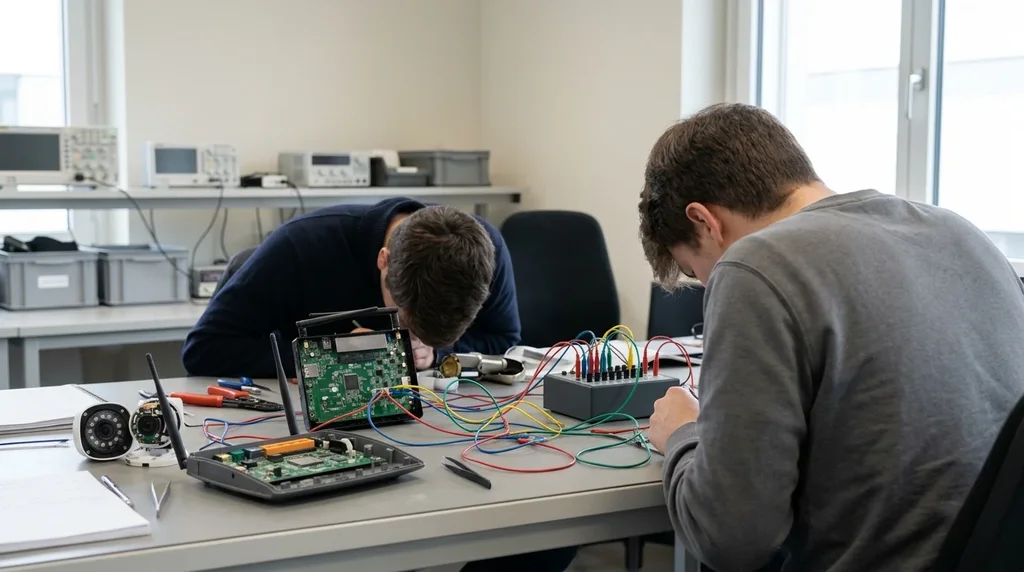
The second chair, "Secure Machine Learning Systems", belongs to the Department of Information Technology and Electrical Engineering. It studies the reverse: how to protect an AI system against attacks. ETH specifies that the protection targets the model, but also the hardware and software that run it. Its example is a smart surveillance camera, where all three layers must hold up.
At this stage, nothing has been produced yet. The announcement describes a 25-year research programme, not tools that are available. "We want to identify security vulnerabilities before attackers can exploit them," says Joël Mesot, President of ETH Zurich, who adds that he wants to prevent "AI systems from becoming gateways for attacks".
Why a canton is paying for federal chairs
The two chairs are part of the Cybersicherheitsinitiative Zug (CSI), the cybersecurity initiative that the Zug cantonal government presented on 14 August 2025. Its press release plans spending of around CHF 9 million per year from 2026 to 2030 to implement it, and already names ETH Zurich, the NTC, the Federal Office for Cybersecurity (FOCS) and the Lucerne University of Applied Sciences and Arts (HSLU) as partners. The government wanted to wrap up the political decision by mid-2026.
The money comes from a specific source. According to ETH Zurich, the initiative is to be funded from the additional revenue of the OECD minimum tax, which applies to large international groups. The same mechanism serves another project with ETH: on 27 August 2026, the Zug cantonal parliament examined a credit of CHF 55 million for a joint learning and research centre with the school and Zug-based companies, on the Tech Cluster Zug site, according to Keystone-ATS as reported by swissinfo.ch. That second dossier was still awaiting a final vote, and the approval of the City of Zug and its voters.
The canton's calculation is as much economic as it is security-driven. "With these partnerships, we are strengthening the canton of Zug as a centre of knowledge and technology, fostering growth and creating skilled jobs," said Heinz Tännler, Director of Finance, in the August 2025 press release. On 11 November 2026, he explains that the canton "is not investing in a single project" but is laying "the foundations for continuous research and its practical application over 25 years".
What Zug gets in return
The two chairs remain based at ETH Zurich, but the researchers will regularly carry out part of their work in Zug, according to the school. There they will collaborate with the NTC, an independent non-profit organisation that tests digital products and systems, for example those of hospitals or charging stations for electric cars. The idea is to develop new testing methods, try them out on real products with the NTC, then feed the lessons back into research.
A second agreement completes the arrangement. From April 2027, the canton will invest up to CHF 3.65 million over five years in a partnership with ETH's Zurich Information Security and Privacy Center (ZISC), which brings together research groups in cryptography, data protection and network security. The ZISC will advise the experts of the cantonal Competence Centre for Cybersecurity (KKC), which the canton is currently setting up. According to the cantonal press release of August 2025, this centre has four missions: informing the public, helping Zug SMEs strengthen their resilience, coordinating public and private partners, and promoting Zug as a business and research location.
The signing brought together, in addition to Joël Mesot, Laura Dittli, the canton's Director of Security, Heinz Tännler, Franz Grüter, Vice-President of the NTC, and Pius Baschera, Chairman of the Board of the ETH Foundation, according to ETH Zurich.
How this funding weighs against other resources
The amount is impressive for its duration more than for its annual pace. Spread over 25 years, the 55 million represents an average of CHF 2.2 million per year, by our calculation, and ETH speaks of a ceiling ("up to"). By comparison, the ETH Board allocated CHF 20 million to the Swiss AI Initiative for 2025 to 2028, or 5 million per year, as detailed in our feature on Swiss AI research. The other discoveries from the country's laboratories are followed in our Swiss research section.
| Funding | Amount | Duration | Annual average (2clics calculation) |
|---|---|---|---|
| Two ETH chairs, canton of Zug | up to CHF 55 million | 25 years | 2.2 million |
| ZISC partnership, canton of Zug | up to CHF 3.65 million | 5 years from April 2027 | 0.73 million |
| Zug cybersecurity initiative (CSI) | around CHF 9 million per year | 2026 to 2030 | 9 million |
| Swiss AI Initiative, ETH Board | CHF 20 million | 2025 to 2028 | 5 million |
Sources: ETH Zurich (11 November 2026), canton of Zug (14 August 2025), EPFL (3 October 2024) via 2clics.
Our analysis: the annual envelope remains modest on the scale of Swiss AI research. What changes is the horizon. A chair funded for 25 years can recruit and train over the long term, which a three- or four-year project grant does not allow.
What this could change for Swiss SMEs
The link with businesses runs through the cantonal centre, not through the chairs themselves. "Small businesses in particular often do not have their own cybersecurity experts. Our competence centre is meant to help them spot risks early and protect themselves better," explains Laura Dittli on 11 November 2026. To do so, the canton wants to draw on the knowledge of ETH researchers.
The need is documented. In the "SME Cybersecurity 2026" study, covered by 2clics, 81% of Swiss SMEs expect an increase in AI-related threats, but only 29% plan additional measures. About a third regularly train their staff. And Zug is not spared: the Holcim group, based in the canton, confirmed a data theft, according to ICTjournal of 4 November 2026, and the pension fund of the City of Zug announced that insured persons' data may have been stolen from a software provider.
The timelines must be kept apart, however. The ZISC partnership starts in April 2027 and is aimed first at the cantonal centre. The results of the chairs, for their part, will arrive at the pace of research. None of the sources announces a vulnerability detection tool made available to SMEs, nor a date for such an offering.
What we do not know yet
- Who will hold the two chairs and when they will be filled: ETH Zurich gives neither names nor a recruitment timetable.
- How the 55 million is split between the two chairs and the collaboration with the NTC, as well as the annual pace of payments, which ETH does not detail.
- The opening date of the cantonal Competence Centre for Cybersecurity, which the canton says is "being set up" without specifying it.
Sources
- ETH Zurich, "Canton of Zug invests in two ETH professorships and a new collaboration", 11 November 2026
- Canton of Zug, "Der Regierungsrat stellt seine Cybersicherheitsinitiative vor", press release of 14 August 2025
- swissinfo.ch (Keystone-ATS), "Canton Zug to invest CHF55 million in ETH research centre", 27 August 2026
- 2clics.com, "Raising employee cybersecurity awareness: methods for SMEs"