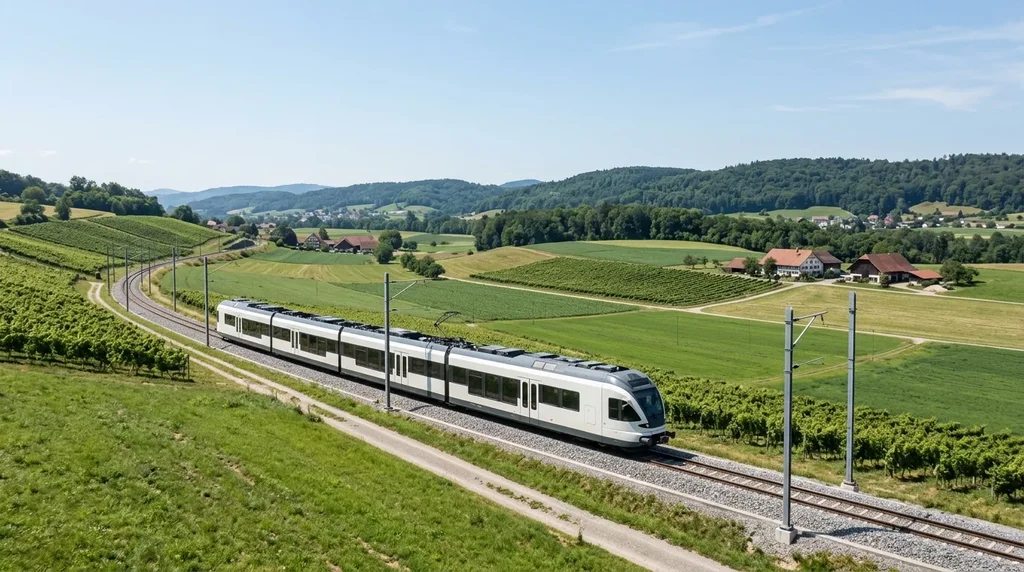
Stadler Rail has achieved what the Keystone-SDA news agency, as reported by swissinfo.ch, describes as a world first: a hydrogen train designed for narrow-gauge track. The vehicle is intended for Sardinia. It is currently being tested in Switzerland, on a test track that the Thurgau-based manufacturer built specifically for this purpose in the canton of Schaffhausen.
Narrow gauge, a well-defined regional market
According to the company's press release cited by swissinfo.ch, regional transport in southern Italy relies in part on lines with a gauge of 950 millimetres. Trains designed for this particular gauge run in Apulia, Sicily, the Naples area and Sardinia, among other places. This is the niche market Stadler Rail is targeting: networks that cannot simply take over rolling stock designed for standard gauge.
The first customer named is Sardinia's regional transport company (ARST). But the order does not stop at the island: according to the same source, Stadler Rail is building a hydrogen fleet for three Italian regions, Sardinia, Calabria and Sicily. To date, tests are planned for a total of 21 vehicles. The sources specify neither the value of these contracts nor the delivery schedule region by region.
A test track between Hemishofen and Ramsen
To test this rolling stock, Stadler Rail built a test track this spring between the stations of Hemishofen and Ramsen, in the canton of Schaffhausen. Nearly 4 kilometres long, it adds a third rail inside the existing standard-gauge track, allowing narrow-gauge vehicles to run on it.
The choice of this section is no accident. It was on this same standard-gauge line that the FLIRT H2 hydrogen train, built for California, carried out its tests. According to swissinfo.ch, the idea of extending the line stems precisely from the success of that project. Over the next three years, the Schaffhausen track is set to play a key role in commissioning the fleet destined for Italy: this is an announced programme, not yet a track record.
What the Sardinian operator expects
For ARST, the stakes are first and foremost operational. "The imminent delivery of the new hydrogen trains represents a decisive milestone," says its managing director, Carlo Poledrini, quoted in the press release. According to him, the trains will arrive in Sardinia after a substantial testing phase, which should make it possible to quickly begin the final tests on the island's network. He sees it as a concrete step towards emission-free transport and greater energy independence. These objectives remain the operator's own: the sources quantify neither the emissions avoided nor the operating costs.
What the world first says about Swiss industry
For Stadler Rail, the significance of this first lies less in the number of vehicles than in the technical demonstration: the company is showing that it can adapt hydrogen propulsion, already proven on standard gauge with the FLIRT H2, to more constrained narrow-gauge networks. And it is doing so in Switzerland, where the testing phase takes place before export.
This Swiss footprint is also reflected in the company's figures. Stadler Rail has its origins in the engineering office founded by Ernst Stadler in Zurich in 1942. The group, now based in Bussnang, in Thurgau, manufactures a wide range of rolling stock, from high-speed trains to regional trains, as well as trams and metros, some of which run in Switzerland and Ticino. It employs 18,000 people, including 6,000 in Switzerland, and generated revenue of 3.7 billion francs in 2025.
On the stock market, according to swissinfo.ch, Stadler Rail shares have risen 44% since the start of January, and 57% over the past twelve months. These observed gains say nothing about the stock's future performance, and the sources do not link them directly to the Sardinian announcement.
Sources
- SWI swissinfo.ch: "Stadler Rail builds world's first narrow-gauge hydrogen train"