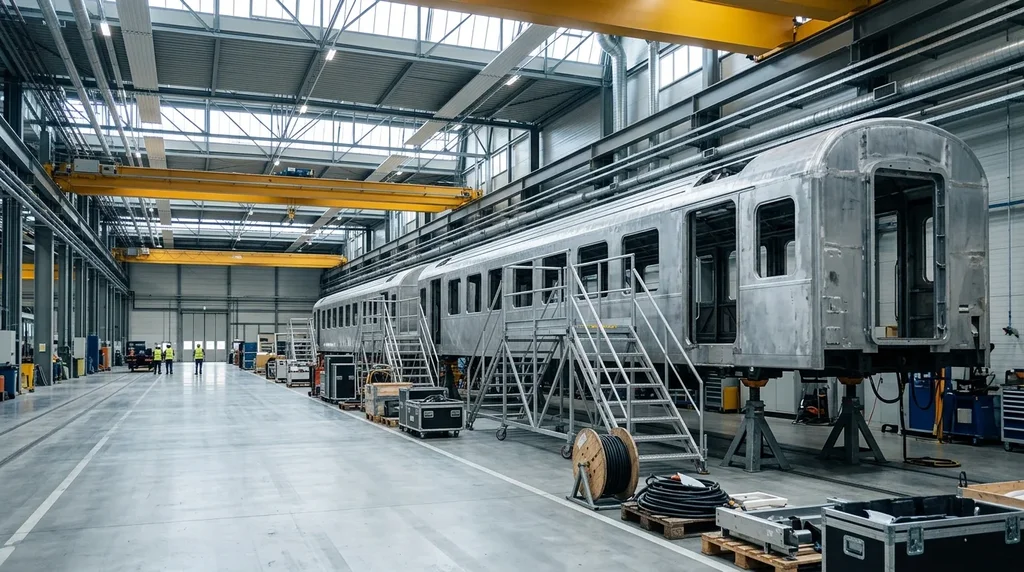
Stadler Rail has secured the second part of a major order from Saudi Arabia. According to SWI swissinfo.ch, which carries a Keystone-SDA dispatch, Saudi Arabia Railways (SAR) has ordered ten additional Intercity trains worth CHF 300 million. Stadler made the announcement on Friday, 9 October 2026.
An option exercised on the original contract
This is not a new deal as such: SAR exercised an option provided for in the contract signed two years ago, whose value is estimated at around CHF 600 million. A swissinfo.ch article published on 6 February 2024 described that first order at the time as Stadler’s first for the Gulf region, worth up to around CHF 600 million.
The source does not specify whether the CHF 300 million for this second tranche is included in the roughly CHF 600 million envelope cited for the original contract, or comes on top of it. Nor does it state what share of the amount goes to the trains themselves and what share to the extension of the maintenance contract.
In terms of vehicles, however, the scope is clear: the fleet of trains specially developed for Saudi Arabia doubles, from ten to twenty trainsets. The existing maintenance contract will be extended to the additional trains.
Trains designed for heat and sand
The Intercity trainsets are around 175 metres long and can carry some 320 passengers. They were designed for the country’s climatic and operating conditions: two independent power cars, numerous redundant systems, and protection and filtration devices intended to operate in extreme heat and in the presence of sand.
The trains will run on SAR’s east-west line, which connects the regions of Riyadh, Hofuf, Abqaiq and Dammam. According to Stadler, commercial passenger service is expected to begin in the second half of 2029. This is an announced timeline, not a certainty.
Largely Swiss production
This is arguably the most tangible aspect for the Swiss economy: the new trains will be produced largely at Stadler’s plants in Switzerland. The power car bodies will come from Stadler’s plant in Valencia, Spain. The source specifies neither which Swiss sites are involved nor the volume of work or number of jobs associated with this order.
Manufacturing of this second series will follow directly on from the first, which began in April 2026. The source does not quantify the effects of this sequencing on workshop workloads.
What the contract says about rail exports
For the Swiss rail industry, this contract shows that a manufacturer can export a product adapted to a distant market with conditions very different from those in Europe, while keeping a large share of production in Switzerland. The exercise of an option, two years after signing, also indicates that the Saudi customer chose to expand its fleet with the same supplier.
The significance of this order should nevertheless be assessed with caution: the source does not relate it to Stadler’s order book or revenue, and does not say whether further orders are expected in the region. These points are not specified.
Sources
- SWI swissinfo.ch (Keystone-SDA), “Swiss train maker Stadler secures CHF300m Saudi contract”, 9 October 2026.