Swiss startup Sonexos, based in Lausanne, announced on 21 October 2026 that it has raised 5 million francs. The money is meant to take its plasma-based noise reduction technology from prototype to industrial product. The first series production is targeted for early 2028.
What does the 5 million franc round finance?
The funding will be used to turn prototypes into qualified industrial products. It is an equity financing round, known as a "pre-Series A".
Sonexos is already running paid integration programmes with global manufacturers of household appliances and heating, ventilation and air-conditioning equipment. According to Startupticker, the most advanced programmes are aiming for series production in early 2028.
This date remains conditional. The company itself makes it subject to three steps: integration into the devices, regulatory compliance and the launch of new products by its customers.
What noise does plasmacoustics aim to reduce?
Sonexos is tackling low-frequency noise from fans, compressors and motors. This is the deep hum that travels through walls and windows, and which is the hardest to escape.
Data centre fans are one example cited by the source. On its website, the company also mentions kitchen hoods, tumble dryers and ventilation in cars and public transport.
How does this active plasma noise control work?
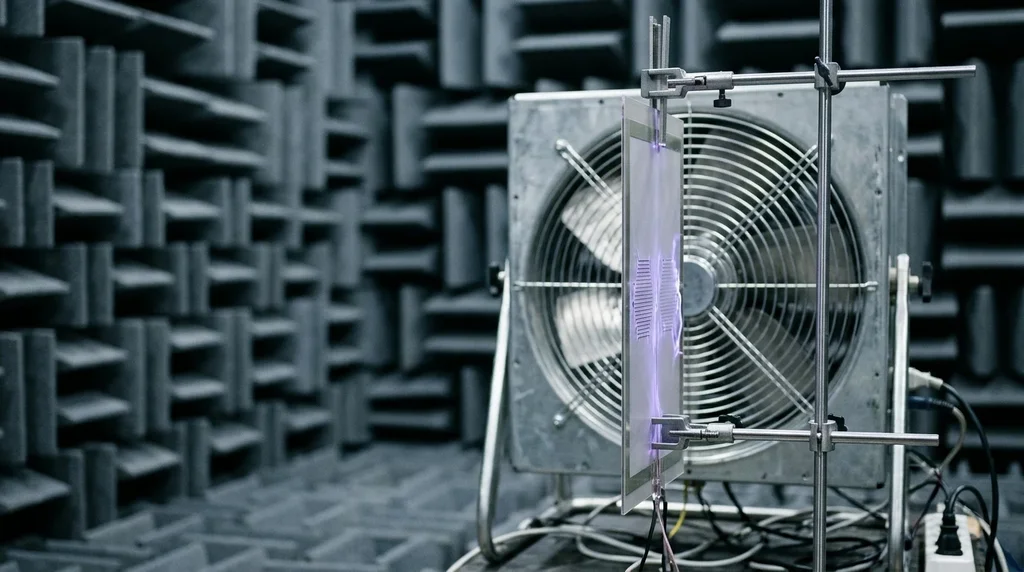
The principle relies on a software-controlled plasma layer that absorbs sound at the surface of a panel. Sonexos calls this patented device the Plasmacoustic Metalayer.
In practical terms, a controlled electrical discharge, known as a corona discharge, creates a thin layer of ionised gas. This layer acts as a "massless" membrane that reacts instantly to incoming sound.
The system continuously measures ambient noise and processes this data in real time. It then adjusts the plasma layer to change its acoustic impedance, in other words its resistance to the passage of sound, and dissipate unwanted sound energy.
The company describes three building blocks:
- Plasmadrive: the core component, which converts a cold atmospheric plasma into controllable acoustic pressure;
- Plasmacoustic Metalayer: the AI-assisted control layer that shapes the plasma field;
- Plasmapanel: the panel built into the product, designed for large-scale manufacturing.
The system is thin, light and has no moving parts. This is why Sonexos speaks of "solid-state" active noise control.
What does it offer compared with passive silencers and loudspeakers?
Plasmacoustics aims to fill a gap left by both existing families of solutions. Sonexos's sources describe them as follows:
| Approach | Strength | Limitation described by the sources |
|---|---|---|
| Passive treatments (foams, insulation, barriers) | Effective at higher frequencies | Often insufficient below 1 kilohertz, bulky, heavy, can restrict airflow |
| Active control using loudspeakers (noise-cancelling headphone type) | Very effective in a confined space | Difficult and costly to extend to complex three-dimensional sound fields |
| Sonexos plasmacoustics | Active surface absorption, thin, light, no moving parts | Still at prototype stage; series production targeted for early 2028 |
According to Mark Donaldson, founder and CEO of Sonexos, "engineers have always had to sacrifice space and weight to achieve silence". Plasmacoustics would remove this trade-off.
Where does the technology come from?
The core plasmacoustic technology is licensed from the Swiss Federal Institute of Technology in Lausanne (EPFL). The company's headquarters and its plasma research are located in Lausanne.
Sonexos also has an operations centre in Milan and a high-voltage research centre in Auckland, New Zealand. Its sales teams are in San Jose, in the United States, and in Hong Kong.
Mark Donaldson has spent three decades building companies in active noise control. Among others, he founded SoundChip, which designed noise-cancelling audio chips for earphones. SoundChip was acquired by DSP Group, now part of Synaptics.
Who are the investors?
The round is led by Valquest Partners. Robert Bosch Venture Capital GmbH (Bosch Ventures) is participating, alongside private investors and business angels from the industrial sector.
Fadi Noureddine, founder and managing partner of Valquest Partners, is joining the Sonexos board of directors. He highlights differentiated science, strong intellectual property and progress with major manufacturers.
Ingo Ramesohl, managing director of Bosch Ventures, says he was convinced above all by "a credible path to industrial scale".
How does Sonexos plan to produce in series?
The startup will not manufacture all the components itself. It relies on industrial partners:
- STMicroelectronics, which selected it for its ST for Startups programme, is helping it develop low-power, low-cost electronics;
- the Vandewiele group, through its subsidiary Roj, is opening up a series manufacturing route for European manufacturers' programmes;
- SIT, a company listed on Euronext Milan, has been working with it since July 2026 on fan platforms.
Sonexos will offer two models. The first supplies turnkey panels with integration support. The second allows large manufacturers to integrate its components, such as the Plasmadrive, and its software into their own production lines.
Why are data centres a target?
The growth of artificial intelligence infrastructure is increasing cooling needs. This cooling often relies on large fans that run continuously.
Their low-pitched noise is hard to mask for nearby residents. Where noise limits restrict night-time operation, quieter cooling could help operators without restricting airflow.
To this end, Sonexos is developing the Plasmapanel Radial Active Silencer, mounted around a fan outlet. SIT is the first member of its certified partner programme. The two companies plan to present a first working demonstrator at the Consumer Electronics Show (CES) 2027.
What has been demonstrated, and what remains to be done?
The established result concerns prototypes. They reduced low-frequency noise by up to 20 decibels (dB) in ventilation systems and by up to 16 dB in household appliances.
These figures were obtained under test conditions specific to each application. They therefore do not apply to all devices or all environments.
According to its website, the first generation of the Plasmapanel is being evaluated in several sectors, after four years of research and development. The second generation is moving towards high-volume manufacturing. These are the company's claims.
Industrial qualification is the step still to be taken. It involves integration at manufacturers, regulatory compliance and industrialisation: precisely what the funding is meant to finance.
What we don't know yet
- The original scientific publication of the EPFL work is not cited in the sources consulted, nor is the laboratory involved.
- The sources give neither the power consumption of the panels in operation nor their price.
- The names of the appliance and ventilation manufacturers involved in the paid programmes have not been published.
- The results have not been compared with independent measurements.
Sources
- Startupticker: Sonexos funding round (in English, 21 October 2026)
- Sonexos official website (in English)
- Sonexos plasmacoustic technology (in English)