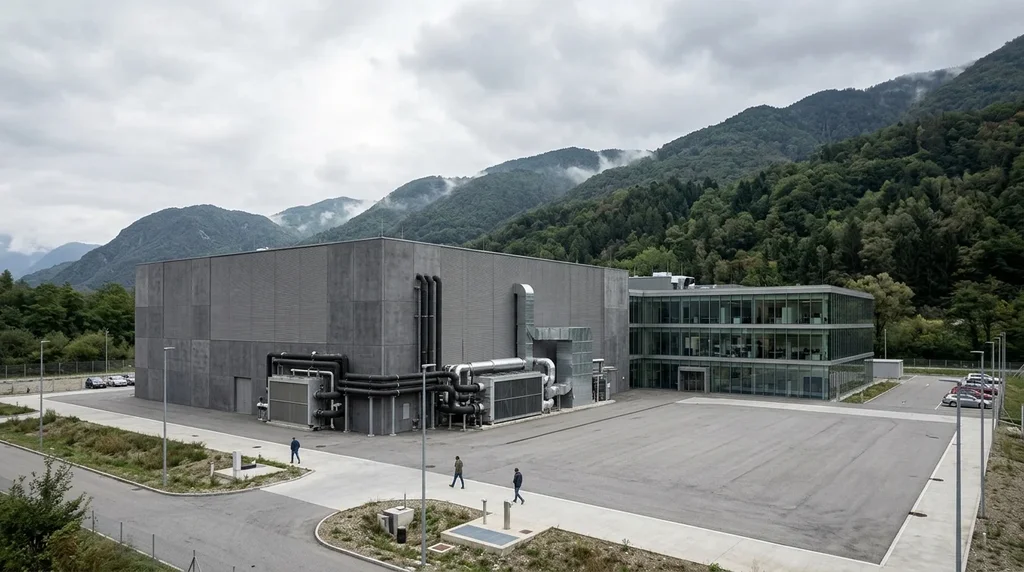
Alps, the supercomputer of the Swiss National Supercomputing Centre (CSCS) in Lugano, holds on to 10th place in the Top500, the global ranking of supercomputers published on 16 November 2026 at the SC26 conference in Chicago. It keeps its 434.9 petaflops, or 434.9 quadrillion floating-point operations per second. According to Inside IT, it stays well ahead of Finland's Lumi, measured at 379.7 petaflops.
Top500 of November 2026: an unchanged top ten
The 68th edition of the Top500 repeats the top of the June 2026 list exactly. The Top500 press release, relayed by HPCwire on 16 November 2026, puts it bluntly: the ten leading systems have not moved.
LineShine, installed at the National Supercomputing Center in Shenzhen, China, remains first with 2.198 exaflops. It is followed by three American machines, El Capitan (1.809 exaflops), Frontier (1.353) and Aurora (1.012), then Germany's JUPITER Booster (1.000). According to the press release, these five systems alone make up the exascale class.
Alps has not changed either. According to Inside IT, its performance and that of Lumi are identical to the June 2026 measurement. The Top500 entry describes it as an HPE Cray EX254n system with 2,121,600 cores. It combines 72-core Nvidia Grace processors with Nvidia GH200 superchips, and consumes 7,124 kilowatts.
What the ranking measures, and its limits
The rank rests on a single test, the High Performance Linpack (HPL). The score used, called Rmax, is a measured performance. For Alps, it reaches 434.9 petaflops, against 574.84 petaflops of theoretical performance (Rpeak). The Top500 specifies that this theoretical value is calculated from the processors' advertised clock frequency.
Other tests complete the picture. HPCG aims to reflect data-intensive applications, and HPL-MxP measures mixed-precision computing. The press release does not mention Alps on any of their podiums.
Finally, the list only covers declared systems. The Top500 notes that no other large Chinese system was announced for this edition. The computing clusters of the cloud giants, which the press release calls "AI factories", remain largely outside the ranking.
Alps compared with European supercomputers
Alps is the fourth European system in the ranking, and the only Swiss one in the top ten. The table shows the measured performance published by the Top500 and, for Lumi, by Inside IT.
| Rank | System | Operator | Country | Measured performance (petaflops) |
|---|---|---|---|---|
| 5 | JUPITER Booster | EuroHPC, Jülich Supercomputing Centre | Germany | 1,000 |
| 6 | HPC7 | Eni | Italy | 571.5 |
| 8 | HPC6 | Eni | Italy | 477.9 |
| 10 | Alps | CSCS, Lugano | Switzerland | 434.9 |
| Behind Alps | Lumi | Not specified by Inside IT | Finland | 379.7 |
JUPITER Booster remains Europe's first exascale system, according to the Top500. The two Italian machines belong to the company Eni, whereas Alps is run by a national research centre.
The best newcomer closely resembles Alps. Hangang, installed at the Korea Institute of Science and Technology Information (KISTI) in Daejeon, South Korea, enters at 12th place with 342.6 petaflops. Like Alps, it is an HPE Cray EX254n combining Grace processors and GH200 superchips.
What Alps drives for Swiss AI research
Alps provides the computing power for the Swiss AI Initiative, the joint programme of EPFL and ETH Zurich launched in December 2023. Our feature on Swiss AI research recalls that it started with more than 10 million GPU hours provided by the CSCS. The ETH Board then allocated it 20 million francs for the years 2025 to 2028.
Its most visible result is Apertus. This Swiss language model Apertus was trained on 4,096 GH200 superchips of Alps, according to its technical sheet. The announcement by ETH Zurich, EPFL and the CSCS on 24 July 2026 confirms that version 1.5 was also trained on Alps. It now reads images and audio in addition to text.
The documented uses remain specific. According to the CSCS, the first version is used by the internal translation service of the canton of Ticino and by the Basel newsroom Bajour. Valais has integrated it, alongside other open models, into the sovereign AI of Valais, whose computing runs on dedicated GPUs located in Switzerland.
The computing power is also used beyond language models. The models accompanying the spora tissue atlas, presented by EPFL on 28 October 2026, were trained with resources from the Swiss AI Initiative. This work remains at the research stage, with no clinical application announced.
Here, what is established must be distinguished from what is planned. Alps' rank and the training of Apertus on the machine are published facts. Regular updates to Apertus "over the coming years" remain an intention of the team, with no timetable. Since July 2026, the CSCS has also been offering an Apertus 1.5 inference service to its users and the Swiss academic community.
A frozen ranking, computing power that has moved elsewhere
The stability at the top hides a record. According to the Top500 press release, the list includes only 27 new systems, or 5.4% of the total, the lowest level in its history.
Yet performance is rising further down the list:
- the 500th system reaches 2.857 petaflops, against 2.662 in June, an increase of 7.3%;
- systems above 100 petaflops go from 25 to 27;
- the combined performance of the 500 machines grows by 4.4%, to 19.57 exaflops.
The authors of the ranking locate the new computing power elsewhere, in AI factories. They cite the research institute Epoch AI: quarterly additions of AI computing capacity have been multiplied by about 2.5 per year. According to the same source, five large American cloud groups held about 71% of this global capacity in the fourth quarter of 2025.
Our reading: for Swiss research, Alps' 10th place positions a public machine among the declared supercomputers. It does not compare it with the private clusters where the large commercial models are trained. Our Swiss research section follows the work carried out on the machine.
What we do not know yet
- The share of Alps' computing time devoted to AI: the Top500 does not publish it.
- The date of the next version of Apertus: the announcement of 24 July 2026 promises regular updates without setting any.
Sources
- Inside IT, "Schweizer Supercomputer weiter in den Top 10", 17 November 2026
- TOP500, November 2026 list
- TOP500, press release relayed by HPCwire, "TOP500 Leadership Holds Steady as New System Turnover Falls to a Historic Low", 16 November 2026
- CSCS, ETH Zurich and EPFL, "Apertus 1.5: Building the next generation of open AI infrastructure", 24 July 2026