ETH Zurich spin-off ZuriQ and semiconductor manufacturer Infineon Technologies are expanding their collaboration on quantum computing. According to a press release relayed on October 12, 2026 by Startupticker.ch, the two companies want to take ZuriQ's trapped-ion architecture from the laboratory demonstration stage to quantum processors manufactured with industrial semiconductor processes. This is a partnership announcement, not a product: the press release mentions neither a timeline nor a commercial machine.
A two-dimensional architecture
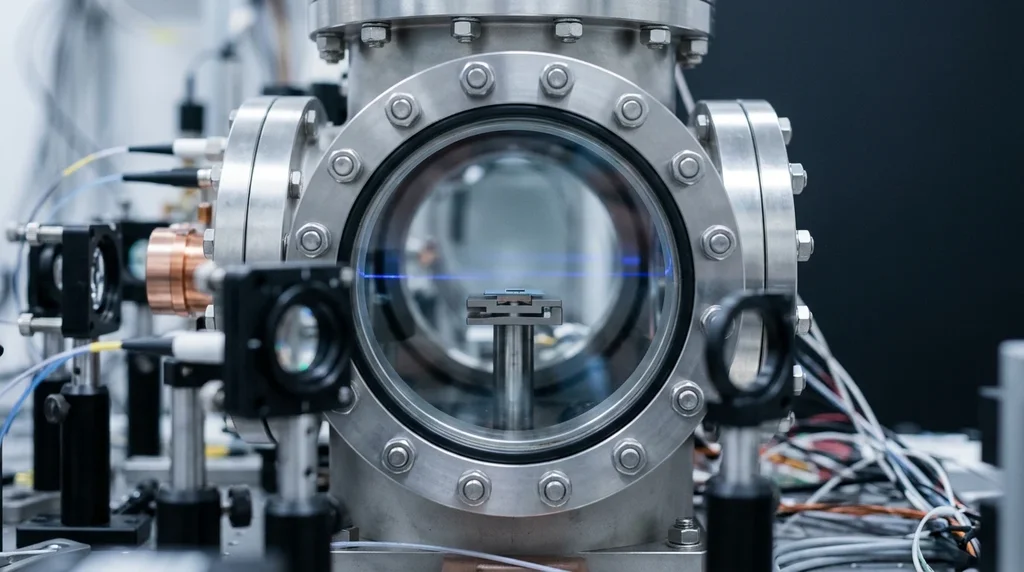
Conventional trapped-ion quantum computers line up their ions in one-dimensional chains. ZuriQ has chosen a different path: a natively two-dimensional micro-Penning-trap architecture that uses electric and magnetic fields to move ions directly across the chip. According to the press release, this design avoids complex junction structures, making it easier to accommodate larger qubit arrays.
The division of roles is clear. ZuriQ contributes the design and architecture, Infineon its expertise in semiconductor manufacturing, advanced packaging and integrated photonics. Integrating ZuriQ's approach with Infineon's photonic and semiconductor processes is presented as central to accelerating the transition from laboratory demonstration to real-world applications.
What has been demonstrated, and its limits
The result put forward is concrete, but small in scale. In earlier development work, ZuriQ and Infineon trapped a 3×3 array, that is, nine individually controlled ions. According to the two partners, this is the largest two-dimensional array of its kind to date, a result the press release describes as a world record. It serves to demonstrate the feasibility of the architecture.
Two limits are worth highlighting. First, the source is a press release: it does not refer to any scientific publication detailing the method and measurements, and gives no indication of qubit performance beyond their individual control. Second, nine ions is still a small array: the text itself sets the next step as moving to "significantly higher" qubit counts, without putting a figure on that goal.
Result, goal, outlook
- Demonstrated: the feasibility of the architecture, with a 3×3 array of nine individually controlled ions.
- Goal: scale up toward significantly larger qubit counts, drawing on Infineon's industrial manufacturing expertise.
- Outlook: according to the press release, two-dimensional trapped-ion technology offers a promising path toward precise and scalable quantum processors, for fault-tolerant quantum computing and commercial applications. The text notes that quantum computers have the potential to solve problems too complex for classical computers and supercomputers, without citing any specific application.
The leaders of both companies are on the same page. "Advancing quantum computing toward commercial impact will require close collaboration between quantum innovators and industrial technology leaders," says Pavel Hrmo, co-founder and CEO of ZuriQ, who says he wants to turn the young company's technological progress into "scalable, manufacturable quantum hardware." For Clemens Rössler, Senior Director and head of quantum processing units at Infineon, progress in the field requires breakthroughs in physics, "but also robust manufacturing technologies." In his view, combining the two partners' capabilities represents "an important step toward the industrialization of this key technology."
A spin-off alongside a semiconductor giant
The difference in size is striking. Infineon describes itself as a global leader in semiconductors for power systems and the IoT; the group had around 57,000 employees worldwide at the end of September 2025 and generated revenue of around €14.7 billion in fiscal year 2025, which ended on September 30. On the other side, ZuriQ is an ETH Zurich spin-off.
The partnership illustrates a common pattern in disruptive technologies: the startup brings the architectural idea, the industrial player the processes to produce it. This is in fact precisely what the press release presents as the key to moving from the lab to applications. One question remains open for Swiss readers: how much of the value of this technology will remain with the Zurich spin-off once the industrial phase is underway? The press release says nothing about the financial terms or intellectual property.
Sources: "Infineon and ZuriQ partner to scale quantum processing units toward commercial systems," Startupticker.ch (press release), October 12, 2026.