Europe's benchmark gas price reached its highest level since December 2022 on Tuesday. The Dutch TTF futures contract rose 2.17% to 86.19 euros per megawatt-hour, after touching 86.79 euros in the morning, according to AWP/AFP. Oil moved in the opposite direction: a barrel of North Sea Brent for December delivery fell 1.92% to 104.60 dollars, and West Texas Intermediate (WTI) for November delivery slipped 2.08% to 91.79 dollars.
A winter ahead with little LNG from the Gulf
The rise in gas is first and foremost a matter of supply. The war in the Middle East has disrupted Qatar's production and exports of liquefied natural gas (LNG). “The market is coming to terms with the idea that we are about to go through a large part of the winter in the northern hemisphere with very little liquefied natural gas (LNG) supply coming from the Persian Gulf,” note analysts at ING. The lasting loss of part of this supply intensifies competition between Asian and European buyers, two importing regions, which pushes prices up.
European stocks well behind
The second factor concerns reserves. As winter approaches, European stocks are only 73.75% full, compared with 83% at the same point last year and a five-year average of 89%, according to ING. Germany is well below that, with a fill rate of 59.96%, according to the European platform Aggregated Gas Storage Inventory (AGSI).
Oil retreats, for debated reasons
On the oil side, Donald Trump claimed that Russia and Ukraine had agreed to suspend their attacks on energy infrastructure. The implementation of this truce remains uncertain: Kyiv says it is ready to stop its strikes on Russian facilities if Moscow does the same, while denouncing continued attacks on its own infrastructure. An effective suspension would reduce one risk, without eliminating those linked to the war with Iran, notes Le Journal du Coin.
Another reading emphasises Russian diesel. The US Treasury has issued a temporary authorisation covering certain sale, delivery and import operations for this fuel, valid until 7 April 2027, without a general lifting of energy sanctions against Russia. John Plassard, head of investment strategy at Cité Gestion Private Bank, attributes the fall in crude to “the belated recognition of the very short-term effect” of this agreement. Some analysts, however, consider the announced volumes insufficient to guarantee a lasting decline, and CNBC commentator Jim Cramer said on X that he expects a barrel at around 100 dollars as long as the war continues. Despite the pullback, Brent indeed remains above that threshold. “Volatility will remain very high in the coming days,” warns John Plassard.
For Switzerland, an indirect but real exposure
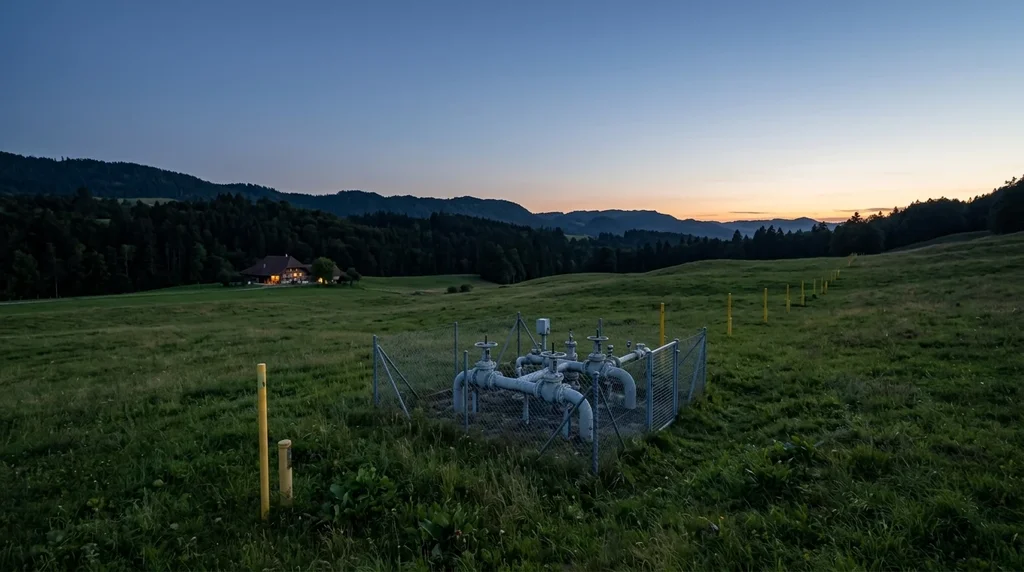
Switzerland imports all of the gas it consumes and has no significant storage capacity on its territory. It therefore depends both on prices set on European markets and on the reserves built up by its neighbours. The low fill level of German storage is, in this respect, a point to watch.
On prices, a distinction must be made between what has been observed and what is expected. The observation concerns the wholesale market: on Tuesday the TTF reached a level not seen since December 2022. A pass-through to the bills of households and businesses in Switzerland has not, at this stage, been established. It will depend in particular on how long the rise lasts and on how distributors source their supplies, as their tariffs do not necessarily follow the market day by day. Industrial companies that use gas in their processes, or that buy their energy on terms close to the market, would be the most directly exposed to a prolonged rise.
For now, the easing of oil and the tension on gas coexist, and nothing yet makes it possible to say which of the two trends will prevail in the coming weeks.