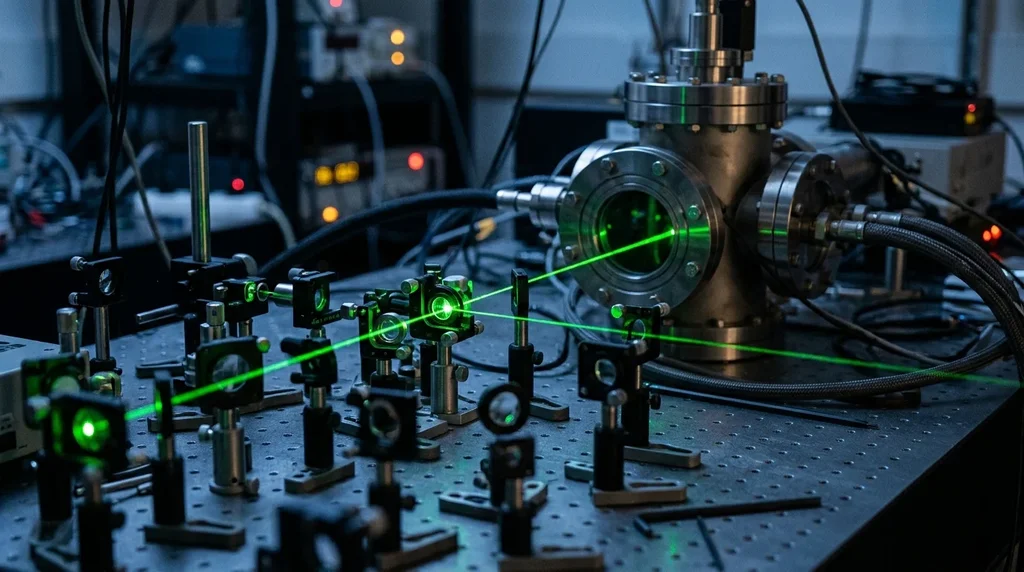
A quantum computer is more than its qubits. For a computation to succeed, lasers, cameras and detectors must act with great precision and in the right order. This often-overlooked link is what Qendra is targeting. According to an article published on 20 October 2026 by ETH News, the news service of ETH Zurich, the young company builds control systems for trapped-ion and neutral-atom machines, with a specific goal: detecting and correcting errors during the computation, rather than after the fact.
An ETH Zurich spin-off born from a doctorate
Qendra was founded in February 2026 by three ETH Zurich alumni: Martin Stadler, Ferdinand Felder and Chidzahi Mabritto. A physicist who came from Graz, Austria, for his master's degree, Martin Stadler did his doctorate in Professor Jonathan Home's group, after discovering quantum mechanics in his course. Until recently, he was a Pioneer Fellow at ETH Zurich. "Towards the end of my doctorate, it became clear that the technology had to be pursued in a commercial setting to bring the product to market," he explains.
The team now has four people and plans to bring together seven by the end of the year. Qendra is also looking for investors. Martin Stadler, who initially held both the CEO and CTO roles, now focuses on the commercial side; Chidzahi Mabritto has taken over technical leadership.
The "conductor" between the algorithm and the qubits
A quantum computer calculates with qubits. In trapped-ion systems, each qubit is an electrically charged atom, held in place by electric fields. With neutral atoms, the qubits are held by tightly focused laser beams, known as optical tweezers. According to ETH News, these two platforms are among the most promising in the race to build the first practically usable quantum computer.
The control system links the algorithm and the software on one side with the physical signals and the qubits on the other. Martin Stadler compares it to an orchestra conductor: "Everyone listens to the conductor, who makes sure the result is a symphony and not just noise."
In practical terms, it is a compact grey box with numerous inputs and outputs. It generates radio-frequency signals that reach the qubits in two ways: either they drive a modulator that sends pulses into a laser beam, or they are transmitted directly to the ions via an antenna. The device also reads signals from photodiodes and controls other equipment, such as lasers, signal generators or oscilloscopes.
Quantum error correction: moving from post-processing to real time
The heart of the project lies in conditional operations, the equivalent of an "if… then" instruction in classical programming. According to ETH News, there is not yet a usable commercial control system for trapped-ion or neutral-atom machines, unlike other types of quantum computers. In particular, current systems cannot detect an error during a computation and correct it immediately.
The task is tricky: qubits are sensitive to disturbances, and their state cannot be measured directly without destroying the information they carry. According to Martin Stadler, developers therefore work mainly in post-processing: they collect measurements during the experiment, then calculate what the result would have been with correction. "That is often sufficient for research, but not for reliable and practical quantum computers," he says.
Qendra's system is meant to evaluate measurements continuously and, depending on the result, choose the signal that triggers the correction pulse, by laser or by radio frequency. That is the company's promise, as described by ETH. The article publishes neither performance measurements nor any quantified comparison with other systems.
What has been demonstrated and what remains to be proven
What is established: the device is already running in the lab. Its first users include Jonathan Home's group and ZuriQ, another ETH Zurich spin-off that is building a trapped-ion quantum computer and aims, together with Infineon, to industrialise two-dimensional trapped ions. Qendra is also in talks with neutral-atom players, including the Boston start-up QuEra and Mikhail Lukin's group at Harvard University. These are discussions, not announced contracts.
What remains to be proven: the box is still only an MVP, a minimum viable product, meaning the simplest version that allows customer feedback to be gathered. "Our control system already performs quite well, but it is not yet quite ready for large-scale deployment," Martin Stadler acknowledges. Its reliability on machines with many qubits, and in industrial use, therefore remains to be demonstrated.
A market that is still small, with declared ambitions
According to estimates cited by ETH News, research groups and companies in the field spend around 50 million dollars worldwide on their control systems, a relatively small market. Martin Stadler expects strong growth: "We think the market could well exceed 1 billion dollars within ten years," because neutral atoms are quickly gaining ground and are well suited to machines with many qubits. This is the founder's projection, not a published market study.
The same caution applies to the stated goal: to become, within five years, the reference solution for controlling trapped-ion and neutral-atom quantum computers. The company's name reflects this ambition: it comes from the first name Kendra, which means "sovereign" in Old English and "centre" in Sanskrit. For now, Qendra mainly adds one more piece to Zurich's quantum ecosystem, around the Hönggerberg campus.
Sources
- ETH Zürich News: "Spin-off developing “conductors” for quantum computers"