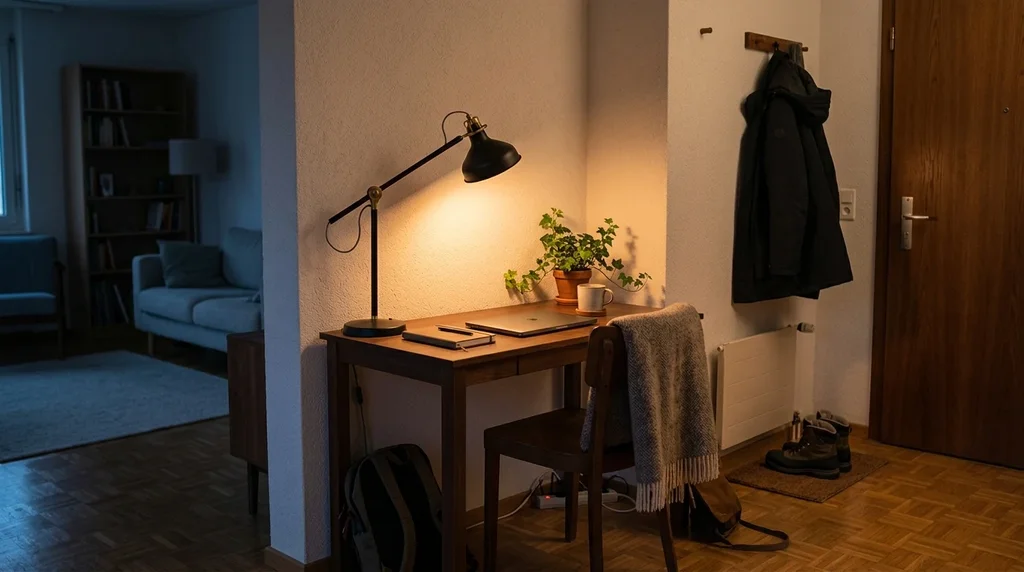
Two days at the office, three at home: for many employees, remote work is now part of everyday life. On a tax return, this pattern is not neutral. A person who regularly works from home cannot in principle claim the same deductions as someone who is at their workplace five days a week, notes the magazine PME, which questioned the Federal Tax Administration (FTA) and the Vaud tax authority. Meal expenses are directly affected, as are, in certain situations, travel expenses.
The Vaud example: deductions reduced pro rata
The canton of Vaud provides a concrete example. Deductions calculated on an annual basis of 240 days must be reduced proportionally there when work is carried out remotely. For meals taken away from home, the maximum amount reaches 3,200 francs per year when there is neither a canteen nor an employer contribution. These parameters are those of the canton of Vaud: the PME article does not detail the rules applied by other cantons.
Who knows the number of remote working days?
A practical question remains: how does the tax authority know how many days were actually spent at home? Not necessarily through the employer. In the canton of Vaud, employers are encouraged to state this information under item 15 of the salary certificate, but they are not required to do so. And not all cantons ask taxpayers to indicate their remote working days in their tax return: according to the FTA, only a minority of them currently do so.
The FTA therefore acknowledges that the system relies partly on the taxpayer’s own declaration. “A correct deduction on the part of the taxpayer, whose good faith is presumed, is always possible,” explains Adrian Grob, spokesperson for the FTA. In practical terms, an employee who works three days a week from home must themselves limit meal expenses to the days on which they were actually away from home. They cannot theoretically claim a full year at the office. Even when the form asks for no specific information, they remain obliged to declare their actual situation.
What the tax authority can demand
The presumption of good faith does not mean there are no checks. In case of doubt, the authority can ask the taxpayer to provide conclusive evidence of the working days spent away from home. The taxpayer is obliged to provide the information needed for a complete and accurate assessment.
The canton of Vaud applies the same principle. “The Cantonal Tax Administration trusts taxpayers to complete their tax return in line with reality,” says Julien Lambert, spokesperson for the Directorate General of Taxation. This trust does have its limits, however: additional documents may be requested and checks carried out. In the event of irregularities, corrections or even penalties are possible.
In practice, the authority does not check every taxpayer’s diary in detail. The system works on good faith, with targeted checks when inconsistencies or doubts arise. How often these checks take place, however, is not specified in the answers reported by PME.
Travel expenses: travel pass or car, two approaches
Remote work also affects the deduction of work-related commuting expenses, but not in the same way depending on the means of transport. For public transport, the deduction of a travel pass may in particular be allowed regardless of the exact number of journeys made. For a private vehicle, on the other hand, the calculation may depend on the number of days spent at the workplace and the kilometres travelled.
Key points for your tax return
Nobody systematically counts remote working days on the taxpayer’s behalf. It is therefore up to the taxpayer to adjust their meal expenses, and where applicable their vehicle expenses, to their actual presence at the workplace, and to be able to justify this if the authority asks. The amounts and arrangements cited here concern the canton of Vaud and do not constitute tax advice. For a specific case, particularly regarding how to declare remote working days, the point of contact remains the cantonal tax authority.
Sources
- PME: “Home office: comment le fisc contrôle vos jours de télétravail?”