GraphEnergyTech, a Swiss and British startup spun out of the Swiss Federal Institute of Technology in Lausanne (EPFL) and the University of Cambridge, has closed the first tranche of its seed funding round. Aramco Ventures, the venture capital arm of Saudi oil group Aramco, is among the participants, according to a press release published by Startupticker on 6 November 2026. The company is aiming for up to 3 million pounds sterling in total for its electrodes that use neither gold nor silver.
Who is investing in this first closing?
Three groups of investors are taking part in this first tranche, according to the company's press release. Aramco Ventures is continuing its support. Existing shareholders are putting in more money. New business angels are coming on board, including Canadian investors.
The amount raised so far has not been disclosed. A first closing means that part of the round is completed while the rest remains open. GraphEnergyTech says as much: its seed round remains open to other investors, who are invited to get in touch before the next closing. The seed stage brings the first investors into the company's capital, as our article on the seed funding round explains.
Thomas Baumeler, CEO and co-founder, says he is "delighted" to have secured this first closing, according to the press release. The money is meant to accelerate the development and commercialisation of its graphene-based electrodes with industrial partners. Zayed Alamri, executive managing director of Aramco Ventures, sees potential in it to reduce dependence on costly metal electrodes.
What does GraphEnergyTech make?
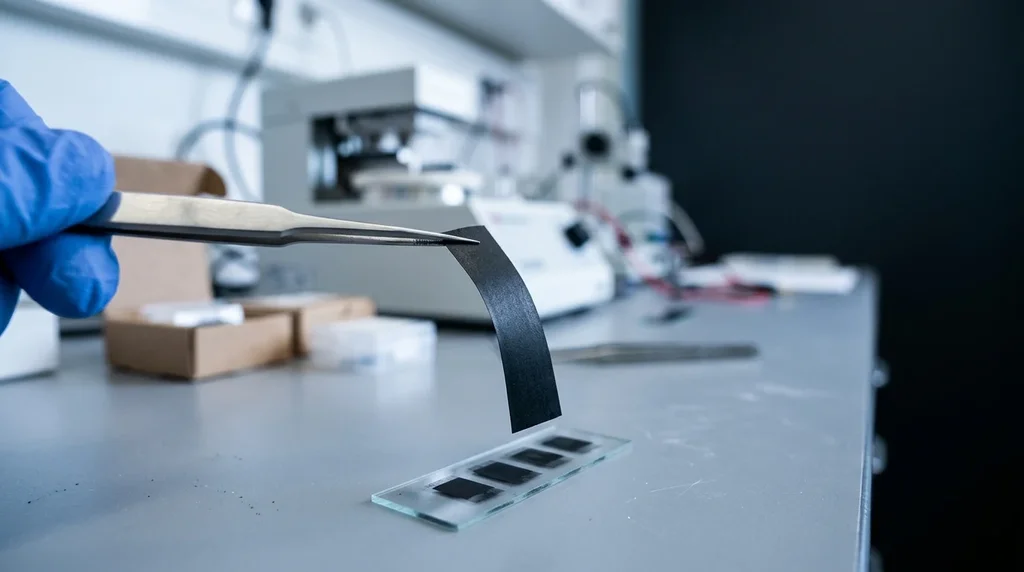
The company develops conductive inks and pastes based on carbon and graphene. They are used to make electrodes, the thin tracks that collect electrical current, without gold or silver. Carbon thus avoids dependence on volatile metal markets while maintaining efficiency and durability, according to the company, which describes its technology as "revolutionary".
The first market is solar. According to pv magazine, on 11 March 2025, its electrodes were being tested in silicon heterojunction cells and in perovskite cells. The magazine notes that the material remains compatible with standard industry processes such as screen printing and slot-die coating.
The targeted applications have changed in two years. In August 2024, Venture Kick mentioned batteries, supercapacitors, LED lighting and displays. The November 2026 press release now cites fuel cells, heating technologies and printed electronics.
What is the link with Michael Grätzel's work?
GraphEnergyTech grew out of research from two laboratories. At EPFL, Michael Grätzel heads the Laboratory of Photonics and Interfaces, according to pv magazine. The magazine describes him as the pioneer of dye-sensitised solar cells, and the press release presents him as a perovskite pioneer. At Cambridge, Andrea Ferrari founded and heads the Cambridge Graphene Centre.
The two researchers co-founded the company with Frontier IP, a British firm specialising in university spin-offs, again according to pv magazine. Venture Kick places its offices in Lausanne and Cambridge.
Funding round, grants, projects: the financing track record
This seed round follows a pre-seed round led by Aramco Ventures. The 2026 press release puts it at 1 million pounds. Venture Kick, which announced it on 20 August 2024, spoke of 1.1 million Swiss francs. Alongside this equity funding, the company has received grants from Innosuisse, the Swiss Innovation Agency, from Horizon Europe and from Innovate UK.
The two need to be kept apart. A grant brings no shareholder into the capital: it is not a funding round. The 2026 press release does not put a figure on the Innosuisse and Horizon Europe support either.
| Date | Stage | Type | Amount (source) |
|---|---|---|---|
| 2023 | Venture Kick Stage 2 winner | Early-stage prize | Not specified (Venture Kick) |
| May 2024 | SiLEAN project, heterojunction cells, over three years | Project funded by Horizon Europe | Not disclosed (pv magazine) |
| 20 August 2024 | Pre-seed round led by Aramco Ventures | Funding round | 1.1 million Swiss francs (Venture Kick); 1 million pounds (2026 press release) |
| January 2025 | GETPSC project, perovskite modules, over two years | Innovate UK grant | 884,129 pounds out of a 1.14 million pound project (pv magazine) |
| 6 November 2026 | First closing of the seed round | Funding round | Not disclosed; target of up to 3 million pounds (press release) |
The GETPSC project brings together the University of Cambridge, Taiwanese manufacturer Taiwan Perovskite Solar Corp and Taiwan's Industrial Technology Research Institute, according to pv magazine. It is a research partnership, not an equity stake.
What this round says about funding for EPFL spin-offs
The case follows a familiar pattern among Swiss startups: prizes and grants first, then business angels and industrial investors. Corporate venture capital, the kind provided by large groups, plays an early role. In October 2026, Lausanne-based Sonexos and its 5 million had also attracted Bosch Ventures, with technology licensed from EPFL.
For an overview of the stages, our guide explains how to raise funds for a Swiss startup. Other recent cases can be found in our section on startup funding rounds.
What we don't know yet
- The amount of the first tranche: GraphEnergyTech's press release does not give a figure.
- The valuation and Aramco Ventures' stake in the capital, which have not been disclosed and which determine founder dilution. The clauses of the startup term sheet also remain confidential.
- The date of the next closing: the press release does not set one.