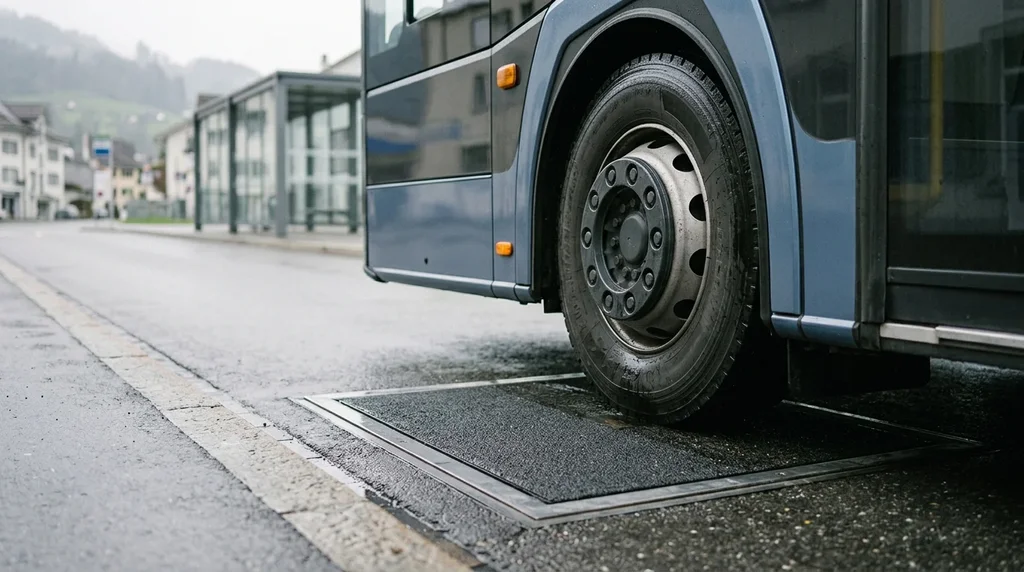
Winduction, a spin-off of the Swiss Federal Institute of Technology in Zurich (ETH Zurich), has developed a wireless charging system that transfers electricity to electric buses through their wheels while they are at stops. This is reported by ETH News in an article by Christoph Elhardt (Corporate Communications), published on 5 October 2026. According to the company, the technology should significantly reduce the cost of operating a bus line.
The starting point: heavy batteries charged overnight
Today, most electric buses charge overnight at the depot and carry heavy batteries around during the day. Large batteries and powerful charging stations with thick cables are expensive, both to buy and to maintain. Night-time electricity does not yet come entirely from renewable sources, and the weight of the batteries causes greater wear on certain components and takes up space.
Winduction's three founders, Sonam Bhuka, Sylvain Fricker and Laurin Schwitter, start from a different assumption. “We believe electric buses can be operated at much lower cost if they are charged wirelessly and regularly while in service,” explains Laurin Schwitter, an ETH graduate and CEO of the spin-off.
The method: bringing the coils closer through the wheel
Inductive charging is not new: it is already used for phones and some electric cars. Most systems transfer energy, via a magnetic field, from a coil in the ground to a coil attached to the underside of the chassis. However, the distance between the road and the underside of the vehicle is relatively large and varies from one model to another. And efficiency decreases as this gap increases.
“In any vehicle, the only thing that is always in contact with the ground is the wheels,” sums up Sylvain Fricker, an ETH alumnus and head of technology. Hence the name Winduction, for “wheel-based induction”. The principle:
- a plate embedded in the road surface and connected to the power grid contains coils that generate a magnetic field;
- a second set of coils, built into a specially developed tyre, picks up the energy when the bus stops on the plate;
- this energy is then transferred to the vehicle's battery.
According to the article, the system achieves an efficiency of more than 90% between the ground and the vehicle. The company's first prototype, a somewhat older electric PostBus, already charges this way, with its rear wheel resting on a plate the size of a supermarket trolley.
The technical challenge: a tyre without steel
Conventional bus tyres contain steel belts that give them stability. This steel would react to the magnetic field and turn much of the energy into heat instead of transferring it. “For our system to work, we are developing a tyre that is completely free of steel together with partners,” says Laurin Schwitter. This tyre costs more, but according to the article, the extra cost is almost negligible compared with the purchase and operating costs of a bus.
What this promises for the cost of a line
The founders see their main advantage in the total cost of a line over its lifetime: vehicles, energy, maintenance, infrastructure, staff and financing. Since charging also works during short stops, buses could make do with smaller batteries. They would be cheaper and could carry more passengers; the plates would also be relatively inexpensive compared with conventional infrastructure.
The founders take the example of the line between Zurich Airport and Oerlikon:
- plates would be needed at only 2 of the 24 stops;
- the buses would charge there for a total of 3 hours out of 16;
- fewer reserve vehicles would be needed.
By comparison, the electric buses on this line currently all charge at the same time in the garage, for five hours overnight, with much more power. Spreading charging across the day would reduce peak loads on the power grid. It would also make it possible to take advantage of daytime electricity that is becoming increasingly affordable thanks to photovoltaics.
These gains have yet to be quantified, however. “Our calculations show substantial savings compared with depot charging. How large they are depends on the route. A feasibility study conducted with transport companies is currently quantifying them,” says Laurin Schwitter. The article gives no figures.
Where the project stands
With the support of the Federal Office of Transport and the Swiss Climate Foundation, Winduction is currently building a realistic test infrastructure in Winterthur. It includes a laboratory and a test bus stop. The goal: a fully converted electric bus capable of running outside the private test area.
The first pilot is planned for 2028. Discussions are under way with several Swiss transport companies, notably in the Zurich Airport area. The bus is to be tested there under real operating conditions and carry passengers for the first time.
In summary: the prototype and its efficiency of more than 90% are presented as established; the savings over the lifetime of a line remain a hypothesis to be quantified; the pilot with passengers in 2028 is a prospect.