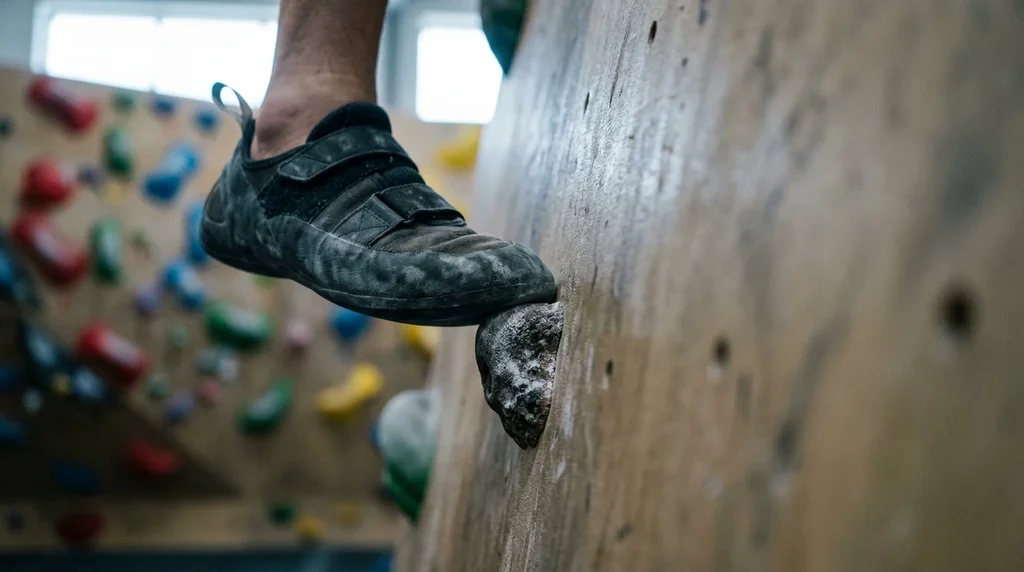
A climbing shoe is nothing like an ordinary sports shoe. It is designed to hold on the smallest holds and is therefore worn very tight. A poor fit is not just uncomfortable: according to Startupticker.ch, in the long run it can damage the foot and spoil the pleasure of climbing. That observation is where hooq started, a Winterthur start-up that makes custom-made shoes based on a 3D scan of the foot. It has just ordered its fifth production run.
Three climbers behind the project
Behind hooq are three climbing enthusiasts: Livia Zumofen, her brother Janick Zumofen and Beat Müller. They experienced the problem of the ill-fitting climbing shoe first-hand and wanted to solve it. The project matured over a little more than four years, with support from, among others, the Z-Kubator of the Zurich University of the Arts (ZHdK) and Pro Helvetia. The source mentions no fundraising.
From scan to last
The principle: hooq 3D-scans its customers' feet, then software developed in-house analyses the data and calculates the shape of the shoe. On that basis, the start-up makes lasts (the foot-shaped moulds on which the shoe is built) or chooses from those it already has. Each foot, left and right, thus gets a shoe tailored to it.
"The shoes are made entirely to our specifications; the whole construction of the climbing shoes, including the patterns, was developed by us," explains Livia Zumofen. In addition to the fit, customers can define certain features according to their climbing style and preferences, for example the choice of rubber for the sole.
A supply chain to build
Finding a production partner and setting up a supply chain took time. "We first had to build ourselves a network in the industry to gain access to contacts with material suppliers and potential manufacturers," says the co-founder. The result: the shoes are produced in Europe, in a shoe factory that has mastered the climbing shoe, using high-end materials. The name of this manufacturer has not been disclosed.
Today, the product is finalised, the supply chain is working and hooq's online shop has recently opened. "We were once again able to take a few orders and have already launched the fifth production run," adds Livia Zumofen. Neither the price of a pair nor the number of shoes per run is given in the source.
The scan, a bottleneck
This is where the next stage will be decided. For now, customers have two options for getting scanned: go to Winterthur, or visit one of the climbing gyms in Switzerland when Beat Müller is "on tour" with the scanner. A model that inevitably limits volume.
"To be able to scale up further one day and expand, scanning should be possible from home via an app as soon as possible," says Livia Zumofen. No date has been given for this app.
What remains to be proven
hooq points to a market that is far from negligible: according to the start-up, some 350,000 people climb or boulder regularly in Switzerland alone. Still, this figure describes a population of practitioners, not a customer base ready to pay for made-to-measure. To break out of its niche, hooq will have to show that a remote scan delivers results as reliable as one done in a gym, and that its production runs can grow without losing quality. Five runs ordered is a sign of interest from the climbing and bouldering scene; it is not yet a market.