Swiss inflation reached 1.5% year on year in October 2026, up from 1.0% in September, according to the Federal Statistical Office (FSO). Heating oil, petrol and diesel account for most of this acceleration in consumer prices. Excluding fuels and fresh and seasonal products, inflation remains limited to 0.5%.
What the FSO published on 3 November 2026
The consumer price index (CPI) rose by 0.2% in one month, to stand at 101.7 points. The base of 100 corresponds to December 2025. These figures appear in the FSO press release published in Neuchâtel on 3 November 2026.
The FSO attributes the monthly increase to several factors, first and foremost heating oil, petrol and diesel. Women's and men's shoes also became more expensive, as did hospital outpatient medical services. Conversely, medical practices, international package holidays and the hotel sector lowered their prices.
The figure exceeds expectations. According to the financial news agency AWP, quoted by Allnews, the economists surveyed had forecast annual inflation of 1.1% to 1.4%. They expected a monthly change of between −0.1% and +0.1%.
Inflation that has been accelerating since August
October extends a rise that began at the end of the summer. According to the summary by Agence France-Presse (AFP), carried by Boursorama, inflation stood still at 0.1% at the start of the year. It climbed in the spring with the conflict in the Middle East, eased in the summer, then accelerated again.
| Month (2026) | Year-on-year inflation |
|---|---|
| Start of the year | 0.1% |
| March | 0.3% |
| April | 0.6% |
| May | 0.6% |
| June | 0.5% |
| July | 0.4% |
| August | 0.8% |
| September | 1.0% |
| October | 1.5% |
The half-point jump between September and October is the largest month-on-month gap in this series. According to AFP, the rise since the summer is due to tensions on oil, but also to the franc's retreat against the dollar.
Energy or underlying inflation: two readings of the same index
Core inflation tells a different story from the headline figure. It excludes fresh and seasonal products as well as fuels. According to Allnews, it remained stable over the month, at 100.6 points, and rose by only 0.5% year on year.
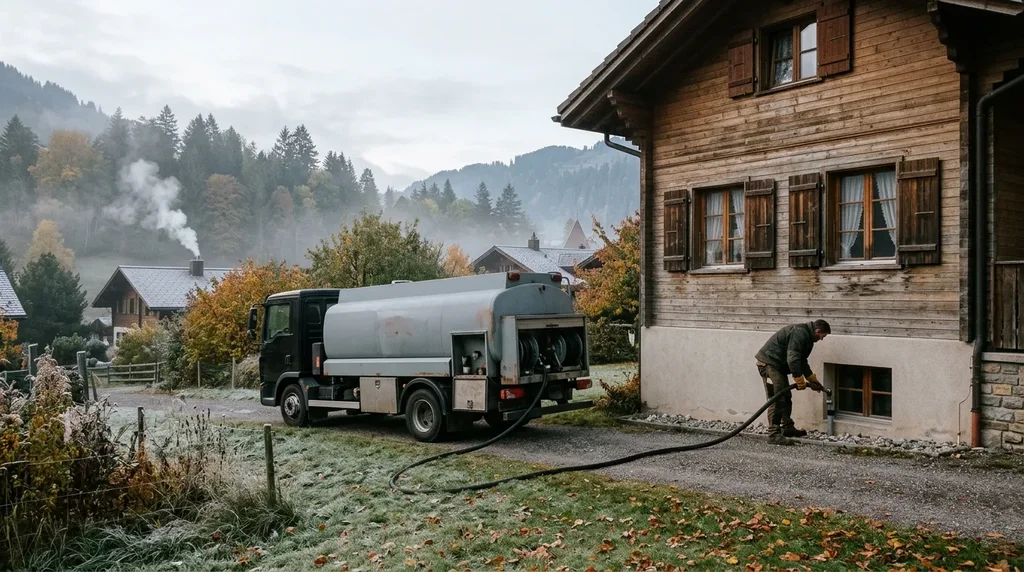
The shock comes from petroleum products. Heating oil became 81.4% more expensive year on year, petrol 26.5% and diesel 36.9%. According to AFP, petroleum products as a whole show a jump of 40.3% year on year.
Arthur Jurus, an economist at the financial group ODDO BHF, puts a figure on this weight. In his view, these products account for 2.1% of the consumer basket but explain nearly 85% of the monthly rise in the index. He sees it as "a concentrated energy shock" rather than broad-based inflation.
The origin of the goods confirms this reading. Prices of domestic products fell by 0.1% over the month and rose by 0.8% year on year. Those of imported products jumped by 1.2% over the month and by 3.7% year on year.
The harmonised index, used for European comparisons, gives a slightly higher measure. It stands at 101.77 points, i.e. +0.4% over the month and +1.6% year on year.
What does inflation change for a household in Switzerland?
The effect depends above all on the heating system and on car use. Arthur Jurus notes that the bill weighs first on households heated with oil and on those who drive every day. For most other expenses, the increases remain moderate.
At the pump, prices remained high in mid-October. According to figures from the Touring Club Suisse (TCS), reported in our article on fuel prices in Switzerland, 95 unleaded cost an average of 2.16 francs per litre. Diesel reached 2.45 francs, one centime short of its annual high in mid-September.
Purchasing power also depends on wages, and they are rising only slightly. According to a survey by UBS, the major Swiss bank, of 400 companies, nominal wages rose by an average of 1.1% in 2026. Adjusted for inflation, the real increase is only 0.4%.
For 2027, the companies surveyed plan only +1% in nominal wages. UBS estimates the real increase at 0.2%, with inflation expected to average 0.8%. These are intentions and forecasts, not increases already secured.
| Indicator (UBS) | 2026 | 2027 (forecast) |
|---|---|---|
| Nominal wages | +1.1% | +1.0% |
| Real wages | +0.4% | +0.2% |
| Expected average inflation | 0.7% | 0.8% |
Health insurance premiums squeeze the margin further. UBS estimates their average increase at 5% in 2027. According to the bank, this extra cost slows income growth by around 0.3 points, which is more than the expected rise in real wages.
One point needs clarifying. The October rate measures one month, whereas wages are compared with the average inflation for the year. UBS has in fact raised its forecast for 2026 from 0.6% to 0.7%, because of oil.
Will the SNB raise its policy rate?
The figure remains within the range targeted by the Swiss National Bank (SNB). The SNB equates price stability with an annual increase of less than 2%, as explained on our page on the SNB policy rate. Economists at Raiffeisen and at Banque Migros speak of a range of 0 to 2%.
On 24 September 2026, the SNB held its policy rate at 0%. Its conditional inflation forecast then stood at 0.7% for 2026, then 0.8% for 2027 and 2028. According to AFP, its chairman Martin Schlegel expected inflation to "rise somewhat in the fourth quarter", then to fall back in the course of 2027.
Economists disagree on what comes next. Santosh Brivio, of Banque Migros, speaks of a "warning signal", but not of grounds for a "hasty" tightening. Like Arthur Jurus, he expects a first rate hike only in 2027, possibly even at the end of the year.
The economic research institute BAK Economics, on the contrary, sees tightening as early as December. Its economist Claude Maurer cites the interest rate differential with other countries, a franc depreciated in real terms and solid economic conditions. Raiffeisen's economists also consider that a hike could come as early as 10 December 2026.
The decisive criterion would be the duration of the shock. For Santosh Brivio, it is not the surge itself that matters, but how long it lasts: if energy prices remain high, the risk of second-round effects increases. Arthur Jurus believes the SNB will have to monitor the indirect effects of energy on transport costs and goods prices. The next SNB quarterly assessment is scheduled for 10 December 2026.
By international comparison, Martin Schlegel judged Swiss inflation in September to be "relatively low". In the United States, rising prices were the subject of our article on US inflation and the Fed.
What we do not know yet
- The SNB's decision of 10 December 2026: the forecasts by BAK Economics and Raiffeisen do not bind the central bank.
- How long the surge in heating oil and fuel prices will last, on which any second-round effect on other prices depends.
- The wages actually negotiated for 2027: the UBS survey reflects companies' intentions in the autumn of 2026.
Sources
- Federal Statistical Office: "Les prix à la consommation ont augmenté de 0,2% en octobre", 3 November 2026
- Allnews (AWP): "L'inflation poursuit sa hausse en octobre", 3 November 2026
- Allnews (AWP): "Vers une hausse des salaires de 1% en 2027", 3 November 2026
- Boursorama (AFP): "Suisse : l'inflation augmente à 1,5% sur un an en octobre", 3 November 2026