The Swiss National Bank (SNB) holds its quarterly assessment of the economic and monetary situation in March, June, September and December. Each assessment leads to an interest rate decision, an inflation forecast and a press conference. The next one is set for 10 December 2026, according to the schedule published by the SNB.
The official name of this event is the "monetary policy assessment". It is on this occasion that the National Bank sets its SNB policy rate, which steers the level of interest rates in Switzerland. The schedule is published well in advance: it already covers the whole of 2027.
What is the SNB's quarterly assessment?
Four times a year, the SNB carries out an in-depth assessment of the economic and monetary situation. This assessment leads to a monetary policy decision and to the publication of a medium-term conditional inflation forecast.
The decision lies with the SNB's Governing Board. It takes it every quarter, or more often if necessary. The quarterly rhythm is therefore the rule, not an absolute limit.
The framework remains the mandate set out in the Federal Constitution: to ensure price stability while taking due account of economic developments. The SNB considers tightening its policy if inflation threatens to exceed 2% on a lasting basis. It considers easing it if inflation threatens to remain too low on a lasting basis.
What are the dates of the SNB's assessments?
In 2026, the SNB held its first three assessments on 19 March, 18 June and 24 September. The fourth will take place on 10 December 2026. For 2027, the schedule announces assessments on 18 March, 24 June, 23 September and 16 December.
Each assessment is followed by two other publications in the following weeks. The table shows the dates announced by the SNB as of 23 October 2026.
| Assessment and decision | Quarterly Bulletin | Summary of deliberations |
|---|---|---|
| 10 December 2026 | 16 December 2026 (4/2026) | 7 January 2027 |
| 18 March 2027 | 24 March 2027 (1/2027) | 15 April 2027 |
| 24 June 2027 | 30 June 2027 (2/2027) | 22 July 2027 |
| 23 September 2027 | 29 September 2027 (3/2027) | 21 October 2027 |
| 16 December 2027 | 22 December 2027 (4/2027) | 13 January 2028 |
These dates can be added to a personal calendar. The SNB offers an iCal feed, in iCalendar format, which displays its events in real time.
How does decision day unfold?
The day follows a fixed timetable, in Swiss time. For the assessment of 10 December 2026, the SNB's schedule provides for two stages:
- 9:30 a.m.: the press release, which announces the decision and explains the reasons for it;
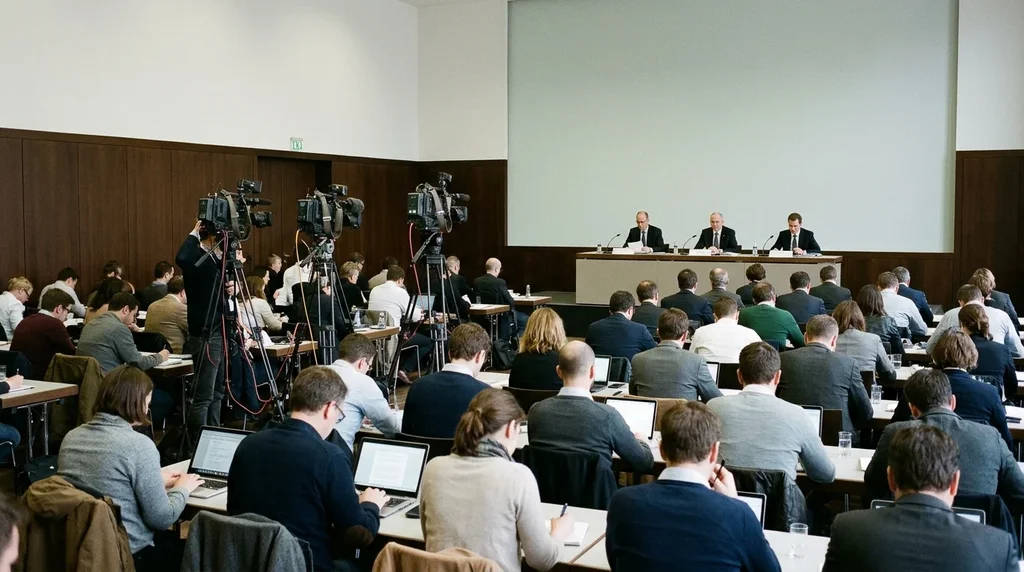
- 10 a.m.: the introductory remarks, followed by the press conference given by the members of the Governing Board.
The same timetable is announced for the four assessments of 2027. According to the list of past events, the press conferences are held in German and French. The one on 19 March 2026 took place in Zurich, those on 18 June and 24 September 2026 in Bern.
What does the SNB publish after a quarterly assessment?
The decision is not limited to the press release. The SNB details it in several documents, published at different times:
- the conditional inflation forecast, published at the end of the assessment: it shows how inflation would develop if the policy rate remained unchanged over the following three years;
- the Monetary Policy Report, published in the Quarterly Bulletin, six days after the assessment according to the current schedule;
- the summary of deliberations, published four weeks after each decision since September 2025.
The Quarterly Bulletin also contains another perspective. It reports on the talks that the SNB's delegates for regional economic relations hold with company executives.
The summary of deliberations sheds light on internal debates. The one for the assessment of 24 September 2026 was published on 22 October 2026. It indicated that the SNB had not considered it necessary to strengthen its capacity to intervene in the foreign exchange market, as detailed in our article on the franc and interventions.
How to read an SNB interest rate decision?
A decision can be read on several levels. The figures published by the SNB are facts; the forecasts of banks and analysts remain interpretations.
- The level of the policy rate. This is the main figure: held, raised or lowered. Banks' sight deposits held at the SNB are remunerated at this rate up to a certain threshold, with a discount above it.
- The conditional inflation forecast. If forecast inflation moves outside the range equated with price stability, an adjustment of monetary policy may become necessary. As it is revised at each assessment, comparing it with the previous one makes it possible to follow how the diagnosis evolves.
- The franc. The press release states whether the SNB stands ready to intervene in the foreign exchange market. The franc exchange rate is one of its levers, just like interest rates.
- The economic outlook. The SNB also provides its growth forecast for Switzerland and the uncertainties it identifies.
The policy rate alone does not set the price of credit. In the third quarter of 2026, fixed-rate mortgages became more expensive while the SNB kept its rate at 0%. According to Comparis's indicative rates, the ten-year fixed rate reached 2.07% at the end of September 2026. An indicative rate shows a trend, not the offer made to a given borrower. This article does not constitute investment advice.
Example: the assessment of 24 September 2026
On 24 September 2026, the SNB kept its policy rate at 0%. It noted that inflation had risen since June, mainly because of energy, and that medium-term inflationary pressure was only slightly higher. It considered its policy appropriate.
Its conditional inflation forecast, calculated on the assumption of a rate of 0%, stood at 0.7% for 2026, then 0.8% for 2027 and for 2028. According to the SNB, it remained within the range of price stability over the entire horizon. The discount above the sight deposit threshold remained set at 0.25 percentage points.
The SNB also forecast growth of 1.5% to 2% for 2026, amid high uncertainty linked to the Middle East. It remained willing to intervene in the foreign exchange market if necessary. In June 2026, it had signalled an increased willingness to do so; in September, it did not consider it useful to strengthen it.
The press conference was held the same day at 10 a.m., in Bern. The summary of deliberations followed on 22 October 2026. As of 21 October 2026, the SNB website still showed a policy rate of 0.00%.
What can be expected from the assessment of 10 December 2026?
The date and timetable are known, the decision is not. Published opinions diverge and do not bind the SNB.
Raiffeisen's economists believe that an SNB rate hike could come as early as 10 December 2026. Financial expert Dirk Renkert, quoted by the Keystone-SDA agency, by contrast considered that the SNB should not be "in any particular hurry to raise rates" in the short term.
After the decision, Quarterly Bulletin 4/2026 will be published on 16 December 2026 and the summary of deliberations on 7 January 2027. 2clics articles on this topic are grouped in the SNB and rates section.
Key figures
- Monetary policy assessments: four a year, in March, June, September and December.
- Next assessment: 10 December 2026, press release at 9:30 a.m., press conference at 10 a.m.
- Assessments announced for 2027: 18 March, 24 June, 23 September and 16 December.
- Summary of deliberations: four weeks after each decision, since September 2025.
- Horizon of the conditional inflation forecast: three years.
- SNB policy rate: 0.00% as of 21 October 2026.
- Inflation forecast by the SNB in September 2026: 0.7% in 2026, 0.8% in 2027 and in 2028.
What we do not yet know
- The direction of the decision of 10 December 2026 and the content of the new inflation forecast: nothing is known before 9:30 a.m. that day.
- A possible unscheduled decision: the SNB can decide more often than every quarter if necessary, but the sources consulted announce none.
- The location of the press conference of 10 December 2026: the schedule consulted does not specify it.
- The 2027 dates are those published by the SNB as of 23 October 2026; they should be checked against its schedule as each date approaches.